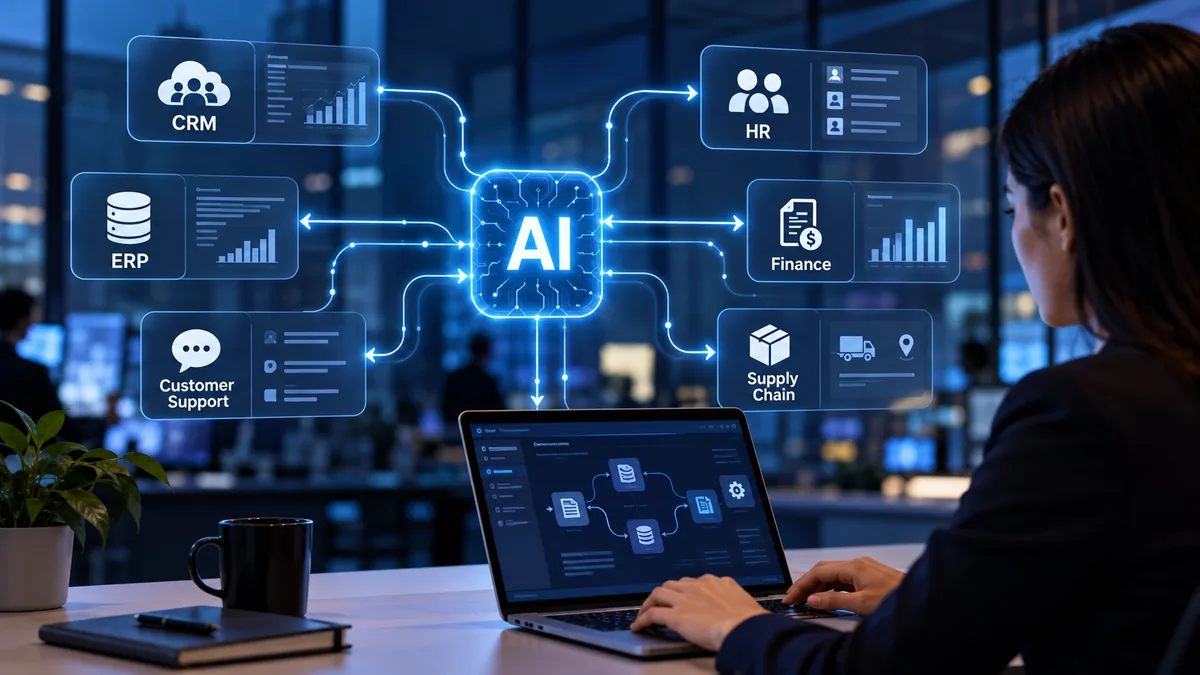
Enterprise AI integration is becoming increasingly important as organizations move artificial intelligence beyond chatbots and into everyday business operations. AI models can interpret requests and recommend actions, but using those capabilities in finance, logistics, customer service, or human resources requires dependable access to operational systems.
The challenge is no longer simply whether AI can understand a business task. Organizations must determine how software agents can use accurate information, carry out authorized actions, and recover from failures. These requirements are shaping enterprise AI deployment architecture.
How Enterprise AI Integration Works
Enterprise AI integration connects artificial intelligence with business applications through application programming interfaces (APIs), middleware, and workflow orchestration tools. APIs provide access to specific functions or information, while middleware manages communication between applications operating in different environments.
Consider an AI assistant handling a delivery inquiry. It may retrieve an order, check available inventory, and request shipping information. An orchestration system coordinates these operations and determines what happens if a service becomes unavailable.
A controlled software layer can expose only the functions required for an assigned task. This allows organizations to introduce AI-assisted operations while maintaining established business rules and access restrictions.
Why Data Quality and Interoperability Matter
Reliable AI operations depend on accurate, consistent, and timely information. Enterprise applications often maintain separate records, naming conventions, and data structures. These differences can affect how automated systems interpret customers, transactions, or inventory.
Data mapping and validation can reconcile compatible records, but they cannot automatically correct missing information or conflicting business definitions. Organizations must also consider data freshness. An inventory figure retrieved several hours earlier may no longer reflect available stock.
Businesses therefore need clear ownership of critical records, strong quality controls, and procedures to resolve inconsistencies. Without those foundations, even capable AI models may produce unreliable operational recommendations.
How AI Agents Change Business Automation
Conventional workflow automation generally executes predefined steps. AI agents add flexibility by interpreting requests, selecting permitted tools, and determining which actions are appropriate. This can be useful when tasks involve variable instructions or unstructured information.
For example, an agent could examine a customer complaint, retrieve transaction details, and prepare a proposed refund. Established business software can then verify eligibility and enforce approval requirements before processing the transaction.
This distinction matters because flexible reasoning and authorized execution are different capabilities. An AI agent may suggest an action, while deterministic software applies financial limits, validates records, and prevents prohibited operations.
Developers are also exploring how to train and evaluate agents in realistic business environments. As TechAmerica.ai previously reported, some approaches use simulated enterprise applications to help AI agents practice complex workflows before deployment.
Not every process requires an autonomous agent. Routine calculations, scheduled data transfers, and predictable validations often suit conventional software better. Organizations should determine whether AI provides measurable value before adding complexity.
Security Requirements for Enterprise AI Systems
Giving AI applications access to operational tools creates new security responsibilities. Authentication establishes a requesting system’s identity, while authorization determines which resources and actions it can use. Permissions should remain limited to the functions required for a specific task.
The National Institute of Standards and Technology examines these issues in its March 2026 update to the API security guidelines. The publication addresses vulnerabilities and protective controls across the API lifecycle, including development and runtime environments.
For example, an assistant retrieving invoice information does not automatically need permission to change payment instructions. Organizations can reduce unnecessary exposure by separating read-only operations from actions that modify sensitive records.
NIST’s zero trust architecture provides another relevant security foundation. It emphasizes protecting individual resources rather than automatically trusting applications because they operate inside a corporate network.
Effective protection also requires credential management, activity monitoring, and access-revocation procedures. Organizations must investigate unauthorized requests and contain unexpected behavior without disrupting unrelated business systems.
AI Governance and Human Oversight
As AI agents become involved in operational decisions, businesses need clear accountability for their actions. Governance policies should define which tasks can be automated, which require approval, and how the system’s performance will be evaluated.
The NIST AI Risk Management Framework provides a voluntary structure for identifying, evaluating, and managing AI-related risks. Its principles can help organizations assess reliability, accountability, and the consequences of deploying AI systems.
NIST also provides a generative AI risk management profile addressing risks associated with generative models. These considerations matter most when AI-generated instructions influence operational decisions.
Audit records can help establish what an agent requested, which actions it performed, and whether it obtained approvals. Human review remains important for high-impact activities such as financial transactions, sensitive account changes, or decisions with significant legal consequences.
Technical Barriers to Wider Adoption
Legacy infrastructure remains a practical obstacle. Some enterprise applications provide comprehensive modern APIs, while others have limited interfaces or depend on older software architectures. Connecting these environments may require custom development and additional maintenance.
System reliability is another concern. API rate limits, expired credentials, network failures, and unexpected interface changes can interrupt automated tasks. Developers must establish appropriate error handling, recovery procedures, and safeguards against duplicate transactions.
AI model behavior introduces a different category of risk. A model may misunderstand instructions, use incomplete information, or select an unsuitable tool. Output validation and restricted execution can limit the impact, but they cannot eliminate every failure.
Economic considerations also affect implementation. Organizations must evaluate development costs, infrastructure expenses, model usage, security requirements, and ongoing support. A technically impressive deployment may offer limited value if its operating costs exceed the benefits.
A Practical Roadmap for Enterprise AI Integration
Organizations can reduce implementation risks by starting with a limited business process rather than connecting multiple critical applications simultaneously. A phased approach creates opportunities to identify technical weaknesses, measure performance, and refine operational controls before broader deployment.
1. Define the Use Case and Assess Data Readiness
Start with a specific business problem, such as categorizing support requests or retrieving information from approved applications. Document the existing workflow, identify its data sources, and establish measurable targets. Review data quality, application interfaces, and relevant compliance requirements before development begins.
2. Build a Controlled Pilot
Create a limited test environment using representative information and narrowly defined functions. Configure access permissions and establish validation rules for AI-generated outputs. Where practical, begin with read-only operations before allowing changes to business records.
3. Test Performance, Security, and Failure Handling
Evaluate the pilot using realistic requests, incomplete records, unavailable services, and unexpected responses. Verify that authorization controls prevent prohibited actions. Measure task accuracy, completion rates, operating costs, and human intervention requirements against the original targets.
4. Deploy Gradually and Monitor Results
Expand access only after the pilot meets established performance and security requirements. Introduce additional workflows in controlled stages, with monitoring and rollback procedures. Assign responsibility for maintaining connections, reviewing incidents, and reassessing the system as applications or business rules change.
This roadmap is a practical implementation approach, not a universal deployment standard. Highly regulated or safety-critical operations may require additional testing, documentation, and approval procedures. Deployment decisions should reflect the organization’s infrastructure, risk exposure, and operational needs.
The Future of Enterprise AI Integration
Future developments are likely to emphasize more manageable interaction between AI agents and existing enterprise applications. Standardized tool interfaces could reduce the engineering effort needed to expose approved business functions. However, technical compatibility alone will not guarantee reliable execution.
More granular authorization is another important direction. Organizations may increasingly distinguish between an agent’s ability to retrieve information, prepare changes, and execute transactions. These controls could support more capable automation without granting broad access to sensitive systems.
Monitoring and evaluation will also influence adoption. Businesses need reliable ways to measure accuracy, identify failures, control costs, and ensure compliance with internal policies. These capabilities become increasingly relevant as workflows involve multiple agents and applications.
The pace of adoption will depend on more than AI model improvements. Data quality, legacy infrastructure, cybersecurity, regulatory obligations, and organizational readiness will continue to influence which processes can be automated responsibly.
Enterprise AI integration provides an operational foundation for putting artificial intelligence to work across business functions. Its long-term value will depend less on how many applications an AI system can access and more on whether organizations can achieve accurate, secure, and accountable outcomes.