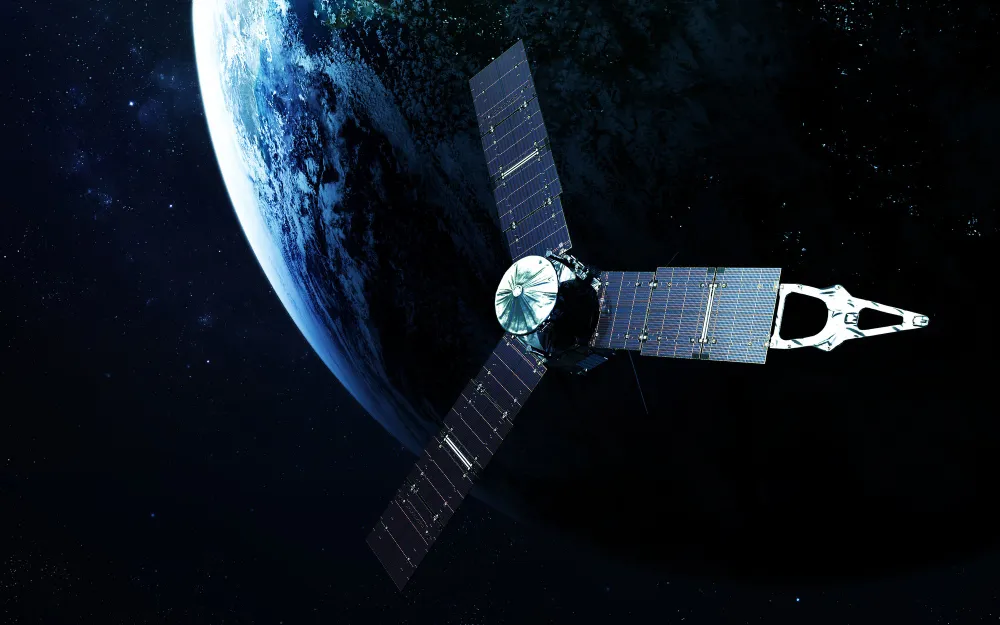
Onboard AI for satellites is moving from laboratory research into practical flight demonstrations. In July 2025, NASA reported a successful test in which an Earth-observing satellite analyzed imagery and adjusted its observation plan without human intervention. The process took less than 90 seconds, demonstrating how spacecraft can make selected decisions while orbiting Earth.
The development addresses a longstanding problem in space operations. Satellites collect enormous amounts of information, but transmitting everything to ground stations consumes time, bandwidth, and power. Artificial intelligence can help spacecraft identify useful observations, discard unnecessary data, and respond to changing conditions. However, limited computing resources, radiation exposure, and mission safety requirements continue to constrain what these systems can accomplish.
How Onboard AI for Satellites Works
Onboard AI lets spacecraft process information locally instead of sending every observation to Earth for analysis. The approach combines machine learning algorithms, embedded processors, satellite sensors, and flight software.
Traditional Earth-observation missions typically capture images on a schedule. They store those images onboard and transmit them when a suitable communication link becomes available. Ground systems then perform additional processing and analysis.
With onboard intelligence, some of that processing happens directly inside the spacecraft. An AI model can examine imagery, identify patterns, and generate information to help determine what to do next.
For example, a satellite observing agricultural regions could distinguish cloud-covered images from clear observations. Instead of storing and transmitting every image, it could prioritize data with greater scientific value.
This approach is also called satellite edge computing. It moves selected computational tasks closer to the data source, potentially reducing unnecessary communication and enabling faster responses.
Not all onboard processing requires artificial intelligence. Conventional software can filter data using predefined rules. Machine learning becomes relevant when a system must recognize complex patterns or interpret observations that fixed instructions can’t describe.
NASA Demonstrates Autonomous Satellite Targeting
NASA’s Jet Propulsion Laboratory has been developing a technology called Dynamic Targeting to improve how spacecraft select observations. The system uses onboard image analysis and planning software to determine where an instrument should point.
During a July 2025 flight demonstration, the technology examined imagery ahead of a satellite’s orbital path. It identified cloud cover and selected clearer areas for observation without waiting for a ground-based decision.
NASA’s mission report says the demonstration used the CogniSAT-6 spacecraft. The system completed its analysis and targeting process in approximately 60 to 90 seconds.
The initial test focused on avoiding clouds rather than detecting wildfires or other hazards. NASA has identified future applications involving storms, volcanic activity, and short-lived environmental events.
The demonstration matters because satellites move rapidly across Earth’s surface. A spacecraft may pass an interesting location before ground controllers can review its observations and send new instructions. Onboard decision-making can help address that timing constraint.
However, successful cloud avoidance does not establish that a satellite can independently manage every mission operation. Autonomous targeting remains a specialized capability with defined operating conditions.
How ESA Is Testing AI-Based Earth Observation
The European Space Agency is also testing onboard artificial intelligence through its Φsat-2 mission. The small satellite launched in August 2024 with a multispectral camera and AI-processing hardware.
In July 2025, ESA announced that Φsat-2 had completed commissioning and entered its science phase. It was designed to process observations in orbit, including cloud screening, image compression, and identifying selected environmental features.
ESA’s mission update describes applications involving wildfire detection, maritime activity, pollution monitoring, and disaster analysis.
These capabilities illustrate a practical advantage of local processing. Instead of treating every captured image equally, software can identify information that deserves further attention.
For environmental monitoring, this could help prioritize observations associated with fires or unusual maritime activity. The results still need appropriate validation, and the usefulness of any alert depends on communication availability and downstream processing.
Φsat-2 remains a technology demonstration mission. ESA has emphasized the need to study the system’s limitations, processing requirements, and performance under real operating conditions.
Where Satellite AI Can Deliver Practical Benefits
Earth observation is one of the most immediate applications because satellites regularly collect more imagery than they can analyze or transmit without constraints.
Environmental Monitoring and Disaster Response
AI models can examine satellite observations for patterns linked to wildfires, flooding, and other environmental changes. Processing information in orbit may help identify relevant observations earlier in the data pipeline.
For disaster response, the benefit depends on how quickly authorities receive useful information. Onboard analysis can reduce some processing delays, but it does not eliminate communication gaps or replace ground-based verification.
Maritime Monitoring
Satellite imagery can help identify vessels and activity at sea. Onboard models may help prioritize images containing relevant targets instead of transmitting every observation for immediate analysis.
Such systems face challenges involving weather, image resolution, vessel size, and classification accuracy. A detected object may still require confirmation through other information sources.
Spacecraft Operations
Artificial intelligence may also assist with selected spacecraft management tasks. Potential applications include identifying unusual sensor readings, supporting fault diagnosis, and recommending responses to changing conditions.
Related developments in autonomous control are attracting research attention. TechAmerica.ai has previously covered AI-powered spacecraft autonomy, including efforts to reduce dependence on continuous ground-based supervision.
These operational applications require stronger safeguards than ordinary image classification. Incorrect decisions affecting propulsion, electrical systems, or spacecraft orientation could jeopardize an entire mission.
Why Space Computing Is More Difficult Than Earth-Based AI
AI models deployed in data centers benefit from substantial electrical power, cooling infrastructure, and relatively accessible hardware. Satellites operate under much tighter physical constraints.
Spacecraft must balance processing capability against mass, power consumption, thermal conditions, and available onboard memory. Every additional computing component introduces engineering requirements and potential failure points.
Radiation presents another challenge. High-energy particles can interfere with electronic circuits, corrupt information, or damage hardware over time. Spaceflight computing therefore requires suitable protection, fault detection, and recovery mechanisms.
NASA’s 2026 small spacecraft avionics assessment examines onboard computing, radiation tolerance, and the increasing role of edge processing and machine learning in satellite systems.
Power efficiency is especially important. A processor capable of running a complex AI model may consume more electricity than a small spacecraft can provide continuously. Engineers must consider whether the expected scientific benefits justify the additional demand.
Communication remains a limitation even when processing happens locally. Satellites may have limited contact windows with ground stations, and available downlink capacity varies by mission.
Local AI can reduce the amount of data that must be transmitted, but it cannot guarantee immediate delivery to Earth. The mission still depends on communication infrastructure and reliable data-handling procedures.
Reliability and Safety Challenges for Autonomous Spacecraft
Artificial intelligence introduces uncertainty because learned models may respond differently to unfamiliar inputs. A model trained on clear imagery might struggle with unusual lighting, unexpected cloud formations, or sensor degradation.
False positives and missed detections can affect scientific results. A system that incorrectly discards useful imagery may lose observations that cannot be captured again under the same conditions.
Engineers therefore need to assess how models behave outside their training environments. Testing should include unexpected inputs, hardware failures, changing illumination, and limited computing resources.
Autonomous decisions must also remain compatible with spacecraft safety rules. AI should not override critical protective controls simply because its model predicts a different action.
NASA’s April 2026 spacecraft autonomy research discusses onboard event detection and automatic responses to changing conditions. Such approaches can allow spacecraft to execute predefined protective activities without immediate ground intervention.
Not every autonomous function uses machine learning. Traditional control software, rule-based responses, and AI-based analysis can serve complementary roles depending on mission requirements.
A Practical Roadmap for Deploying Onboard Satellite AI
Space organizations evaluating onboard AI should start with a narrow mission requirement rather than aiming for fully autonomous spacecraft operations. A phased engineering approach can help establish whether local intelligence improves performance without creating unacceptable risks.
1. Define the Mission Benefit
Identify a task where onboard processing could improve scientific value or operational efficiency. Examples include cloud filtering, image classification, or detecting unusual sensor readings. Establish measurable targets for accuracy, processing time, and reduced data transmission.
2. Select Suitable Computing Hardware
Evaluate processors against available power, memory, mass, and thermal limits. Review radiation tolerance and compatibility with the spacecraft’s flight software. The hardware must support the intended workload without compromising essential mission functions.
3. Validate Models Before Flight
Test machine learning models with representative mission data and difficult operating conditions. Assess false detections, unexpected inputs, processing failures, and recovery behavior. Hardware-in-the-loop testing can help identify problems that ordinary software simulations may miss.
4. Introduce Controlled On-Orbit Operations
Begin with limited onboard processing and compare results against ground-based analysis. Where appropriate, allow the system to recommend actions before granting authority to execute them. Expand autonomous capabilities only after demonstrating performance and meeting safety requirements.
This approach does not replace formal spacecraft engineering and mission assurance procedures. Deployment requirements vary significantly between experimental CubeSats and missions operating critical or expensive spacecraft systems.
The Future of Onboard AI for Satellites
Future developments may allow satellites to interpret more information and coordinate selected actions with other spacecraft. Rather than operating as isolated observation platforms, groups of satellites could exchange findings and organize follow-up measurements.
NASA researchers are exploring concepts in which one spacecraft identifies an event and helps direct another toward a useful observation. Such arrangements could support scientific monitoring of rapidly changing phenomena, although dependable coordination remains a technical challenge.
Improved spaceflight processors may also expand the range of models that can operate in orbit. NASA’s High Performance Spaceflight Computing project addresses the need for greater processing capability, power management, and fault tolerance in future missions.
However, more computing power will not automatically produce reliable autonomy. Spacecraft will still need validated algorithms, dependable sensors, effective communication, and engineering safeguards suited to their operating environments.
Onboard AI could make future satellites more selective observers and more responsive scientific platforms. Its greatest practical value may come from performing well-defined tasks that would otherwise require additional ground processing or delayed instructions.
For satellite operators, the central question is not whether artificial intelligence can make every decision in orbit. It is whether specific onboard capabilities can deliver better observations, reduce communication demands, and support mission objectives without compromising reliability or safety.