Besxar has raised nearly $14 million to develop semiconductor manufacturing systems that operate in orbit, starting with a series of experiments flown on SpaceX Falcon 9 boosters.
The startup, founded by former OpenAI employee Ashley Pilipiszyn, is exploring whether the vacuum of space can provide cleaner conditions for producing materials used in advanced semiconductors. Its funding includes a $9 million seed round led by Dauntless Ventures and Overture VC.
Besxar plans to prototype its orbital manufacturing technology across roughly a dozen SpaceX flights. Falcon 9 boosters completed 163 round trips to space and back last year and have already flown more than 100 times this year, giving the company a relatively frequent platform for testing its systems.
Testing semiconductor production in orbit
Semiconductor fabs on Earth require tightly controlled clean-room environments because microscopic dust and contaminants can damage wafers during production. Pilipiszyn argues that operating in the vacuum of space could reduce some of the infrastructure needed to maintain those conditions.
“We’re at a time where it’s actually more cost-effective to go where the physics already works,” she said. “Don’t do it on Earth where you’re fighting physics.”
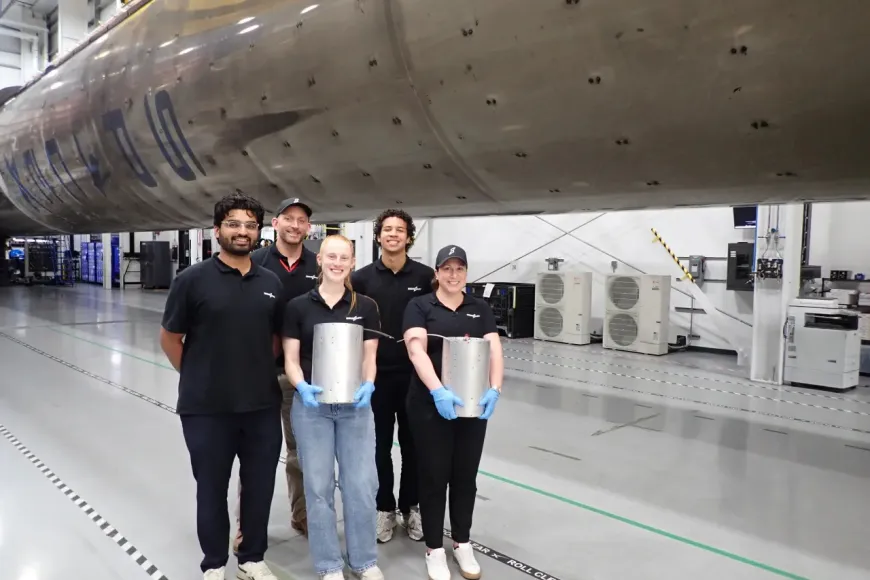
Besxar’s first two small manufacturing test units, which the company calls “fabships,” flew aboard a Starlink mission in July. The canisters were designed to test whether wafer samples could survive launch, remain protected from contamination and be exposed to the vacuum of space.
The company said both experiments met those objectives, although one canister experienced a malfunction in its flight data system that Besxar is investigating. Pilipiszyn said the samples flown in space had less particulate contamination than comparable wafers that remained on Earth.
Besxar plans larger orbital fabs
The company expects to continue developing the technology over the next two years. Its next steps include heating wafers in orbit and progressively testing the deposition of one material, followed by multiple materials.
Pilipiszyn first approached SpaceX about three years ago to discuss purchasing flights on Starship, SpaceX’s next-generation rocket. Besxar instead began testing on Falcon 9 boosters to reduce technical risk while Starship remains under development.
Once the startup can produce qualification samples, it plans to supply semiconductor manufacturers with wafers for advanced power chips used in data centres, robots and electric vehicles.
Besxar is not alone in pursuing semiconductor manufacturing in space. Companies including United Semiconductors and Space Forge are also exploring how orbital conditions could improve semiconductor production, but returning meaningful quantities of material to Earth remains a major constraint.
Besxar ultimately wants each orbital factory to handle hundreds and eventually thousands of wafers. Reaching that scale will depend on lower-cost launch and return systems, including SpaceX Starship or next-generation rockets being developed by companies such as Rocket Lab and Stoke Space.
“We believe that there is a solid transport layer now so that we can focus on the application layer,” Pilipiszyn said. “We can just focus on our core manufacturing and getting our products back down to earth to market as quickly as possible.”