A brain-computer interface can learn to recognize a person’s intended movement or speech, only to lose accuracy when the next recording session begins. Small changes in neural activity, sensor measurements, and recording conditions can affect how the system interprets signals. Correcting these differences is a central challenge in brain-computer interface calibration, particularly for devices intended to support people with severe disabilities.
Researchers are investigating whether artificial intelligence models can learn useful patterns from multiple people, rather than requiring extensive training for every new user. Studies published in 2026 have explored shared neural representations, signal alignment, and adaptive decoding. The results suggest that some calibration work could become faster, although reliable operation outside controlled research settings remains difficult.
Why Brain-Computer Interface Calibration Is Necessary
Brain-computer interfaces, or BCIs, translate measured neural activity into commands that computers can interpret. Depending on the system, those commands might control a cursor, select letters, or help generate speech.
The technology relies on decoding algorithms trained to recognize patterns associated with particular tasks. For example, researchers may record neural activity while a participant attempts to speak. A model then learns relationships between the recorded signals and elements of the intended speech.
Those relationships differ across individuals. Brain anatomy, electrode placement, recording methods, and neural activity patterns all influence the signals available to a decoder.
Even within one person, recordings can change over time. Electrodes may measure slightly different activity, and physiological conditions can alter signal characteristics. A model trained on earlier recordings may therefore require adjustment before it performs reliably again.
Calibration attempts to correct these differences. Traditionally, that may involve collecting task-specific recordings from a new user, labeling the corresponding activity, and training or fine-tuning the decoding system.
The difficulty is particularly important for people with limited movement or communication abilities. Repeated training sessions may be tiring, and collecting enough labeled neural data can be challenging.
Can One AI Model Interpret Signals From Different Brains?
A conventional neural decoder often learns primarily from recordings collected from one participant. That approach lets the model specialize, but it also limits how easily the system can transfer to someone else.
Cross-subject decoding takes a different approach. Researchers train models using information from multiple participants and attempt to identify patterns that remain useful despite differences between recordings.
A July 2026 study published in the Journal of Neural Engineering investigated this possibility for speech brain-computer interfaces. Researchers jointly trained a neural-to-phoneme decoder using two major intracortical speech datasets.
Phonemes are the basic sound units that distinguish words. A neural-to-phoneme decoder attempts to identify intended speech sounds from recorded brain activity, providing information that can generate text.
In the study, researchers introduced mathematical transformations to align recordings from different participants and recording days. They also developed a hierarchical decoding model designed to interpret the shared signal patterns.
The resulting approach matched or exceeded single-participant baselines in the reported experiments. The researchers also found that adaptation to previously unseen participants could be performed with a relatively simple transformation or limited additional training.
These findings support reusing parts of a trained model across individuals. They do not establish that one model can immediately interpret every person’s brain activity or operate without further calibration.
How Neural Signal Alignment Works
The main obstacle in cross-subject decoding is that similar intentions do not necessarily produce identical recorded signals. The problem becomes more complicated when the number, location, and sensitivity of recording electrodes differ.
Researchers use signal alignment to make these datasets more comparable. Rather than requiring every recording to have the same raw values, an algorithm transforms the data into a representation where useful patterns can be recognized more consistently.
One way to understand the process is to consider two microphones recording the same speaker from different positions. The recordings contain related information, but their sound levels and other characteristics differ. Adjustments can make them easier to compare without changing the words being spoken.
Neural signals are considerably more complex, and simple normalization cannot always correct their differences. Nevertheless, the comparison illustrates why translating measurements into a shared representation can help a model trained on one dataset interpret another.
In June 2026, researchers publishing in Frontiers in Systems Neuroscience compared several alignment techniques for electroencephalography, or EEG, data. Their work examined how transformations could reduce differences between participants during attention decoding.
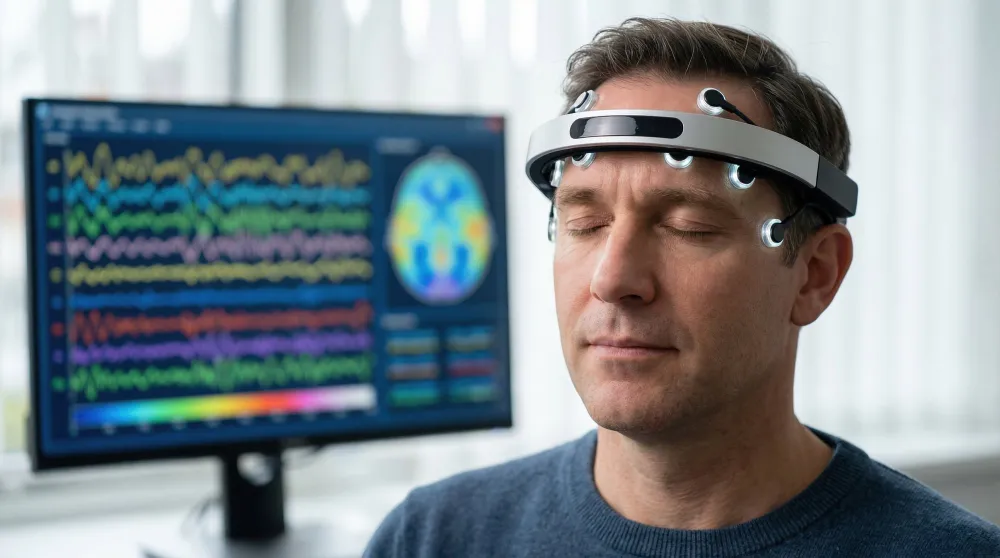
EEG measures electrical activity through electrodes placed on the scalp. It is less invasive than systems that use electrodes implanted within or on the brain, but it generally provides less signal detail and is affected by its own sources of noise.
EEG results cannot automatically be applied to implanted speech devices. Recording technologies, tasks, and available neural information differ.
Brain-Computer Interface Calibration and Assistive Speech
Speech restoration is one of the most important clinical goals in neural decoding research. People with conditions such as amyotrophic lateral sclerosis, stroke-related paralysis, or severe neurological injuries may retain the intention to speak while losing the physical ability to communicate normally.
Researchers have demonstrated systems that decode attempted speech from brain signals and produce text or synthesized voice. In a 2025 Nature study, scientists used implanted microelectrodes to synthesize speech from neural activity in a participant with ALS and severe speech impairment.
The experimental system supported real-time vocal output, including changes in intonation. It demonstrated that neural decoding could recover aspects of spoken communication beyond selecting individual words on a screen.
Such advances also illustrate why calibration matters. Speech decoders must distinguish complex patterns associated with different sounds while remaining responsive enough for conversation.
If a system requires extensive retraining after each interruption or recording change, everyday use becomes more demanding. Improved transfer learning could reduce that burden, but clinical usefulness also depends on accuracy, comfort, reliability, and the user’s ability to correct mistakes.
Why Less Calibration Does Mean No Personalization
The phrase “calibration-free” appears increasingly in BCI research, but it requires careful interpretation. A system may avoid a dedicated training session while still adapting during normal operation.
Some approaches use population-level pretraining followed by adjustments based on a new user’s recordings. Others attempt to update model parameters continuously as additional information becomes available.
The distinction matters because reducing initial setup time does not eliminate the need to account for individual differences. A decoder may still require feedback, supervised examples, or periodic updates.
Researchers must also consider how the system behaves when its predictions become uncertain. An incorrect character in a text message may be frustrating, while an incorrect command sent to a mobility device could have more serious consequences.
Adaptation algorithms therefore need safeguards against learning from incorrect predictions or gradually drifting away from accurate interpretations.
What Researchers Must Prove Before Wider Clinical Use
Laboratory accuracy is only one part of evaluating a brain-computer interface. A system that performs well on a recorded dataset may encounter different challenges when used continuously by a person at home.
Clinical evaluation needs to address several questions:
- Does the decoder remain accurate across days and recording sessions?
- How much training does a new user need before the system becomes useful?
- Can the system detect uncertainty and recover from decoding errors?
- Does the interface support meaningful communication or control in everyday conditions?
- Are the recording hardware, software updates, and data storage practices safe for long-term use?
These considerations are especially important for implanted devices, where surgical procedures, device stability, and long-term maintenance introduce additional risks.
The U.S. Food and Drug Administration has published guidance for implanted BCI devices intended for people with paralysis or amputation. It addresses nonclinical testing and the design of clinical investigations, reflecting the need to evaluate both engineering performance and patient safety.
Development in this field also depends on recording hardware. TechAmerica.ai has reported on implantable neural interface technology being developed to capture brain signals and translate them into digital commands.
Neural Data Privacy Becomes More Important as Models Improve
Training models across participants creates another challenge: determining how neural recordings should be collected, shared, and protected.
Brain data may contain information beyond the particular movement or communication task being studied. The potential sensitivity of those recordings raises questions about consent, secondary use, and control over information gathered by implanted devices.
A July 2026 review in Communications Medicine examined gaps in protections for implantable BCI data. The authors highlighted concerns about de-identification, patient control, consent practices, and using neural information beyond its original purpose.
Cross-subject training makes these questions particularly relevant because useful models may depend on data gathered from several participants. Research institutions and device developers need clear rules governing who can access recordings, what information may be retained, and whether data can be reused for unrelated purposes.
Privacy protections must be considered alongside model performance, not added only after a device becomes clinically useful.
The Next Challenge Is Consistency Outside the Laboratory
Progress in brain-computer interface calibration suggests that future neural decoders may require less individual training than earlier systems. Shared representations and adaptive models could make it easier to introduce new users and maintain performance across recording sessions.
Yet the practical challenge remains substantial. Neural activity changes, recording equipment differs, and the consequences of decoding mistakes depend on what a device controls.
For people who rely on assistive communication, an effective BCI must do more than achieve impressive results during a demonstration. It needs to work reliably during ordinary conversations, require manageable maintenance, and preserve the user’s control over both the device and personal information.
The most meaningful advance may not be a decoder that never needs calibration. It may adapt quietly, accurately, and safely enough that calibration no longer dominates the user’s experience.