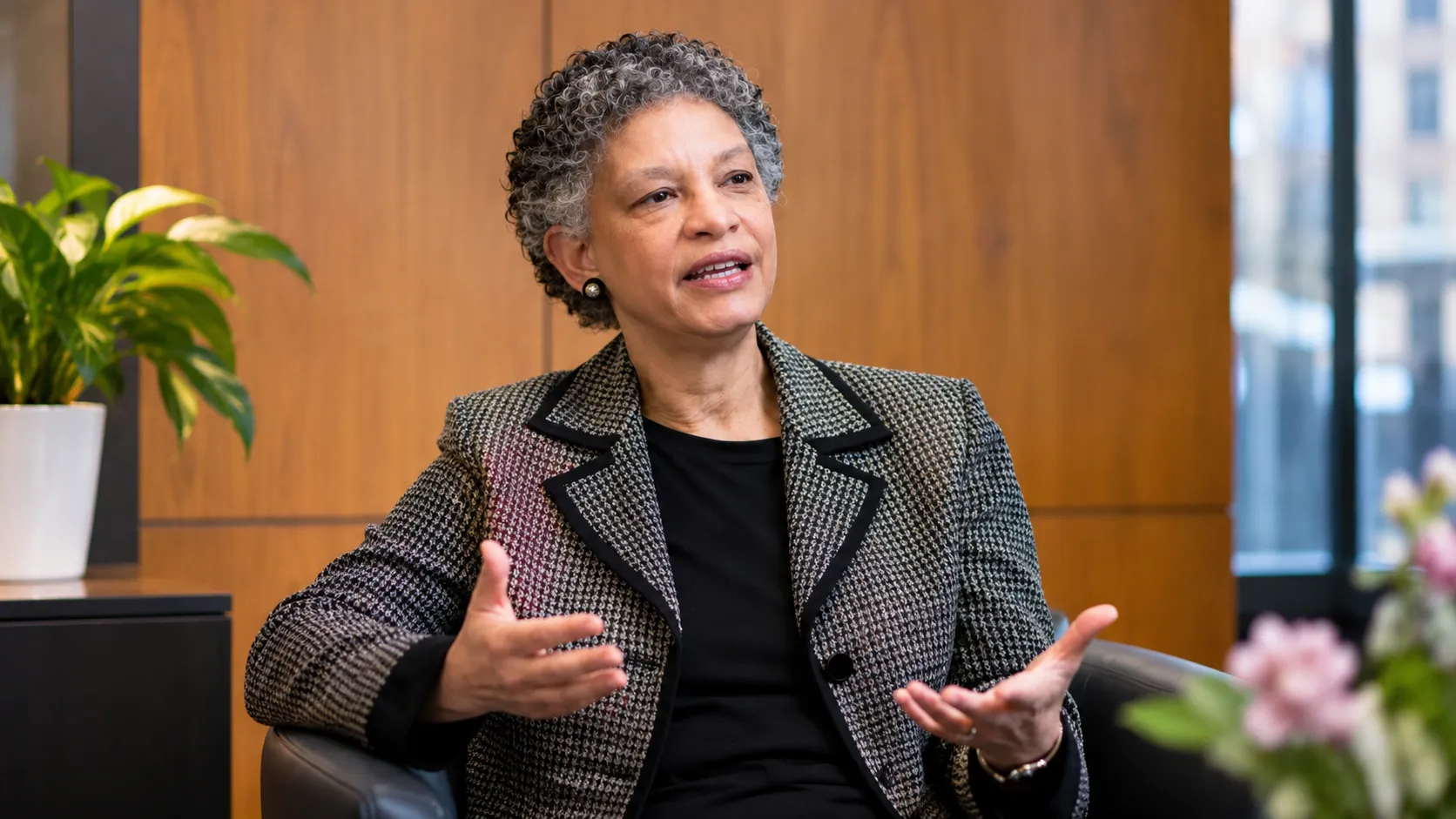
Boston Federal Reserve President Susan Collins said Saturday that gradual Fed rate hikes remain the most appropriate response to persistent inflation and economic uncertainty. She favors smaller increases that allow policymakers to assess the impact of tighter borrowing conditions before taking further action.
Speaking with reporters at a housing conference in Boston on November 14, Collins acknowledged that inflation remains elevated while the labor market has shown renewed strength. She also warned that rising longer-term interest rates and unexpected economic shocks could weaken demand, making aggressive monetary tightening potentially risky.
Why Collins Supports Gradual Fed Rate Hikes
Collins sees competing risks in the economic outlook. Inflation has remained above the Federal Reserve’s 2% target for more than five years, and recent price increases have spread across a wider range of goods and services. At the same time, employment conditions remain relatively stable, giving policymakers room to address inflation without immediately raising rates further.
However, higher interest rates can also discourage spending, borrowing and business investment. Collins noted that medium- and long-term borrowing costs have already risen this year. Their effect on consumer and business demand could be greater than currently anticipated, adding another reason to avoid accelerating monetary tightening.
Her position is consistent with her October economic outlook, in which she supported additional tightening while emphasizing the importance of incoming data. Collins has continued to argue for flexibility as economic conditions change.
December Federal Reserve Meeting Could Bring Another Increase
The Federal Reserve last increased its benchmark interest rate in September, raising the target range by 25 basis points to 3.75% to 4%. Policymakers held that range steady in October, according to the Fed’s official interest rate history.
Financial markets broadly expect another quarter-percentage-point increase at the December 8-9 meeting, with another increase expected in January. Those expectations are not policy commitments, and the final decisions will depend on inflation, employment and broader financial conditions.
Some Federal Reserve officials have expressed greater concern about persistent price pressures. Governor Christopher Waller’s recent comments raised the possibility of a larger increase in December. Others have supported smaller adjustments to give households and businesses more time to respond to rising borrowing costs.
The next decision is scheduled for December 9, according to the Federal Reserve’s official meeting calendar.
Inflation and Employment Could Push Rates Higher
Although Collins favors a measured approach, she has become more concerned about how high interest rates may ultimately need to rise. Stronger inflation readings over the past three months and improved labor market conditions have changed her assessment of the policy outlook.
She now sees the possibility of interest rates moving somewhat higher over the coming year than she anticipated several months ago. That does not necessarily mean larger increases at individual meetings. Instead, it suggests the central bank may need to maintain restrictive monetary policy for longer or make additional adjustments if inflation remains stubborn.
The distinction matters for financial markets and borrowers. A gradual tightening cycle can still result in substantially higher borrowing costs over time, even when individual increases remain modest.
Higher Borrowing Costs Create Risks for Housing and Businesses
Interest rate decisions affect mortgage financing, consumer credit and corporate borrowing. Higher financing costs can reduce demand for homes, delay business expansion and make major purchases more expensive for households. These effects often emerge gradually rather than immediately after a policy announcement.
Housing is particularly sensitive to borrowing conditions. In her November 13 remarks on housing challenges, Collins discussed the relationship between monetary policy, price stability and housing affordability. She also emphasized structural housing supply problems that interest rate decisions alone cannot resolve.
These concerns help explain why Collins is reluctant to accelerate rate increases despite persistent inflation. Raising rates too quickly could weaken demand more than intended, while moving too slowly risks letting elevated inflation continue.
What Comes Next for Federal Reserve Interest Rates?
The Federal Reserve’s December decision will offer the next indication of how policymakers intend to balance inflation risks against economic stability. Incoming price and employment reports will be especially important as officials assess whether current borrowing conditions are sufficiently restrictive.
Collins has not committed to raising rates at every meeting. Her preference for gradual tightening leaves room to pause, continue with smaller increases or reconsider the pace if economic conditions change.
For now, her comments reinforce the likelihood of further monetary tightening without setting a precise timeline or final extent. The central question is whether the Fed can bring inflation closer to 2% while avoiding an unnecessarily sharp slowdown in the broader economy.