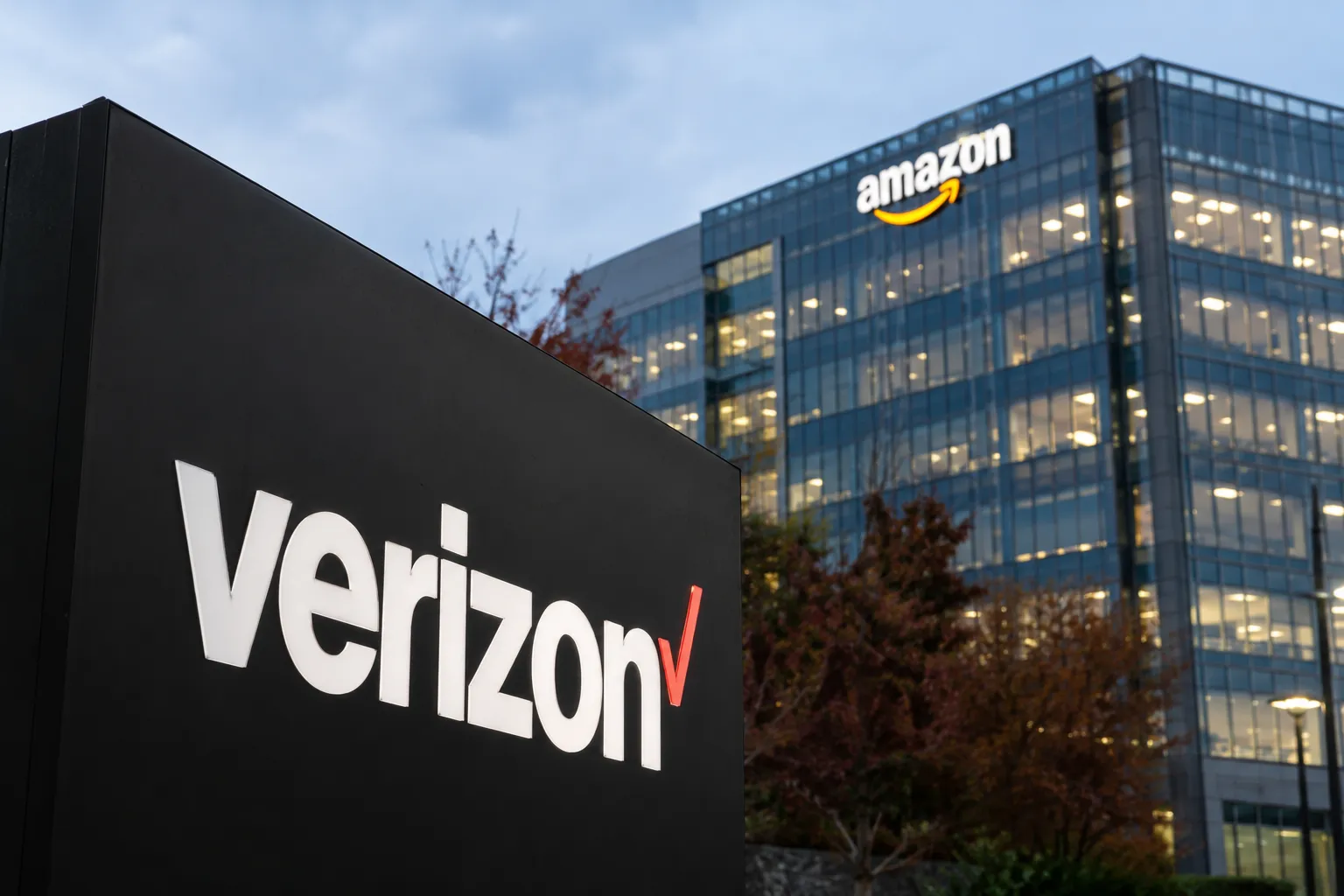
Verizon has signed an artificial intelligence infrastructure agreement with Amazon Web Services worth more than $2 billion, expanding its role in connecting major cloud data centers. The Verizon-Amazon AWS deal comes as the telecommunications company raises its 2026 earnings and subscriber forecasts after stronger-than-expected third-quarter wireless growth.
The company added 406,000 postpaid phone connections during the quarter, its strongest third-quarter performance in five years. Verizon also reported higher profits and cash flow, although overall revenue fell short of Wall Street expectations.
Verizon Amazon AWS Deal Expands AI Infrastructure Business
The AWS agreement will provide high-capacity fiber connectivity to support distributed computing and artificial intelligence workloads. According to Verizon’s earnings announcement, the commercial framework is designed for the growing demands of generative AI and autonomous AI agents.
Such workloads require reliable connections between data centers and computing facilities. Verizon’s fiber network could become increasingly important as cloud providers expand infrastructure across different locations.
The agreement follows a separate contract with Google announced in July. That deal, valued at more than $1 billion, includes dark-fiber connectivity between data centers. Dark fiber refers to unused fiber-optic cables that customers can operate using their own networking equipment.
These agreements allow Verizon to generate revenue beyond its traditional wireless and broadband businesses. They also illustrate how AI infrastructure spending is creating opportunities for companies that supply the networks connecting computing facilities.
The expansion comes as Amazon faces broader questions about data center development. TechAmerica.ai previously covered Amazon’s data center transparency changes amid growing concerns about electricity demand, water consumption and community impacts.
Verizon Raises 2026 Earnings and Subscriber Forecasts
Verizon now expects to add 1.1 to 1.2 million postpaid phone connections in 2026. Its previous guidance called for results in the upper half of a range between 750,000 and 1 million additions.
The company also raised its adjusted earnings forecast to $5.04 to $5.06 per share, up from its previous range of $4.99 to $5.04. The updated outlook represents projected annual adjusted earnings growth of approximately 7% to 7.5%.
Verizon raised its full-year guidance for the third consecutive quarter. It also expects free cash flow growth to approach 12%, compared with its earlier projection of 9% to 10%.
The stronger outlook reflects improved subscriber growth, customer retention, and operating efficiency. Verizon has been simplifying its wireless plans while reducing its reliance on expensive device promotions.
Wireless Growth Accelerates Despite Revenue Miss
Verizon reported $34.3 billion in third-quarter revenue, up 1.5% from a year earlier. However, the result fell short of the approximately $34.74 billion analysts expected, according to Reuters reporting based on LSEG estimates.
Equipment revenue declined 9% as customers kept their smartphones longer and upgraded less frequently. Verizon also reduced handset subsidies, limiting promotional spending while attempting to improve profitability.
Despite weaker equipment sales, mobility and broadband service revenue increased 2.9% to $23.5 billion. The company reported net income of $5.3 billion, up 5.2% from the previous year.
Adjusted earnings reached $1.31 per share, compared with $1.21 a year earlier. Quarterly free cash flow rose 12.1% to $7.8 billion, giving Verizon more financial flexibility for network investments.
Subscriber additions were particularly encouraging. Verizon gained 137,000 postpaid accounts and 314,000 broadband connections during the quarter. Its 406,000 postpaid phone additions were nearly double the 209,439 analysts surveyed by Visible Alpha expected.
Verizon’s Strategy Shifts Toward Retention and Profitability. Since taking the top job in October 2025,
Chief Executive Dan Schulman has focused on simplifying Verizon’s offerings and improving customer loyalty. The strategy emphasizes sustainable subscriber growth rather than relying heavily on discounted devices to attract customers.
Verizon introduced its Simplicity offering earlier this year, emphasizing clearer pricing and unlimited data. Its expanded loyalty initiatives also aim to encourage existing customers to stay with the carrier.
The financial results suggest that the approach is gaining traction. Postpaid phone churn, a measure of customer departures, improved to 0.94%, while acquisition and retention promotional costs declined.
There are still challenges. Lower smartphone upgrade volumes continue to weigh on equipment revenue, and wireless competition remains intense. Verizon must maintain subscriber growth without undermining the profitability improvements supporting its higher forecast.
AI Connectivity Offers Verizon Another Growth Opportunity
The AWS agreement adds a potentially valuable business alongside Verizon’s consumer wireless operations. Demand for AI computing is driving greater demand for high-capacity connections between data centers, cloud regions, and enterprise networks.
Verizon’s agreements with AWS and Google suggest that major technology companies increasingly view telecommunications infrastructure as part of their AI expansion plans. However, the company has not provided a detailed revenue recognition schedule for the AWS agreement or disclosed its expected profit contribution.
For investors, the immediate evidence of improvement comes from wireless subscriber growth, higher adjusted earnings and stronger cash generation. The longer-term opportunity depends on whether contracts supporting AI infrastructure become a meaningful, recurring source of revenue.
Verizon’s next challenge is to sustain its wireless recovery while converting large infrastructure agreements into profitable growth. Its latest results show progress on both fronts, but the AWS partnership’s financial contribution will become clearer as the agreement develops.