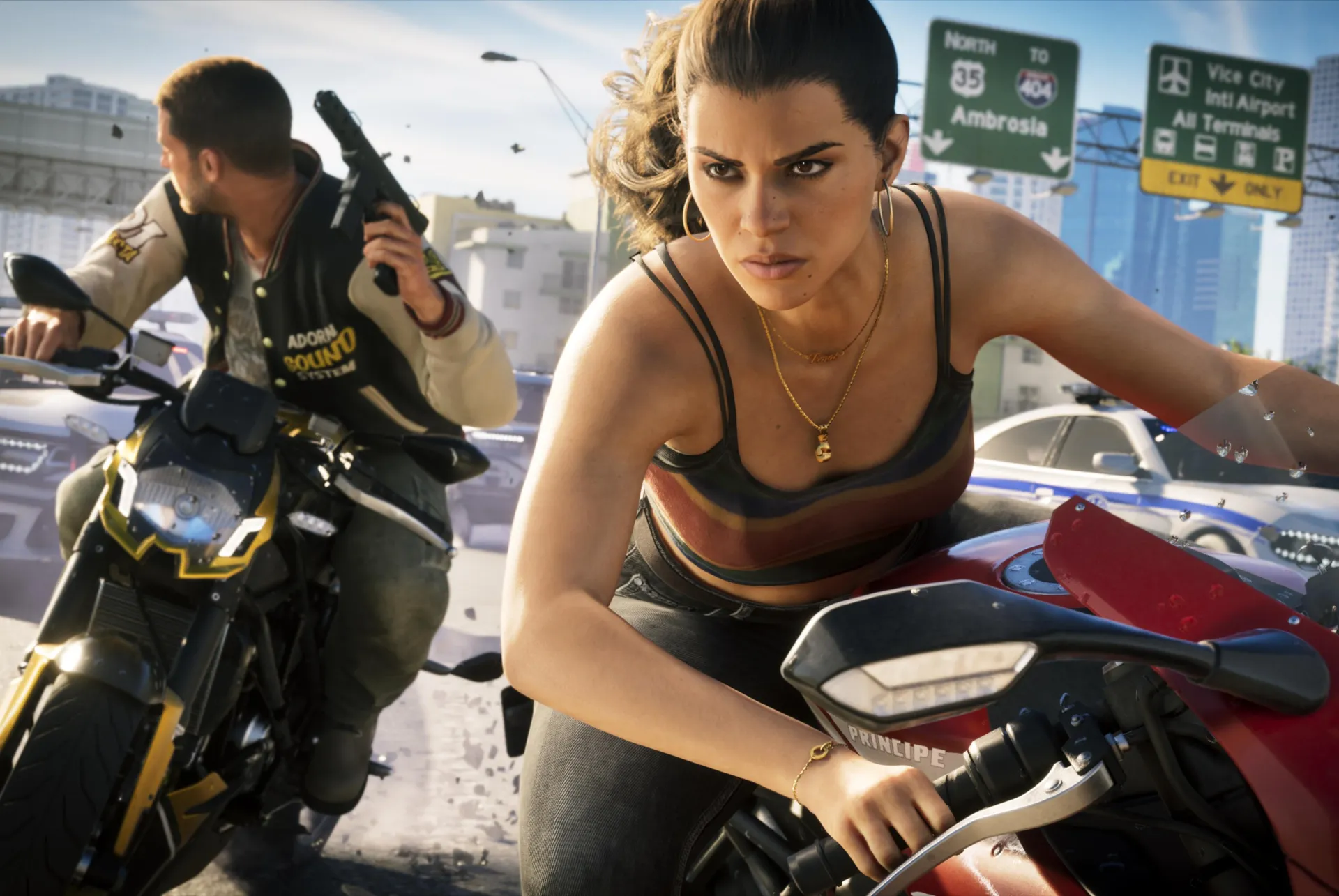
Grand Theft Auto VI review coverage points to a remarkable achievement for Rockstar Games: an open-world crime adventure that combines the freedom of GTA V with the environmental detail and character-focused storytelling associated with Red Dead Redemption 2. Returning to Vice City 13 years after the last numbered release, the sequel introduces a more personal story, a richer fictional Florida setting, and new systems designed to make everyday activity meaningful.
The game’s greatest distinction is not simply the size of its world. Rockstar has connected exploration, criminal activity, and character relationships more closely than in previous installments. Its ambitious design also carries familiar weaknesses, particularly during extended gunfights and complicated weapon selection.
Jason and Lucia Give GTA VI a More Personal Story
Grand Theft Auto VI follows Jason Duval and Lucia Caminos, two criminals whose partnership becomes central to their attempts to escape a dangerous life. Their story unfolds across Leonida, Rockstar’s fictional take on Florida, where a failed criminal operation draws them into a larger conspiracy.
Unlike GTA V, which divided its narrative among three protagonists, the new game concentrates on a couple whose relationship develops alongside their criminal ambitions. Players can control both characters, though the opening chapters establish their individual circumstances before giving them greater freedom to switch between them.
Lucia’s prison experience and Jason’s connections to local criminals offer different perspectives on the same world. Their shared objective gives a stronger narrative reason to accumulate money, take dangerous assignments, and build relationships with other characters.
Rockstar’s official character profiles explain the protagonists’ backgrounds and introduce the people and locations shaping their journey.
The relationship also extends beyond scripted dialogue. Everyday interactions between Jason and Lucia contribute to their characterization, making their partnership a meaningful part of the experience rather than merely a device for switching protagonists.
Vice City and Leonida Offer a More Interactive Open World
Vice City remains the recognizable centerpiece of GTA VI, but the surrounding state broadens the setting considerably. Players can travel through densely populated urban districts, coastal communities, wetlands, and rural areas with distinct environments and activities.
The important improvement is how these locations support exploration. Streets feature pedestrians, businesses, traffic, and situations that can lead to unexpected encounters. Interactions with non-playable characters create opportunities for conversation, confrontation, and occasional side activities.
Rockstar has also introduced everyday systems that add credibility to the environment. Clothing, transportation, food, and vehicle maintenance become part of the world without necessarily dominating the player’s attention.
Public transportation and smaller vehicles provide alternatives to traditional driving, while ordinary encounters can interrupt a planned journey. These details strengthen the impression that Leonida operates independently of the main storyline.
The scale reflects years of investment in game development technology. As TechAmerica.ai previously reported, Rockstar believes the tools and production infrastructure developed for GTA VI could also accelerate future projects.
Criminal Activities and Heists Create Greater Freedom
GTA VI retains the series’ familiar combination of theft, police pursuits, gunfights, and elaborate criminal operations. However, the broader range of activities gives players more flexibility in how they earn money and approach the world.
Vehicle theft, armed robbery, and other illicit opportunities provide alternatives to progressing exclusively through major story missions. Smaller activities also encourage exploration because useful opportunities can emerge away from predetermined objectives.
Large heists remain a central attraction. These operations involve preparation, acquiring equipment, gathering information, and executing plans that can develop into cinematic action sequences.
The mission checkpoint system reduces the consequences of failure by limiting how much previously completed activity must be repeated. This is especially valuable during lengthy encounters, where restarting an entire sequence could otherwise interrupt the story’s momentum.
Nevertheless, prolonged shootouts remain a limitation. The familiar combat mechanics and weapon-selection interface can feel cumbersome when rapid decisions are necessary. GTA VI improves the surrounding experience more substantially than it transforms the fundamental gunplay.
Small Details Make the World More Convincing
One of GTA VI’s most consequential design decisions is integrating ordinary activities into its wider systems. The in-game smartphone functions as a communication tool, navigation interface, and connection to Leonida’s fictional social networks.
Messages can direct players toward assignments or reveal details about characters. Social content also contributes to Rockstar’s satire of contemporary American culture, connecting the game’s fictional society to recognizable online behavior.
Character interactions extend into daily routines. Changing clothes, spending time with a partner, and participating in recreational activities add context to the story without necessarily becoming mandatory objectives.
These systems suggest an open-world design approach where realism matters because it creates choices. Players interested in exploration or role-playing can engage with the details, while those focused on criminal missions can concentrate on the central campaign.
The approach builds on Rockstar’s established strengths while giving the modern setting a distinct identity. The result is a world that aims to reward attention rather than overwhelm players with activities.
Graphics, Performance, and Platform Availability
Grand Theft Auto VI emphasizes dense environments, detailed character animation, varied landscapes, and extensive interaction systems. Its visual direction combines Vice City’s brightly colored urban environment with the contrasting natural environments surrounding it.
The game’s extensive production requirements reflect the complexity of creating such a detailed world. Rockstar has invested heavily in animation, environmental systems, and development technology to support its ambitious scope.
The official Grand Theft Auto VI website provides trailers, environmental previews, character information, and other details illustrating its presentation.
Rockstar has targeted 30 frames per second on PlayStation 5 and Xbox Series X|S, prioritizing world density and visual detail. Players seeking higher frame rates should keep that limitation in mind before purchasing.
The game launches November 19, 2026, for PlayStation 5 and Xbox Series X|S. A native PC release date has not been announced.
Xbox players also have an additional access option. TechAmerica.ai has detailed the confirmed Xbox Cloud Gaming support, which allows eligible Xbox consoles, including Xbox One, to stream the game under specified conditions.
Grand Theft Auto VI: Strengths and Limitations
Grand Theft Auto VI’s strongest qualities lie in its interconnected systems rather than any single feature. Its two protagonists, varied criminal activities, and detailed environments reinforce one another, giving exploration a clearer narrative purpose.
The principal compromises concern familiar combat frustrations, the deliberate pace of early storytelling, and the technical demands of such an ambitious world.
Players who enjoy methodical exploration, character development, and discovering optional activities are particularly well served. Those who prefer immediate action may find the slower introduction and extended encounters less appealing.
Final Verdict
Grand Theft Auto VI represents a significant expansion of Rockstar’s open-world design. The relationship between Jason and Lucia gives the criminal narrative greater emotional focus, while Leonida provides an extensive setting for exploration and unpredictable interactions.
Its greatest achievement is bringing together detailed environmental simulation, player freedom, and cinematic storytelling without abandoning Grand Theft Auto’s chaotic identity. Although combat and interface frustrations remain, the broader design offers a substantial advance over the series’ previous formula.
For players who value immersive environments and story-driven criminal adventures, GTA VI presents a compelling reason to return to Vice City. Those expecting a complete reinvention of shooting mechanics or consistently fast-paced missions should approach it with more measured expectations.