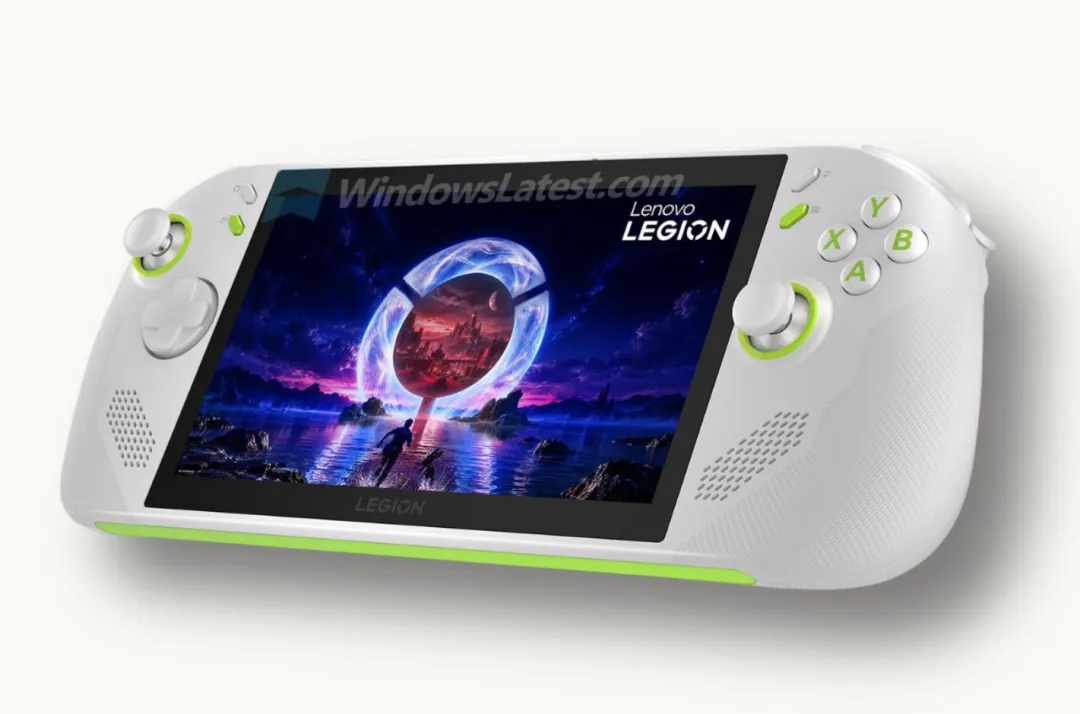
The Lenovo Legion Go Beam leak suggests that Lenovo is developing a simpler handheld gaming PC with fixed controllers and fewer premium features. Images published on November 18, 2026, show a white device with lime-green accents, thick display bezels, and a conventional gaming layout.
The unannounced handheld could offer a more affordable alternative to the Legion Go 2. However, Lenovo has not confirmed its specifications, price, operating system, or release date. The leaked design provides an early indication of its possible market position.
Lenovo Legion Go Beam Leak Reveals a Simpler Design
The first images appeared in an exclusive report from Windows Latest. They show a handheld with integrated controllers, rounded grips, and a white chassis accented by bright green elements.
The design more closely resembles Lenovo’s existing Legion Go S than the premium Legion Go 2. Both devices use a conventional handheld shape with controls positioned around the display.
The Beam appears to have an Xbox-style joystick arrangement. Its left analog stick sits above the directional pad, while the right stick sits below the face buttons.
Green rings surround both joysticks. Matching accents also appear around the power button and along the lower edge.
The leaked images show noticeably thick screen bezels. That could indicate a less expensive display assembly, although the panel technology remains unknown.
Unlike the original Legion Go and Legion Go 2, the Beam appears to have non-removable controllers. This would eliminate the detachable-controller arrangement found on Lenovo’s higher-end models.
Fixed Controllers Could Help Reduce Manufacturing Costs
One of the clearest differences is the apparent absence of detachable controllers. Lenovo’s premium handhelds allow users to remove their controllers for alternative playing configurations.
The Legion Go 2, for example, retains detachable controllers and a built-in kickstand. Its design supports tabletop play and other control arrangements.
The leaked Beam instead uses fixed grips. This construction could reduce mechanical complexity by eliminating detachable connections and their associated components.
However, a fixed design also limits flexibility. Players would lose the ability to separate the controllers from the screen or use Lenovo’s established FPS-style controller mode.
The Beam also appears to lack the touchpad found on the Legion Go S. That omission could reduce costs, but it may complicate desktop navigation if the device runs Windows.
These changes suggest Lenovo may prioritize conventional handheld gaming over additional control features.
Ports and Buttons Visible in the Leaked Images
The images reveal several familiar handheld controls. Two rear buttons, labeled Y1 and Y2, sit behind the grips.
The device also appears to include conventional shoulder buttons and triggers. Front-facing speaker grilles are positioned near the lower ends of the controllers.
Along the top edge, the images show a USB-C port, headphone jack, microSD slot, and physical volume controls. Ventilation openings are also visible.
Only one USB-C port is visible in the available top-edge images. However, the bottom edge isn’t shown, so the full port arrangement remains uncertain.
The Legion Go S offers two USB-C ports, which could be a key differentiator between the models. Fewer ports could reduce flexibility when charging and connecting external accessories.
Lenovo has not confirmed the Beam’s charging specifications, wireless connectivity, storage expansion limits, or accessory compatibility.
Will the Legion Go Beam Run Windows 11 or SteamOS?
The operating system remains one of the biggest unanswered questions. Lenovo has not confirmed whether the Beam will use Windows 11, SteamOS, or another software configuration.
Both Windows and SteamOS are already available across Lenovo’s handheld gaming lineup. The company’s existing strategy makes either platform a possibility.
Windows provides broad access to PC gaming stores, applications, and compatible launchers. However, navigating a desktop interface can be less convenient on smaller handheld displays.
SteamOS offers a controller-focused interface designed around portable gaming. Software requirements and anti-cheat systems can limit its compatibility with certain Windows games.
TechAmerica.ai previously examined these differences in its coverage of the Lenovo Legion Go S SteamOS. That model demonstrates how operating-system choices can influence the overall handheld experience.
The Beam’s missing touchpad could become more significant if it runs Windows. A touchscreen and software-based navigation tools might help compensate for that omission.
Until Lenovo announces the operating system, claims about game compatibility and user experience would be premature.
How Could the Legion Go Beam Compare With the Legion Go 2?
The existing Legion Go 2 occupies Lenovo’s premium handheld category. It offers an 8.8-inch OLED display, detachable controllers, and high-performance AMD Ryzen Z2-series processor options.
The Beam appears designed around different priorities. Its fixed controls, thicker bezels, and simpler exterior suggest a device intended to cost less.
However, appearances alone cannot establish its performance. Lenovo has not disclosed the Beam’s processor, graphics architecture, RAM, storage, display resolution, or battery capacity.
Those specifications will ultimately determine whether the device can compete with more established handheld gaming PCs.
A lower-cost processor could make the Beam more accessible, but demanding games might require reduced graphics settings. A smaller battery could also affect endurance during portable play.
The leaked images confirm neither outcome.
Graphics efficiency remains particularly important for handheld PCs. TechAmerica.ai recently examined AMD’s plans for FSR 4 on gaming handhelds, including the challenges of running advanced upscaling within limited power budgets.
There is currently no evidence establishing whether the Beam will support FSR 4 or any particular AMD processor.
Lenovo Legion Go Beam Price and Release Date
Lenovo has not announced a price or release date for the Legion Go Beam. Reports describing it as an affordable handheld are based on its apparent design compromises.
The wider market provides some context. Lenovo introduced the original Legion Go in 2023 for $699. Its Legion Go S later entered the market with lower-priced configurations.
The Legion Go 2 launched at substantially higher prices, and reported US retail listings have since reached approximately $1,999 for certain configurations.
That pricing creates an opportunity for a simpler handheld, particularly if Lenovo can reduce manufacturing costs.
However, the Beam’s positioning below premium models does not guarantee a budget price. Memory costs, processor selection, display technology, and manufacturing expenses will all influence its final retail price.
Lenovo has scheduled its Tech World event during CES 2027 in January. The event could provide an opportunity for new hardware announcements, but the company has not confirmed a Beam presentation.
What the Lenovo Legion Go Beam Still Needs to Prove
The leaked design raises several practical questions for prospective buyers—most concerns center on performance, comfort, and whether the simplified hardware will deliver meaningful savings.
Fixed controllers may make the device easier to manufacture, but images can’t reveal ergonomic quality. Weight distribution, grip comfort, and button placement will require physical testing.
The thick display bezels also leave questions about screen quality. Resolution, refresh rate, brightness, and color performance remain undisclosed.
Battery capacity and cooling performance will matter just as much. Handheld gaming PCs operate within strict power and thermal limits, especially when running demanding titles.
Lenovo must also clarify software support, repairability, and long-term driver updates before buyers can compare models.
Final Assessment: A Promising Design With Major Unknowns
The Lenovo Legion Go Beam leak points toward a potentially useful addition to the handheld gaming market. Its simpler construction suggests Lenovo may be preparing an alternative to increasingly expensive premium models.
The absence of detachable controllers and a touchpad could help control costs. However, those omissions also reduce the flexibility available on existing Legion Go devices.
For players who primarily want a conventional portable gaming PC, that trade-off could make sense. The deciding factors will be processor performance, display quality, battery endurance, and price.
For now, the Beam remains unannounced and is known primarily through leaked images. Lenovo must confirm its hardware and pricing before its value can be assessed reliably.