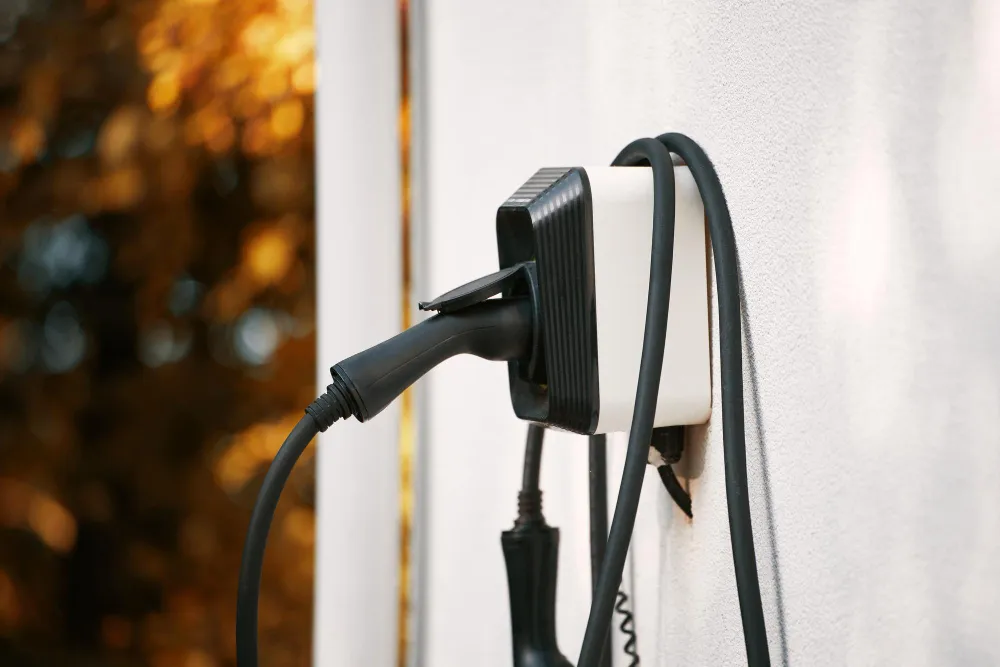
Hardwired Level 2 EV chargers can make overnight charging more practical for drivers who cover long distances or have limited time at home. Instead of relying on a standard 120-volt outlet, a wall-mounted unit connects to a dedicated 240-volt circuit. That gives the car access to more power, provided its onboard equipment can accept it.
Choosing a higher-rated station is not the whole decision. The house must have enough electrical capacity, the wiring and protective devices must suit the continuous load, and the vehicle may charge more slowly than the station’s rating suggests. A safe installation starts with those constraints, not the largest number printed on a charger.
What a hardwired Level 2 EV charger actually does
In North American terminology, Level 2 charging uses alternating current supplied at roughly 240 volts in a typical home. A hardwired unit connects permanently to the building’s electrical system instead of drawing power through a plug and receptacle. The equipment provides switching, monitoring and communication functions that make the connection suitable for vehicle charging.
The wall unit generally does not convert household AC electricity into the DC electricity stored in the traction battery. That conversion happens inside the vehicle through its onboard charger. The external equipment communicates the available current and supervises the connection, while the vehicle controls how much power it actually draws within the permitted limit.
This distinction explains why a station with a higher output rating cannot force every car to charge faster. The circuit constrains the usable rate, the charging station, the cable and connector, and the vehicle’s onboard charger and battery-management decisions.
Why 240-volt charging is different from a household outlet
A standard 120-volt charging arrangement can be sufficient for a short daily commute, especially when a car remains parked for many hours. Its disadvantage is the limited energy added during that time. A 240-volt circuit can deliver substantially more power at a comparable current so that a driver may recover more energy overnight.
Power is calculated by multiplying voltage by current. At 240 volts, a 32-amp charging session corresponds to approximately 7.7 kilowatts, while 40 amps corresponds to 9.6 kilowatts. At 48 amps, the electrical input is about 11.5 kilowatts. These are nominal input-power calculations, not guaranteed energy delivered into the battery.
Charging losses and vehicle limits reduce the energy actually stored. Weather, battery temperature and charge level can also change the rate. Converting kilowatts into miles gained per hour requires the vehicle’s real energy consumption, which varies by model and driving conditions.
Why a 48-amp charger needs more than a 48-amp circuit
Vehicle charging is treated as a continuous electrical load under the commonly adopted U.S. electrical rules. The branch circuit must therefore be sized with a margin above the intended continuous charging current. A common example is a 48-amp setting on a dedicated 60-amp circuit; 40-amp charging commonly uses a 50-amp circuit.
Those examples are not instructions for choosing wire, breakers or an installation method. The correct design depends on the equipment instructions, conductor characteristics, termination ratings, installation conditions and the electrical code adopted locally. A station capable of 50 amps does not mean a 50-amp branch circuit can safely support that output.
The federal home charging guide advises professional installation, a household load calculation and appropriate permits. It also explains the continuous-load sizing principle. Homeowners should have a qualified electrician establish the approved circuit and configuration before energizing the equipment.
Hardwired versus plug-in charging: what changes?
Plug-in Level 2 equipment attaches to a suitable high-power receptacle. It can be easier to remove or replace when an approved receptacle is already present. A hardwired station instead has a permanent electrical connection, eliminating the additional plug-and-receptacle contact points that would otherwise carry the charging current.
Hardwiring can be useful for higher-current installations, outdoor locations or situations where the local electrical requirements make a receptacle arrangement more complicated. It is not a substitute for good terminations, proper grounding or inspection. A poorly installed hardwired connection can still overheat or fail.
The best choice depends on the intended output and the existing electrical installation. A driver with modest overnight needs may gain little from replacing an adequate lower-power arrangement. Select equipment after establishing a realistic charging requirement, rather than assuming permanent wiring always pays for itself.
Electrical panel capacity can become the real bottleneck
A house already supplies heating, cooking equipment, water heating and other loads. Adding a substantial EV charging circuit can push the calculated electrical demand beyond the available service or panel capacity. An empty breaker position does not prove the service can support another high-power continuous load.
An electrician evaluates the household load, existing circuits and installation conditions. Some properties may need an upgraded panel or service. Others can accommodate a new charging circuit at a reduced current, or use approved equipment that adjusts charging in response to other household loads.
Official residential charging installation guidance recommends assessing electrical capacity and contacting the local permitting authority before fitting hardwired equipment. That assessment is especially important in older houses, shared buildings and garages far from the main panel.
How adjustable charging current and load management work
Some stations support a range of output settings. The installer can configure the equipment for the approved electrical circuit, while the vehicle is informed of the maximum current it may use. That limit isn’t just a speed preference; it helps keep the electrical load within the installation’s design.
Load-management systems can go further. Approved monitoring equipment may measure household demand and reduce vehicle charging when other appliances increase the load. Charging can rise again when capacity becomes available. This can help some properties avoid a service upgrade, although its suitability depends on the design and local rules.
Such control is not always an intelligent forecast of grid demand. Basic load management responds to measured capacity, while scheduled charging responds to a timetable. Both require reliable settings and a defined behavior if sensors, communications or monitoring equipment fail.
Connector compatibility is separate from charging power
The physical connector must fit the vehicle inlet or use an approved, compatible adapter. North American AC charging commonly uses the J1772 interface, while J3400 is another established connector specification. The connector alone does not determine the maximum power the vehicle will accept.
A plug can fit, but the onboard charger may still be limited to a lower current. An adapter must also be rated and approved for the intended use. Check compatibility against the vehicle’s documentation, including the inlet type, permissible AC charging rate, and any adapter requirements.
These distinctions matter for households planning to charge more than one vehicle over time. Choosing equipment based only on today’s vehicle may create an avoidable compatibility problem later. On the other hand, paying for the highest output is unnecessary if the expected vehicles cannot use it.
What determines how many hours a charging session takes?
The basic estimate begins with the battery energy that needs to be replaced, measured in kilowatt-hours. If a car needs 30 kilowatt-hours and the electrical input averages 7.7 kilowatts, the idealized calculation is just under four hours. Real charging takes longer because energy is lost and the charging rate may change during the session.
Battery temperature, charge level and vehicle control settings can all affect charging behavior. At very high states of charge, some vehicles may reduce charging power. Owners should not assume a wall station’s advertised miles per hour will be the same across different batteries, seasons, and driving styles.
The federal guidance on home electric-vehicle charging notes that lower-power charging can meet many daily driving needs. For an overnight routine, the relevant calculation is the energy used on a typical day, not the time required to fill an empty battery.
Where to install a wall charger safely
Location affects both convenience and reliability. Place a station where its cable reaches the vehicle’s inlet without stretching across a walkway or creating a trip hazard. Parking orientation may change, and future vehicles may have the inlet on a different side.
Outdoor installations require equipment and fittings suitable for the exposure. Rain, temperature extremes, ultraviolet light and impact risks matter. A weather-rated enclosure does not make loose connections, damaged cables or improper mounting acceptable. Grounding and protective functions must meet the applicable requirements.
Installation distance also changes cost. A long route from the panel to a detached garage may require substantial electrical work and a design that accounts for voltage drop. A licensed professional should evaluate the wiring route, protective devices, accessibility and local permit requirements rather than treating installation as a simple mounting task.
Scheduling, energy use and charging cost
Where a utility offers different electricity prices during the day, scheduled charging may shift some consumption into a lower-cost period. The financial benefit depends on the rate plan, any demand charges or fixed fees, and whether the vehicle can finish charging before it is needed.
Some stations record energy use and communicate with an application. Those features can help drivers review charging sessions, but they are not required for basic AC charging. Connectivity also introduces account, software and data-privacy considerations that a simpler offline unit may avoid.
When comparing equipment, energy consumed while the station is idle also matters over years of ownership. Federal charging-infrastructure guidance discusses energy-efficient equipment and standby consumption. Any projected savings should use the household’s actual electricity tariff and charging habits.
What problems can stop home charging?
A vehicle may refuse to charge because the connector isn’t properly seated, the session wasn’t authorized, or protective monitoring detects a problem. Intermittent faults can also arise from overheating, damaged cables, poor electrical connections or incompatible settings. The user should follow the equipment’s documented error guidance rather than bypassing protective functions.
Slow charging is not necessarily a fault. The vehicle may be limited by its onboard charger, the station may be configured for a smaller circuit, or load management may be reducing available power. Checking the car’s reported charging rate and the equipment’s status can help distinguish these situations without opening electrical enclosures.
Repeated breaker trips, burning smells, visible damage or unusually hot electrical connections require stopping use and professional inspection. Resetting a protection device repeatedly without determining the cause can leave a dangerous condition unresolved.
Installation cost and when faster charging is unnecessary
Total project cost includes the charging station, electrical assessment, labor, protective devices, cable routing and any required permits or inspections. Panel or service upgrades can dominate the budget. A headline equipment price tells a homeowner little about the final installed cost.
The right capacity depends on daily travel and how long the car remains parked. Someone who drives a modest distance and charges overnight may find a lower-current circuit sufficient. Another household with multiple drivers, a large battery or short overnight parking windows may benefit from higher available power.
Reliable home charging is an engineering decision, not a contest to install the largest unit. Hardwired Level 2 EV chargers are most useful when their current settings, electrical supply, vehicle capability, and daily charging needs match. For broader coverage of electric mobility and related infrastructure, readers can explore the transportation technology section.