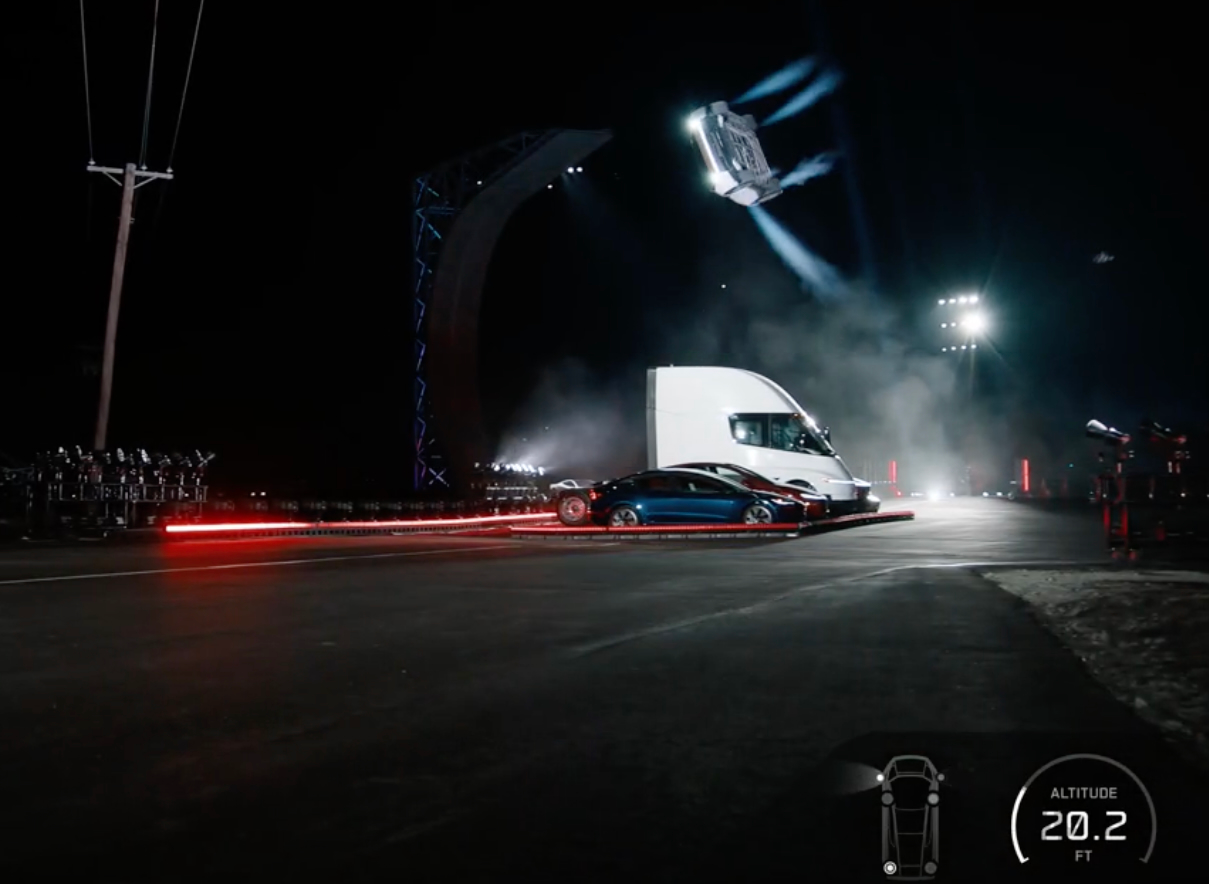
The Tesla Roadster with SpaceX thrusters debuted near Waco, Texas, on October 15. A prototype climbed an inverted ramp, flipped in midair and landed on its wheels. The demonstration revealed a redesigned version of Tesla’s electric sports car, first shown in 2017.
CEO Elon Musk said Tesla plans to begin production in 2028 but has not announced prices. Tesla demonstrated 0-60 mph acceleration in under one second. The company also introduced three trims, including one designed for brief airborne manoeuvres.
During the event, the Roadster jumped over a Cybertruck, Cybertruck, Semi, Model Y, and Model 3. Compressed-air thrusters lifted the car and helped control its movement. An underbody suction system helped the car stay attached to the inverted ramp.
How SpaceX Thrusters Work on the Tesla Roadster
Unlike conventional rocket engines, the Roadster’s cold-gas thrusters generate force by releasing compressed air. Tesla engineering vice president Lars Moravy said the system uses 10 thrusters and approximately 600 litres of stored air. The setup lets the car lift, rotate, and stabilise itself during airborne manoeuvres.
Carbon-fibre-overwrapped pressure vessels, known as COPVs, store the compressed air. Tesla described the system in an official X post. Moravy said the air supply can be replenished. Tesla has not explained how often drivers could use the thrusters under normal conditions.
Tesla reported a roughly 0.81-second 0-60 mph run during the demonstration. It also claims a top speed exceeding 230 mph and more than 300 miles of range. Those specifications remain company claims, not independently verified results from production vehicles.
Three Roadster Versions With Different Capabilities
Tesla’s official Roadster page lists three configurations. The two-seat Performance model combines active aerodynamics with a multi-mode suction system. Tesla says the system improves grip during demanding driving conditions.
The two-seat Thrust version adds rear-mounted cold-gas thrusters for stronger acceleration and track performance. Tesla describes it as race-ready and claims it can accelerate to 60 mph in under one second.
The Rocket version has one seat and 10 thrusters positioned around the vehicle. Tesla says they enable vertical movement and midair rotation. Reservations for this configuration are available by invitation only.
Tesla is accepting reservations with $50,000 deposits for Performance and $250,000 for Thrust. These payments are not confirmed purchase prices. Tesla has not finalised delivery dates or explained the rules governing public-road use of thruster-equipped models.
Roadster Redesign Draws From Fighter Jets and James Bond
The redesigned Roadster has sharper lines than the rounded prototype unveiled nearly nine years ago. Its low, angular body includes aerodynamic surfaces reminiscent of modern supercars.
Tesla cites the SR-71 reconnaissance aircraft and F-35 fighter jet as design influences. It also pointed to the evolution of its styling across Cybertruck, Cybercab and the Optimus robot.
A Lotus Esprit from the 1977 James Bond film “The Spy Who Loved Me” appeared at the unveiling. Musk bought the film’s submarine car in 2013. Its appearance underscored the connection between the movie’s fictional technology and Tesla’s ambitious demonstration.
Musk also raised the possibility of jumping Snake River Canyon. Stunt performer Evel Knievel attempted to cross the gorge in a rocket-powered vehicle in 1974. Tesla has not announced an official attempt or a timetable.
Production Target Follows Years of Delays
Tesla unveiled the second-generation Roadster alongside the Semi in November 2017. At the time, the company suggested deliveries could begin in 2020. It accepted $50,000 reservations and offered limited Founders Series reservations for $250,000.
Musk first floated the SpaceX thruster package in 2018. He said it could improve acceleration, braking, and cornering, and possibly let the vehicle fly. Other Tesla projects, including the Model 3, Model Y and Cybertruck, took priority.
The latest reveal followed several missed targets. Musk previously discussed a 2025 unveiling, then moved the date to April 2026 and later October 1. Severe weather pushed the event to October 15, as TechAmerica.ai previously reported.
The delays have frustrated reservation holders, including YouTuber Marques Brownlee and OpenAI CEO Sam Altman. After the demonstration, Brownlee questioned whether Tesla could deliver on its latest claims. His reaction reflected doubts about the gap between the prototype and a production vehicle.
Roadster Thrusters Raise Safety Questions
The new propulsion system raises safety and real-world use. During an earlier appearance on a questions podcast, Musk warned potential buyers that safety wasn’t the Roadster’s top design priority. He compared the car with high-performance sports cars and said Tesla would “aspire not to kill anyone in this car.”
The demonstration took place at a controlled facility, not on public roads. Tesla has not detailed the safety requirements, operating restrictions or regulatory approvals needed for its airborne configurations.
Musk has described the Roadster as an engineering showcase rather than a major revenue source. Meanwhile, Tesla is expanding its Cybercab and autonomous driving efforts while investing in robotics.
The reveal demonstrated a working prototype capable of brief airborne manoeuvres. Delivering those features to customers will require further engineering and regulatory clearance. Tesla must also meet its revised 2028 production target.