

































AI Is Moving Into Handheld Medical Devices
AI is moving into handheld ultrasound, digital stethoscopes and portable ECG devices, bringing automated analysis closer to patients and clinicians.
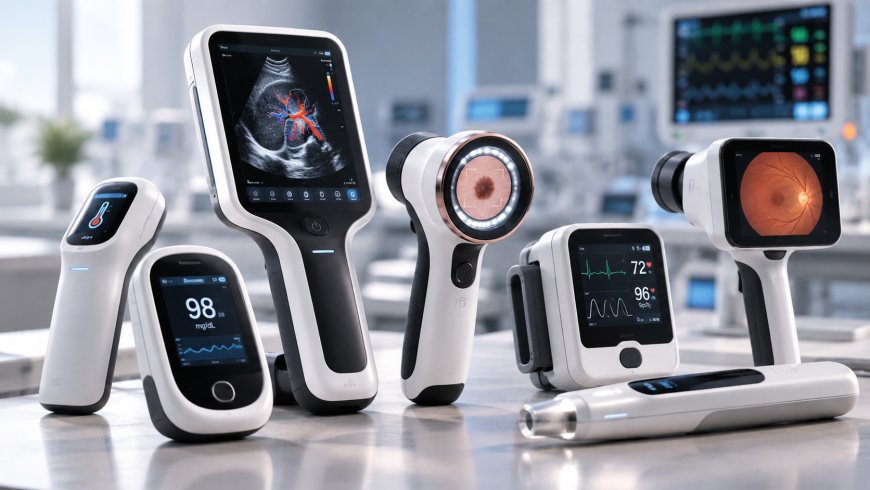
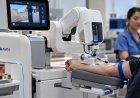
Portable ultrasound systems, digital stethoscopes, and pocket-sized ECG devices show how artificial intelligence is moving closer to the patient.
For years, some of the most visible medical AI has been tied to large imaging systems, radiology workstations and hospital software. That is changing as medical-device companies put AI into equipment that can be carried into an exam room, used at the bedside or connected to a smartphone.
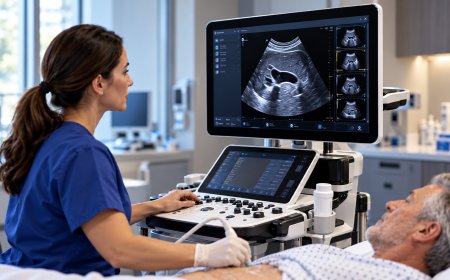
Handheld ultrasound probes can automate measurements: digital stethoscopes can analyse heart sounds and ECG signals. Portable electrocardiogram devices can use software to classify cardiac rhythms within seconds.
The shift follows a broader move toward AI-assisted medical equipment. TechAmerica.ai recently covered how Philips is integrating AI-powered workflows into its Alturion ultrasound system, while companies across the healthcare industry are adding machine learning to diagnostic and clinical tools.
The U.S. Food and Drug Administration maintains a growing list of AI-enabled medical devices authorised for marketing in the United States, spanning medical imaging, cardiovascular care and other clinical specialities.
Here are several products showing how AI is moving from large hospital systems into devices clinicians can carry and use closer to the patient.
GE HealthCare Brings AI Guidance to Handheld Ultrasound
Ultrasound is one of the clearest examples of medical equipment becoming both smaller and more software-driven.
GE HealthCare’s Vscan Air SL with Caption AI combines a wireless handheld ultrasound system with AI-assisted cardiac imaging tools.
Caption Guidance provides real-time instructions intended to help users position and move the probe while acquiring supported cardiac views. The platform also includes AutoEF, which can automatically calculate left ventricular ejection fraction from supported images.
That matters because ultrasound depends heavily on the person operating the probe. Capturing a clinically useful image can require substantial training and experience.
AI-assisted acquisition does not remove the clinician from the process. Instead, it can help with one of ultrasound’s most difficult steps: obtaining the right image in the first place.
Philips Adds AI to Smartphone-Based Ultrasound
Philips has also been developing AI-assisted capabilities for portable ultrasound.
Its Lumify platform uses compact ultrasound transducers that connect to compatible mobile devices, allowing clinicians to perform imaging without a conventional cart-based ultrasound system.
Philips offers features including AI-powered Auto EF for supported cardiac examinations and automated B-line quantification for lung ultrasound.
Auto EF can calculate ejection fraction without requiring the operator to trace the heart chambers manually. At the same time, B-line analysis helps automate a measurement useful in certain lung assessments.
These are relatively focused AI functions, but that is also what makes them practical. Rather than interpreting an entire examination independently, the software automates specific tasks within an existing clinical workflow.
Philips is applying a similar strategy to larger systems. Its Alturion ultrasound platform uses AI-assisted workflows and automated measurements for higher-volume clinical environments.
Butterfly Network Turns a Probe Into a Software Platform
Butterfly Network has taken portability even further with its Butterfly iQ family.
The Butterfly iQ3 combines handheld ultrasound hardware with software and automated imaging tools.
Unlike conventional ultrasound systems that may use multiple specialised probes, Butterfly built its platform around semiconductor-based ultrasound technology designed to support multiple examination types from a compact device.
Its software includes tools such as automated bladder-volume calculations and B-line counting for supported lung examinations.
The result is a device in which much of the value increasingly comes from the software surrounding the imaging hardware.
That model could become more common across medical equipment: a physical sensor captures clinical information while software and AI determine how efficiently that data can be processed and used.
Eko Is Adding AI to the Stethoscope
Few medical devices are as familiar as the stethoscope, but Eko Health has turned it into a connected digital platform.
The company’s CORE 500 digital stethoscope combines digital auscultation with ECG capabilities and software-based analysis.
When paired with supported Eko technology, the system can use FDA-cleared AI to help clinicians identify cardiovascular findings, including atrial fibrillation and certain structural heart murmurs.
Eko has also developed EFAST, a cardiovascular AI model trained using a large dataset of heart sounds and ECG recordings.
The concept is straightforward: the clinician still listens to the patient, but the device can capture additional information and run software analysis alongside the physical examination.
That turns a traditionally acoustic instrument into something closer to a connected cardiovascular sensor.
AliveCor Puts ECG Analysis Into a Pocket-Sized Device
Portable ECG equipment has followed a similar path.AliveCor’s KardiaMobile devices let users capture electrocardiogram recordings with compact hardware paired with a smartphone or tablet.
The KardiaMobile 6L records six leads of ECG data and works with AliveCor’s software platform.
Supported algorithms can analyse recordings for rhythm classifications including atrial fibrillation, bradycardia and tachycardia.
The hardware is small, but the analysis around it can be far more sophisticated.
This illustrates a defining characteristic of modern medical equipment: the physical device does not need to perform every task independently. It can collect the physiological signal while software performs much of the processing and analysis.
Why Portable AI Medical Devices Matter
Large diagnostic systems typically require dedicated rooms, specialised infrastructure and trained operators.
Portable medical equipment changes where some examinations can happen.
A handheld ultrasound system can be taken to a bedside. A digital stethoscope can add software analysis during a routine examination. A compact ECG device can capture cardiac data without requiring a traditional 12-lead machine for every initial assessment.
Artificial intelligence can add another layer by automating narrow tasks within those workflows.
That does not mean the device replaces the healthcare professional.
An ultrasound algorithm may automate a measurement. A cardiac model may flag a pattern for review. An ECG system may classify a recording before a clinician interprets it.
In most cases, the useful question is not whether AI can replace the person conducting the examination. It is whether the technology can reduce repetitive work or provide additional information without disrupting clinical practice.
AI Is Expanding Across Healthcare Technology
Portable equipment is only one part of the broader shift.
AI is also moving into electronic health records and other clinical systems. TechAmerica.ai recently reported on ChatGPT Health’s integration with Epic, which brings AI tools closer to patient records and existing healthcare workflows.
Other companies are taking different approaches to AI-enabled diagnostics. Preventive healthcare startup Neko Health is expanding its AI-powered body-scanning technology, combining sensors and software to collect and analyse health information.
Together, these developments show that medical AI is spreading across both hardware and software rather than developing as a single category of healthcare technology.
Regulation Still Matters
Making a medical device smaller does not lower the regulatory bar.
AI-enabled medical technologies can still require FDA review depending on their intended use and regulatory classification. Performance also needs to be evaluated in the context in which a product is meant to operate.
That is particularly important when software influences information used in clinical decisions.
The FDA’s database of AI-enabled medical devices shows how rapidly machine learning is entering regulated healthcare technology.
AI-assisted functions should also be considered within their approved or cleared indications. A system developed for one clinical purpose cannot automatically be assumed to perform reliably in another.
The Medical Device Is Becoming a Software Platform
The larger change may ultimately be about how medical equipment itself is defined.
Traditional medical devices were largely identified by their hardware—a stethoscope transmitted sound. An ECG machine recorded electrical signals. An ultrasound probe produced images.
Those boundaries are becoming less clear.
A modern device can combine sensors, mobile computing, connectivity, cloud services and machine-learning models within the same workflow.
The hardware captures information. Software increasingly determines what it can do with it.
That can also change how medical equipment improves over time. Historically, adding major capabilities often required replacing the physical machine. Software-driven devices create more opportunities to add supported functions through algorithms, applications and updates.
GE HealthCare, Philips, Butterfly Network, Eko and AliveCor are approaching portable medicine differently, but their products point toward the same direction.
AI in healthcare is not only becoming more capable.
It is becoming small enough to travel with the clinician.
What's Your Reaction?
 Like
0
Like
0
 Dislike
0
Dislike
0
 Love
0
Love
0
 Funny
0
Funny
0
 Angry
0
Angry
0
 Sad
0
Sad
0
 Wow
0
Wow
0