Science Corporation has raised $400 million in Series D funding to expand access to its PRIMA retinal implant in Europe. The financing will also support preparations for a potential U.S. launch, where the company is seeking FDA approval.
Announced Nov. 17, the round brings Science’s total capital raised since its 2021 founding to more than $900 million. Investors include Khosla Ventures, the Ackman Oxman Institute, Tenet Healthcare, 885 Capital, Y Combinator and PLC Neurotech.
The financing follows an earlier $230 million round and PRIMA’s European commercial launch this summer. In its funding announcement, Science said it would expand research, manufacturing and operational capacity while investing in a separate biohybrid neural-interface program.
How the PRIMA retinal implant works
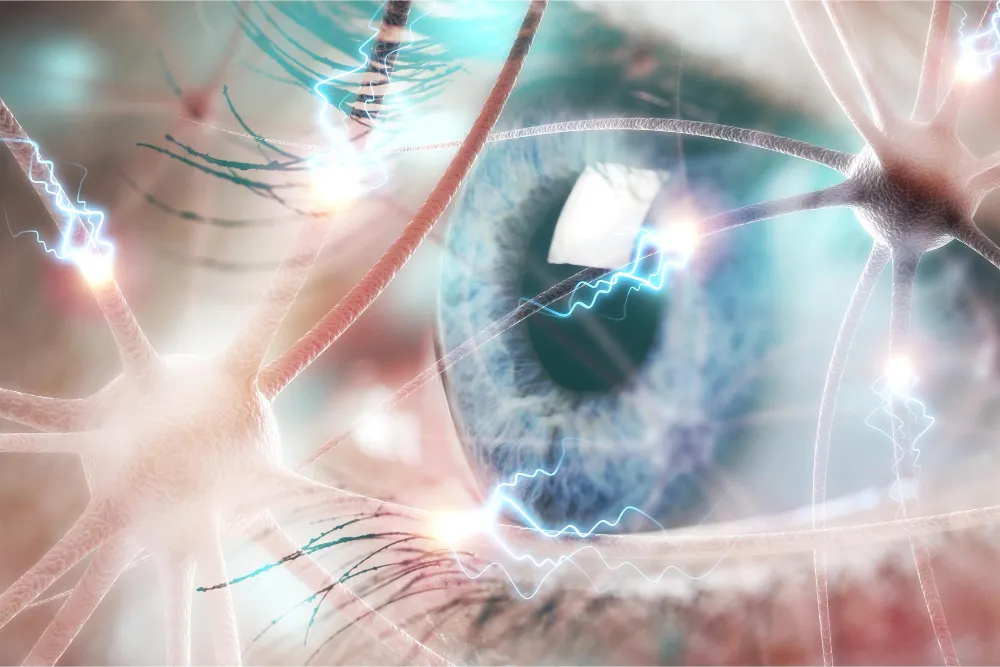
The system pairs a small chip beneath the retina with camera-equipped glasses. The glasses project near-infrared images onto the implant, which converts light into electrical stimulation of surviving retinal cells.
The current chip contains 378 light-powered pixels. It replaces some of the signalling lost when light-sensitive cells deteriorate. The remaining retinal pathways carry the resulting visual information toward the brain.
Science describes the intended benefit as restoring form vision, including the ability to identify letters, numbers and words. This does not mean restoring normal eyesight or reversing the underlying retinal disease.
The PRIMA retinal implant works with glasses that include a zoom feature for magnifying letters. Its reported visual-acuity gains reflect use of the prosthetic system, rather than recovery of unaided natural vision. The technology is intended for selected patients with severe central vision loss, rather than everyone with macular degeneration.
European rollout and U.S. review follow separate paths
PRIMA is CE-marked and has entered commercial use in Europe. Science plans to broaden availability while pursuing U.S. approval through the Humanitarian Device Exemption pathway.
The FDA previously granted two Humanitarian Use Device designations. These establish eligibility for that regulatory route; they do not themselves authorise commercial sale.
The designations cover:
- An advanced subset of geographic atrophy associated with age-related macular degeneration, causing blindness in both eyes without vision loss from other eye diseases.
- Vision loss caused by Stargardt disease, an inherited retinal disorder.
The first designation does not cover everyone with age-related macular degeneration. Science says the qualifying population represents a narrower subset of patients with particularly severe vision loss.
The PRIMA retinal implant still requires FDA review and approval before a U.S. commercial launch. The financing announcement describes preparations for that launch but does not establish an approved U.S. commercial launch date.
Three-year results show gains, with follow-up limits
Science released 36-month follow-up findings from the PRIMAvera trial in October. The study implanted 38 patients at 17 clinical sites across five European countries.
At three years, 27 patients were evaluable for safety and 18 for efficacy. Among the efficacy group, the company reported an average improvement of 29 letters on a standardised eye chart.
Fourteen of those 18 patients achieved an improvement equivalent to at least 15 letters. That represents approximately 78% of the patients assessed for efficacy at three years, rather than 78% of everyone originally implanted.
Science reported no new safety signal between months 12 and 36. Serious adverse events occurred mainly during the first six months after surgery. Three occurred after month 12, with none attributed to the device alone.
The follow-up findings suggest that visual gains persisted among patients assessed at three years. However, efficacy data were available for fewer than half of the original participants, limiting conclusions about the full implanted group.
Funding also supports a separate neural-interface program
Science is also developing a biohybrid neural interface that combines engineered neurons with electronic hardware. This research program targets connections with brain circuits, while PRIMA is implanted beneath the retina.
Part of the Series D proceeds will support that work. Science’s funding announcement identifies biohybrid development as a separate investment alongside PRIMA’s commercial expansion. It does not report clinical results for the biohybrid program comparable to the retinal implant’s patient follow-up.
Science acquired PRIMA from Pixium Vision in 2024, MassDevice reported. The company is now using the new financing to expand European access and support its U.S. approval effort, while continuing development beyond the retinal implant.