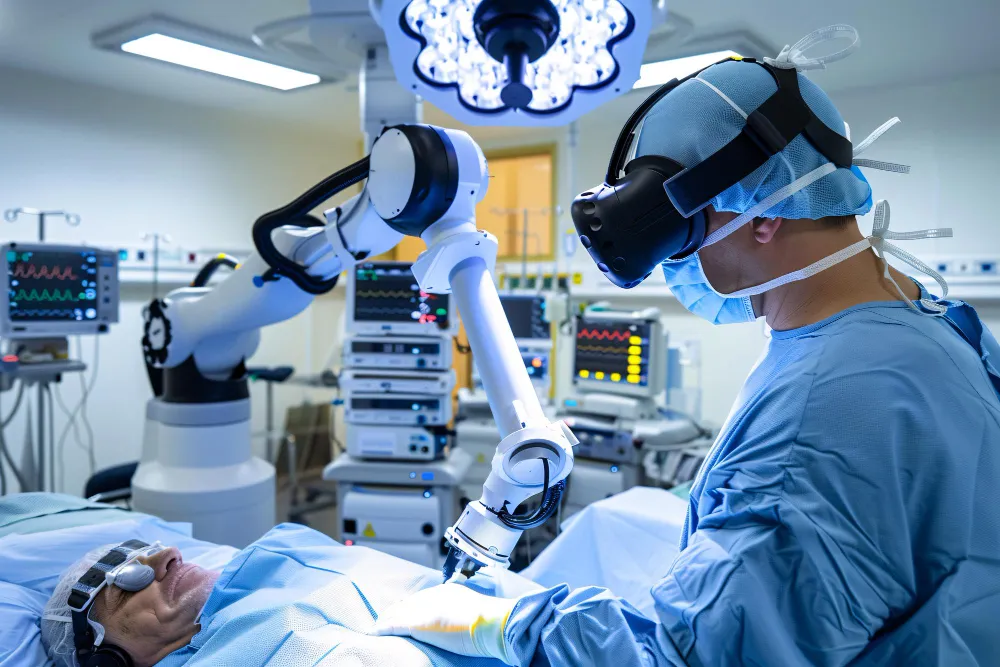
Medtronic’s Hugo robot has received expanded FDA clearance for general surgery, the company announced Nov. 17. The decision extends its U.S. indications beyond urology to upper abdominal general surgery and two specified lower abdominal procedures.
Medtronic estimates that the newly covered procedures represent about 3.5 million operations annually in the United States. That figure describes the potential procedure market, rather than the number of operations performed using Hugo.
Which procedures can the Hugo robot perform?
According to Medtronic’s announcement, the expanded 510(k) clearance covers all upper abdominal general surgical procedures. Examples include gallbladder removal, Roux-en-Y gastric bypass, ventral hernia repair and small bowel resection.
The lower abdominal clearance covers inguinal hernia repair and appendectomy. It should not be read as authorisation for every operation in the lower abdomen or for all surgical specialities.
The scope can be summarised as follows:
-
Upper abdomen: All general surgical procedures in this region, including the examples listed above.
-
Lower abdomen: Inguinal hernia repair and appendectomy.
-
Previous U.S. indication: Urologic surgical procedures, initially cleared in December 2025.
The earlier urology clearance included prostatectomy, nephrectomy and cystectomy, involving removal of prostate, kidney or bladder tissue. Medtronic announced that initial decision on Dec. 3, 2025, establishing the platform’s entry into the U.S. market.
Modular arms and an open surgeon console
The Hugo robot uses separate robotic arm carts that surgical teams can position for the procedure and the patient’s anatomy. Its modular layout allows teams to select the arms needed for a particular operation.
The Hugo robot also has an open console, allowing the surgeon to maintain contact with the operating room team. Medtronic says surgeons can use its LigaSure RAS Maryland vessel-sealing instrument during robotic cases.
Remote consultation is a separate capability from operating on a patient at a distant location. TechAmerica’s coverage of telerobotic surgery describes Hugo’s telepresence support for consultation and training. The general surgery announcement concerns expanded procedural indications, not new telesurgery clearance.
The hernia study provides clinical context.
Medtronic previously reported findings from its Enable Hernia Repair study, which evaluated Hugo in inguinal and ventral hernia procedures. The prospective, multicenter study enrolled 193 patients and used a single-arm design, without a randomised comparison group.
In its September 2025 results announcement, the company reported a 100% surgical success rate against a prespecified 85% performance goal. The study assessed surgical site events separately in the two hernia groups.
Among 92 inguinal patients available for analysis, no surgical site events were reported. Among 94 ventral patients, the rate was 2.1%; the two recorded events resolved without complication, according to Medtronic.
Both groups met the study’s safety benchmark. Those findings concern the study’s defined endpoints and patient groups; they do not establish that Hugo outperforms another robotic platform.
The company also reported mean hospital stays of 4.7 hours for inguinal patients and 6.7 hours for ventral patients. These averages describe this study population, not a guaranteed discharge schedule.
The results also should not be generalised to every procedure covered by the new clearance. A hernia study provides evidence on hernia repair, not direct comparative evidence for gastric bypass or gallbladder surgery.
Expansion brings more procedures into U.S. hospitals
The Hugo robot expansion follows Medtronic’s June 2026 submission of separate applications covering general and gynecologic surgery. That announcement also included an application for the LigaSure robotic instrument, showing how the company has pursued procedural and instrument additions separately.
The FDA is also working on broader surgical robot guidance addressing evidence, testing and labelling for marketing submissions. That guidance process is distinct from clearing a particular device or indication.
Medtronic says a growing number of U.S. hospitals are already using it. MedTech Dive reported that the company expects global procedures to exceed 50,000 by the end of its fiscal year. That remains a company projection, not a total number of completed procedures.