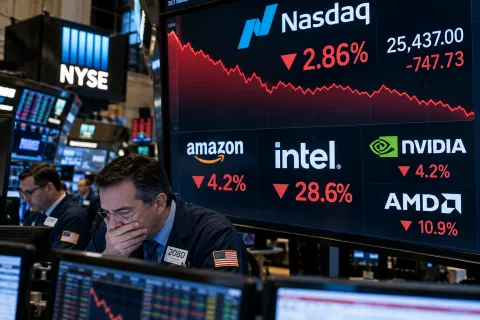
The October tech stock selloff deepened Friday, October 30, as Intel and Reddit each lost about 29% in a punishing final trading session of the month. The Nasdaq Composite posted its steepest daily decline since June, while investors questioned whether the technology industry’s enormous artificial intelligence investments would deliver the profits needed to justify them.
Intel’s plunge followed a disappointing financial outlook that exposed continuing pressure on its chip business. Reddit and memory storage company SanDisk also suffered heavy losses, with SanDisk falling 13%. The selling extended to some of Wall Street’s largest technology companies, turning concerns about AI spending into a broader retreat from stocks.
Intel and Reddit Lead the October Tech Stock Selloff
Intel suffered its sharpest one-day stock decline in decades after forecasting quarterly revenue more than $1 billion below analysts’ expectations. The chipmaker also warned that it did not expect to generate positive cash flow this year. Weakening demand for personal computers and rising memory costs added to concerns about its business outlook.
The decline highlighted Intel’s difficult position. While investment in AI infrastructure continues to drive demand for advanced computing equipment, the benefits are uneven across the semiconductor industry. Intel is also pursuing manufacturing opportunities, including discussions with SK Hynix about potential U.S. memory chip production.
Reddit shares also plunged approximately 29%, making the social media company one of Friday’s most prominent technology-sector casualties. SanDisk, which has benefited from demand tied to AI infrastructure investment, fell 13%. The simultaneous declines showed that selling pressure had spread across businesses with substantially different revenue sources.
Nasdaq Records Its Worst Monthly Performance Since March 2025
The Nasdaq Composite fell 2.9% on Friday to close at 25,437, according to Associated Press market data. The index finished 7.8% below its record close, marking its worst monthly performance since March 2025, as much of the enthusiasm that had supported AI-related stocks earlier in the year weakened in October.
The Nasdaq 100, which tracks major nonfinancial companies, dropped 3.5% during the session. That left it approaching correction territory, generally defined as a decline of at least 10% from a recent peak. The S&P 500 fell 1.8%, while the Dow Jones Industrial Average declined 1.1%.
Microsoft, Meta Platforms, Amazon and Alphabet also came under pressure. Their shares declined roughly 1% to 2% on Friday after experiencing substantial losses earlier in the week. Investors were reassessing the cost of expanding data centers, buying AI chips and building the infrastructure needed to support increasingly demanding AI models.
Big Tech’s AI Spending Raises Questions About Financial Returns
The technology industry’s capital spending has become a central concern for investors. Microsoft, Meta, Amazon and Alphabet accounted for more than one-third of capital expenditure among current S&P 500 constituents over the previous 12 months, according to Capital Economics. The research firm expects their share of spending to increase further.
That concentration creates a financial challenge. Companies are committing enormous sums to computing infrastructure today, while some of the expected revenue and productivity benefits may take years to materialize. As external financing becomes a larger part of these investment plans, investors are paying closer attention to debt, cash flow and the timing of potential returns.
The concerns extend beyond the companies building AI infrastructure. Earlier analysis covered by TechAmerica.ai found that measurable financial gains from AI remained limited across much of corporate America. Apollo Global Management’s chief economist Torsten Slok observed that revenue per employee and profit margins had shown little improvement among S&P 500 companies outside the largest technology businesses.
These findings do not establish that AI investment will fail. They do, however, underline the difference between adopting new technology and demonstrating measurable business value. Investors increasingly want evidence that AI-related spending can produce sustainable revenue growth rather than expand computing capacity.
Market Declines Spread Beyond Technology Stocks
Friday’s losses were not confined to the technology sector. Financial stocks also weakened, with Goldman Sachs falling 4% and Jefferies declining 6%. The broader retreat suggested investors were reducing risk exposure rather than focusing exclusively on companies directly tied to artificial intelligence.
Precious metals experienced significant selling pressure. Silver dropped 6%, leaving it down approximately 31% for 2026, while gold declined 3.5% and was down about 10% for the year. U.S. Treasury securities gained as investors sought relatively safer assets.
Oil prices moved in the opposite direction, rising approximately 2%. Higher energy costs added another concern for an economy in which AI infrastructure development has become an important source of investment activity. Bitcoin also fell about 3% after reports of a major security breach at cryptocurrency exchange Binance.
The combination of falling equities, weaker precious metals and pressure on cryptocurrencies reflected an unusually broad reassessment of risk. It also demonstrated how a reversal in technology-sector sentiment can coincide with sharp moves across other financial markets.
What the Selloff Means for AI Stocks in November
The October decline raises an important question about the AI investment boom’s durability. Technology companies continue to expand their infrastructure commitments, but markets are becoming less willing to reward spending plans without clearer evidence of financial returns.
Some market participants view the recent losses as a correction following an extended rally rather than evidence of a systemic financial problem. Others are concerned that dependence on increasingly expensive AI infrastructure could pressure corporate cash flow and leave highly valued technology shares vulnerable to further declines.
The distinction will become increasingly important as investors evaluate corporate earnings, spending forecasts and financing arrangements. Companies that can connect AI investment to measurable revenue growth may prove more resilient than businesses whose valuations depend mainly on expectations of future demand.
November trading will test investor confidence again. The immediate concern is not whether artificial intelligence will remain an important technology, but how quickly the companies financing its expansion can turn that investment into durable profits. Until that becomes clearer, technology stocks could remain sensitive to disappointing earnings and changes in capital spending plans.
The market figures and investor commentary in this report are based on Reuters reporting published October 30, 2026, alongside independently reported market closing data.