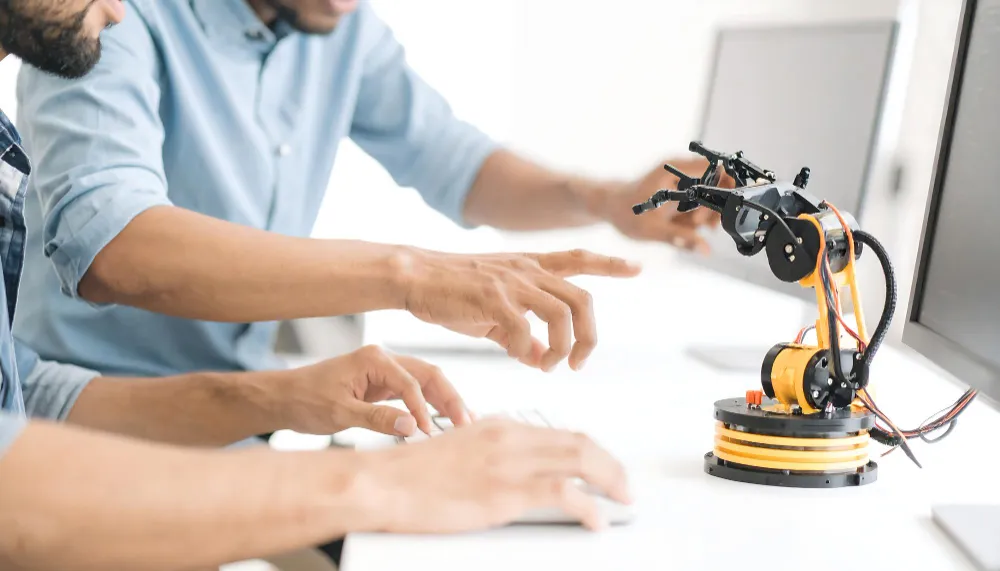
How do you prove a robot can learn a new skill instead of repeating a programmed movement? In June 2026, the National Institute of Standards and Technology highlighted a global robotics testing initiative in which machines perform increasingly difficult manipulation tasks. The tests include inserting pegs into progressively smaller holes, with human experts checking AI-generated scores.
The initiative highlights a central challenge facing robot foundation models: translating learned intelligence into reliable physical action. Researchers are developing systems that learn from video, language instructions, and robot demonstrations rather than requiring separate programming for every task. The potential benefits span factory automation and warehouse operations, but unfamiliar objects, unpredictable environments, and safety requirements remain major obstacles.
What Are Robot Foundation Models?
Robot foundation models are machine learning systems trained on diverse information to support multiple robotic tasks. Instead of developing a separate model for every activity, researchers aim to create reusable AI capabilities that can be adapted to different operations.
The concept draws from foundation models used in language and computer vision. However, robotics introduces an additional requirement: the system must translate information into physical actions.
A robot may need to recognize an object, estimate its position, determine how to grasp it, and adjust its movements during contact. Each step depends on both software intelligence and the physical machine’s capabilities.
This research falls under the broader field of embodied AI, which examines intelligence operating through physical systems. The National Institute of Standards and Technology is studying these capabilities through its Physical AI and Data Generation for Robotics project. The work focuses on evaluating AI-enabled robotics and developing practical testing methods for manufacturing environments.
How Robot Foundation Models Learn New Tasks
Learning a physical skill requires more than recognizing an object or understanding a spoken instruction. A robotic system must connect what it observes with the movements needed to accomplish a goal.
Researchers use several complementary learning methods to develop these capabilities. The training process may combine recorded demonstrations, robot sensor data, simulated environments, and feedback from previous attempts.
Learning From Human Demonstrations
Imitation learning allows robots to learn from examples of successful actions. A human operator might demonstrate how to pick up an object, open a drawer, or arrange items on a work surface.
The system analyzes observations alongside the actions performed during each demonstration. It then learns a policy to select movements when similar conditions arise.
Demonstrations can come from teleoperated robots, where humans remotely control robotic hardware. Video recordings may also provide useful information, although ordinary video often lacks the precise action and force measurements available from robot sensors.
Training data remains a major development challenge. As TechAmerica.ai previously reported, robotics researchers are exploring large-scale collections of human demonstrations and robot movements to support more adaptable systems.
Vision-Language-Action Models
Vision-language-action models, commonly called VLA models, connect visual observations and language instructions with robot actions. A system may interpret a request such as placing a bottle on a shelf, locate the relevant objects, and generate movements toward the goal.
Visual information can come from cameras or other sensors. Language describes the intended task, while the action component produces commands that suitable robotic controllers can execute.
These models do not automatically understand every physical constraint. Successful execution still depends on object geometry, available sensor information, motion control, and the robot’s mechanical capabilities.
Researchers must also account for changing conditions. A bottle can move unexpectedly, a surface may become obstructed, or an object may slip during handling. The system needs feedback to recognize these changes and respond appropriately.
Reinforcement Learning and Simulation
Reinforcement learning offers another approach to acquiring robotic skills. A system attempts actions and receives feedback based on how well those actions achieve a specified objective.
The U.S. National Science Foundation explains this approach in its reinforcement learning research overview. The technique can help robots improve movement and decision-making through experience rather than relying entirely on predefined instructions.
Simulation lets researchers run many training experiments without repeatedly using physical hardware. Virtual environments can represent objects, obstacles, and robot movements while reducing some testing costs and risks.
However, simulated results do not always transfer successfully to real machines. Differences in friction, lighting, object properties, and sensor behavior can produce unexpected outcomes. Researchers must evaluate how well learned skills hold up under these differences.
Can One AI Model Control Different Robots?
One important research objective is cross-embodiment learning. This involves developing models that can transfer useful knowledge between robots with different bodies, sensors, and movement capabilities.
A robotic arm, wheeled mobile manipulator, and humanoid robot do not operate the same way. Their joints, reach, balance requirements, and available actions differ. A movement appropriate for one machine may be impossible for another.
Foundation models may learn shared representations of objects, tasks, and physical relationships. Robot-specific controllers can then translate high-level intentions into movements compatible with the available hardware.
Cross-robot transfer remains an active research challenge, not a guaranteed capability. A model that works well on one robotic arm may still need adaptation, calibration, or additional training to work on another machine.
Related research on world models also explores how robots can represent physical environments and anticipate changes. TechAmerica.ai has covered world-model technology for humanoid robots, including using video and physical-environment information to support skill development.
Where General-Purpose Robot Learning Could Be Useful
Manufacturing is a practical area for developing adaptable robotic capabilities. Factories often need machines to handle objects, perform assembly operations, or adapt to production changes. Conventional automation works well for predictable tasks, but variation can require additional programming.
AI-enabled robotics could reduce that effort when trained systems prove reliable enough. Potential applications include handling different parts, sorting materials, and assisting with assembly processes.
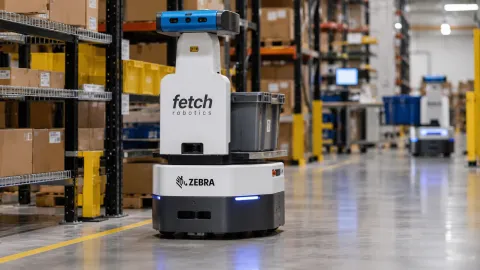
Warehousing presents related opportunities. Robots may need to identify products, manipulate packages, and navigate changing environments. Greater adaptability could help with operations involving items that differ in size, shape, or placement.
Assistive robotics is another research area. Systems that can learn personalized tasks could support people with mobility limitations. However, assistive applications demand careful evaluation because errors may directly affect users.
Household robotics remains especially challenging. Homes contain irregular objects, changing layouts, pets, and unpredictable human activity. Completing one demonstration task does not prove a robot can operate safely throughout an entire household.
The most useful applications will depend on measurable performance, operating cost, and task requirements. General-purpose learning may offer flexibility, but specialized machines can remain more practical for repetitive operations.
Why Reliability and Safety Remain Major Challenges
A robot’s ability to perform a task during testing does not guarantee reliable performance in unfamiliar conditions. Changes in object shape, weight, lighting, or position can affect how a model behaves.
Researchers are investigating these weaknesses through systematic testing. A 2025 robotics study published by NIST examined how changes to object geometry can expose failures in learned manipulation policies.
The study showed that policies that perform well under familiar conditions can fail when presented with certain modified object shapes. It also explored how targeted additional training could improve performance on identified failure cases.
Physical safety introduces requirements that ordinary software applications do not have. A robot may exert force, collide with equipment, or accidentally contact a person. An incorrect action can cause damage even when the AI model appears to understand the task.
Safety therefore depends on more than model accuracy. Robots need appropriate sensing, motion limits, emergency stopping capabilities, and protective controls suited to their working environments.
NIST’s robotic grasping and contact safety research addresses performance measurements and testing methods for manipulation systems. This evaluation matters when determining whether emerging capabilities are suitable for practical use.
How Researchers Measure Robot Learning Performance
Reliable evaluation requires more than counting successful demonstrations. Researchers must measure performance across repeated attempts, unfamiliar objects, and varying operating conditions.
Useful measurements include task completion rates, execution time, positioning accuracy, error recovery, and skill transfer. Safety-related measures become essential when machines interact with people or delicate equipment.
Standardized testing can make results easier to compare. NIST is developing a humanoid robot performance benchmark covering mobility, manipulation, coordination, and basic task understanding.
The benchmark is a developing evaluation effort, not proof that general-purpose humanoid robots have achieved human-level capabilities. It aims to establish comparable measurements for researchers and manufacturers.
Consistent testing can also help distinguish model improvements from hardware advantages. Strong results on a single task should not be treated as evidence of broad physical intelligence.
A Practical Roadmap for Evaluating Robot Foundation Models
Organizations interested in adaptable robotics can begin with a limited operational problem rather than immediately pursuing general-purpose automation. A structured evaluation helps determine whether the technology offers advantages over established robotic systems.
1. Identify a Suitable Physical Task
Select an operation involving meaningful variation, such as handling differently shaped objects or adapting to changing workstations. Document the current process and identify where conventional automation struggles. Establish measurable performance and safety requirements.
2. Assess Hardware, Training, and Data
Review the robot’s sensors, mechanical capabilities, control interfaces, and available demonstrations. Determine whether the intended model supports the required hardware. Evaluate the quality and relevance of training examples before beginning adaptation.
3. Test in Simulation and Controlled Environments
Use representative scenarios to assess task execution, error recovery, and sensitivity to changing conditions. When appropriate, run simulation tests before physical trials. Introduce real-world testing gradually with suitable safeguards and human supervision.
4. Measure Results Before Expanding Deployment
Compare the system with existing automation using task success, reliability, operating costs, and intervention requirements. Record failures and identify whether they arise from perception, planning, motion control, or hardware limitations.
Expand deployment only when evidence supports the decision. Safety-critical applications may require additional engineering assessment, formal testing, and compliance with relevant equipment requirements.
The Future of Robot Foundation Models
Future development will likely focus on improving how robots transfer knowledge across tasks and physical environments. Better training data, learning algorithms, and evaluation methods could reduce the amount of task-specific programming needed for some applications.
More capable vision-language-action models may also help connect natural language instructions with complex physical operations. However, understanding an instruction and executing it reliably remain separate engineering challenges.
Research into simulation, world models, and learning from human demonstrations could make skill acquisition more efficient. Progress will depend on whether improvements demonstrated in controlled settings can transfer to unfamiliar real-world conditions.
Hardware will remain important. Robotic hands, tactile sensors, actuators, and control systems determine what a machine can physically do. More sophisticated AI cannot compensate for every mechanical limitation.
Standardized evaluation and safety research may become increasingly important as companies explore deployment beyond factories and laboratories. Organizations will need evidence of reliable performance rather than isolated demonstrations of success.
Robot foundation models offer a promising path to more adaptable machines, but general-purpose robotics remains an unfinished engineering goal. Their long-term value will depend on whether robots can learn useful new tasks, handle unexpected conditions, and operate safely at costs that justify real-world deployment.