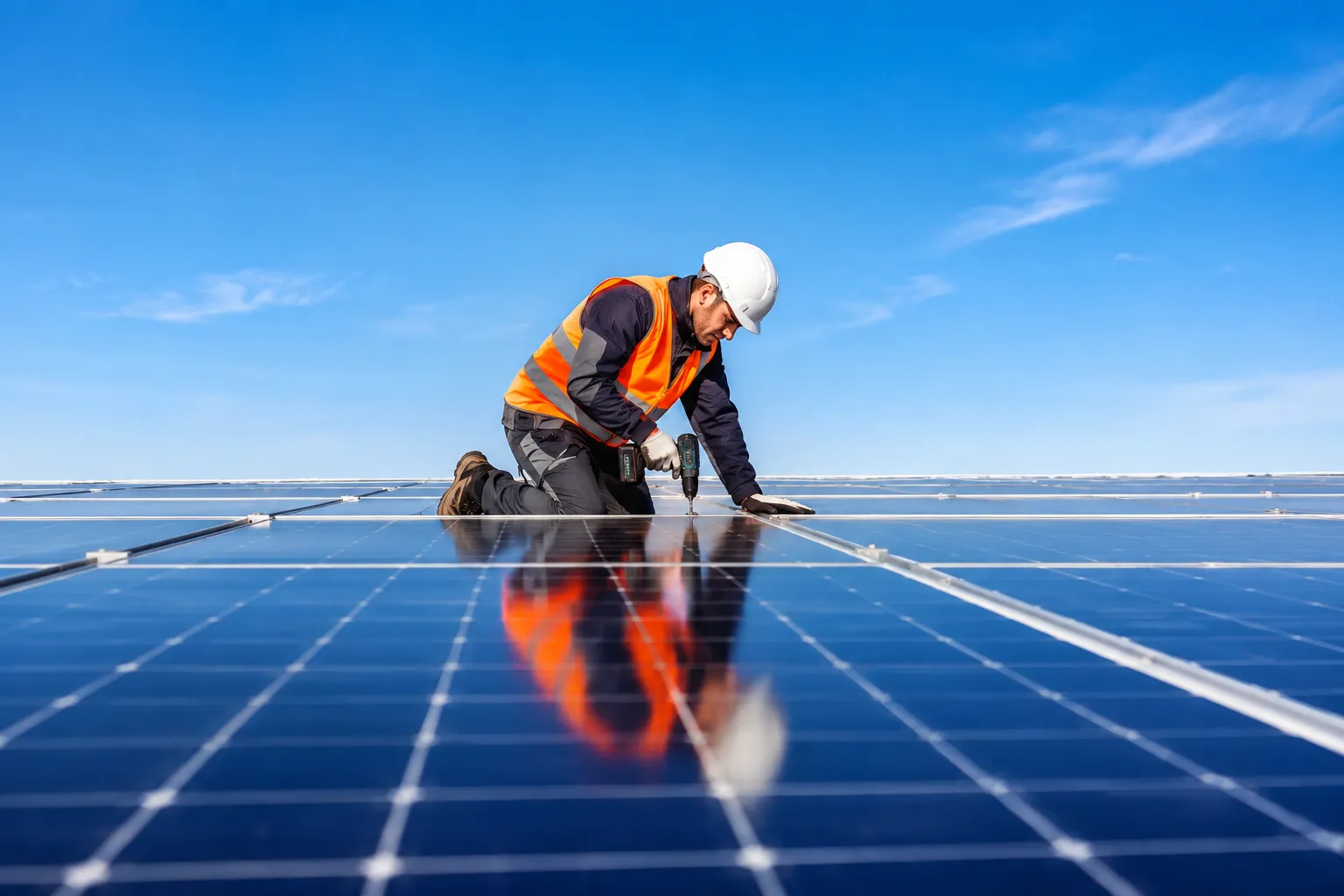
Solar power for AI data centers could become a practical alternative to natural gas as electricity demand accelerates. Brook Porter, a partner at G2 Venture Partners, believes combining solar generation with long-duration batteries could help developers build large computing facilities faster.
G2VP, an early investor in AI infrastructure company Crusoe, estimates that global data center investment could exceed $4 trillion through 2030. The firm sees an opportunity to develop facilities that operate independently of traditional electricity grids.
Solar power for AI data centers offers a scalable option
Porter argues that solar manufacturing can expand faster than conventional power generation. He estimates annual global solar manufacturing capacity exceeds one terawatt, compared with roughly 60 to 70 gigawatts for natural gas turbines.
The economic argument relies partly on Wright’s Law. As Our World in Data explains, manufacturing costs often decline as cumulative production increases.
Solar panels have followed this pattern for decades. Their modular design also allows developers to expand generating capacity incrementally.
TechAmerica previously covered Crusoe’s decision to abandon a $1.25 billion gas turbine agreement, highlighting changes in its energy strategy.
Long-duration batteries address power reliability
Solar generation varies throughout the day and cannot independently supply electricity around the clock. Battery storage can bridge periods when sunlight is unavailable.
Form Energy is developing iron-air batteries designed to store electricity for up to 100 hours. Its technology targets extended periods when renewable generation is limited.
TechAmerica also reported on Form Energy’s $750 million funding round and its agreement to supply storage systems for Crusoe’s AI infrastructure.
Another approach comes from Antora Energy, which stores electricity as heat in solid carbon blocks. Its thermal batteries are designed to deliver industrial heat and electricity.
Off-grid data centers face economic challenges.
Porter expects two approaches to emerge: smaller facilities connected to existing grids and larger campuses supported by dedicated renewable generation.
Off-grid development could reduce delays associated with grid connections. However, developers must account for storage capacity, seasonal weather, land requirements and backup power.
Long-duration storage technologies also need broader commercial deployment before their costs and reliability can be assessed at hyperscale.
G2VP’s proposal reflects growing interest in modular power infrastructure. Its economic advantages will depend on project location, financing and the ability to deliver uninterrupted electricity.