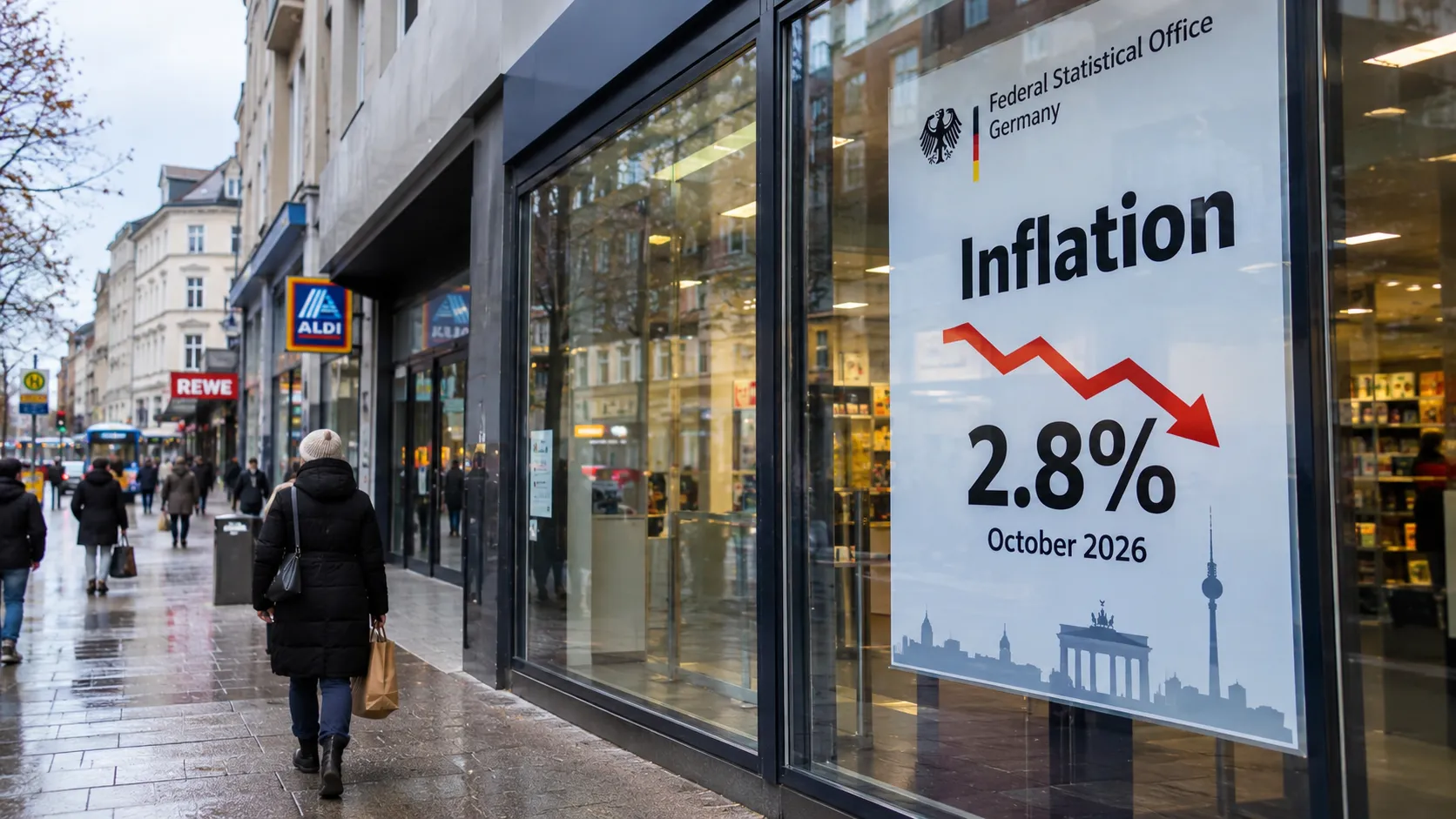
German inflation slowed more than economists expected in October 2026, falling to 2.8% from 3.3% in September. The decline followed a temporary government fuel tax cut that helped lower pump prices, while broader energy costs continued to rise.
The preliminary figures, published Friday by Germany’s Federal Statistical Office, came in below the 3.1% inflation rate forecast by economists surveyed by Reuters. Consumer prices also declined 0.2% from September, providing some relief after inflation reached its highest level of the year.
German Inflation Eases as Energy Price Growth Slows
Energy remained a major contributor to Germany’s inflation rate, but its impact weakened in October. Energy prices were 12.2% higher than a year earlier, compared with a 14.9% annual increase in September. The slowdown helped bring the overall inflation rate below 3%.
Germany introduced a temporary fuel tax reduction at the beginning of October, scheduled to remain in place through December. The resulting decline in pump prices contributed to the lower inflation reading, although energy remained considerably more expensive than a year earlier.
Underlying price pressures also eased. Core inflation, which excludes food and energy, declined to 2.1% from 2.4% in September. Services inflation slowed to 2.5%, while food prices increased just 0.4% from a year earlier.
European Central Bank Faces Continuing Inflation Risks
Germany’s inflation figures arrived shortly after the European Central Bank left interest rates unchanged on Thursday. Despite the improvement in German consumer prices, the central bank remained concerned about persistent energy costs and the possibility of further inflation across the eurozone.
According to Reuters, economists expected eurozone inflation to rise to 3.9% in October from 3.8% in September. The ECB also signaled that another interest rate increase could come in December as policymakers assessed the risks from elevated energy prices.
The contrast highlights an important challenge for monetary policy. Germany’s inflation rate has moderated, but price pressures across the wider currency bloc may require a different response. The ECB must assess whether falling inflation in individual economies represents a lasting improvement or a temporary change driven by government measures.
What the October Figures Mean for Germany
Lower inflation offers some relief to German households after September’s sharp increase in consumer prices. However, slowing inflation does not mean prices have returned to earlier levels. The October reading still indicates that goods and services cost more overall than they did a year ago.
The temporary fuel tax cut also creates uncertainty about how long the improvement will last. If energy prices remain elevated after the measure expires, inflation could face renewed upward pressure. Germany’s final October inflation figures are scheduled for release on November 11, 2026, providing a clearer picture of consumer price developments ahead of the ECB’s next policy decisions.