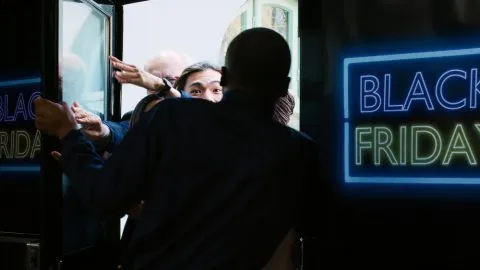
Black Friday falls on November 27 this year, and federal consumer protection officials are warning Americans to scrutinize the shopping ads they encounter online. In a November 2026 consumer alert, the Federal Trade Commission (FTC) warned that fraudulent sellers can buy search ads that appear alongside legitimate retailers.
The annual event takes place against a backdrop of substantial online spending. In its November 19 report, the U.S. Census Bureau estimated third-quarter retail e-commerce sales at $347.3 billion, up 1.6% from the previous quarter after seasonal adjustment. Online sales represented 17.9% of total retail sales in the quarter. The estimates are not adjusted for price changes. The figures cover the entire quarter and are not Black Friday sales totals.
The event offers shoppers a chance to buy holiday gifts and household goods at reduced prices. But retailers set their own prices, sale dates and purchase conditions. A large advertised discount does not necessarily make an item the cheapest option.
What is Black Friday and when does it take place?
Black Friday is the shopping event traditionally held on the Friday after Thanksgiving in the United States. Thanksgiving falls on the fourth Thursday of November, according to the federal holiday calendar. That puts Black Friday on November 27, 2026.
No national requirement forces retailers to participate, and Black Friday is not a federal holiday. A business can begin its campaign before Thanksgiving, limit it to particular stores or continue it through the following week. The calendar date identifies the traditional event rather than establishing universal opening hours or a legally mandated sale period.
| Shopping event | 2026 date | Typical focus |
|---|---|---|
| Thanksgiving | November 26 | Federal holiday; some retailers run promotions |
| Black Friday | November 27 | Online and in-store retail offers |
| Cyber Monday | November 30 | Traditionally online-focused offers |
Where the Black Friday name came from
The shopping-related expression has roots in Philadelphia. A historical account published by the Library of Congress traces its use to the congestion of the post-Thanksgiving shopping period in the 1960s or 1970s. That account does not firmly establish the exact origin and earliest use.
The term eventually lost much of its negative association as retailers adopted it to market seasonal sales. The modern explanation that stores move from losses into profits is a popular interpretation, but it should not be treated as a proven origin of the shopping event.
Today, the name refers to an established commercial tradition rather than a single nationwide sale organized by one institution.
How Black Friday discounts work
Retailers determine which products to discount based on inventory, competition, supplier arrangements and commercial objectives. A business may accept a smaller margin on one product to draw customers into the store, where they might also buy accessories or other merchandise.
Promotional offers can take several forms:
- Direct price reductions: The seller lowers the advertised purchase price for a specified period.
- Doorbusters: Particularly low prices may be restricted to a small quantity of products.
- Flash sales: An offer expires at a stated time or when available stock runs out.
- Bundles: A discount applies when customers purchase a combination of products.
- Conditional offers: Eligibility may depend on membership, a coupon, a minimum purchase or another disclosed condition.
Consider a laptop advertised at $750 against a reference price of $1,000. The advertised reduction is $250, or 25%. But if the same laptop ordinarily sells elsewhere for $720, the promotional percentage alone does not establish that it is the better purchase.
The FTC’s guidance on former price comparisons explains that an advertised former price should be a genuine price at which the product was offered regularly for a reasonably substantial period. An artificially inflated reference price can make an ordinary selling price look like a bargain. This guidance does not guarantee that a sale price is the lowest available.
For shoppers, the relevant comparison is the actual cost of the same product under comparable conditions. Taxes, shipping, required subscriptions and accessories can all affect the amount ultimately paid.
Why Black Friday matters to American retailers
The holiday shopping season allows businesses to attract customers who are already planning purchases. Retailers may also use promotions to reduce existing inventory ahead of new product launches or seasonal changes.
The period’s importance extends beyond individual stores. Warehouses, payment services, delivery networks and customer support operations all help process and fulfill orders. Historical Census Bureau analysis explains the significance of seasonal retail activity to businesses and employment.
Online shopping has changed how this competition unfolds. Customers can compare offers without traveling between stores, while sellers can adjust promotions throughout the day. The latest quarterly e-commerce figures provide context for that market, but they cannot establish how much Americans will spend on November 27. Final event-specific spending remains unknown at the November 26 reporting cutoff.
What technology shoppers should check before buying
Electronics present a particular challenge because visually similar products can have different specifications. Two televisions with the same screen size may differ in panel technology, refresh rate or connectivity. Two laptops may share a product name but offer different processors, memory and storage capacities.
Check the exact model number, configuration, condition and warranty before comparing prices. A refurbished device may be a reasonable choice, but its price should not be compared with a new unit without acknowledging the difference.
Smart home devices and other connected products can also involve ongoing expenses. A required service plan or subscription may offset a lower initial price. Buyers should establish which features work without additional payments and whether the device is compatible with equipment they already own.
Black Friday versus Cyber Monday
Black Friday and Cyber Monday were traditionally associated with store-based and internet-based promotions, respectively. A Census Bureau overview describes both as part of the wider holiday retail period.
That distinction is less useful when sellers offer discounts through their websites and physical stores on the same day. A promotion may continue across the weekend, change before Monday or end as soon as stock is depleted.
Waiting for Cyber Monday can therefore produce a different price, but it does not guarantee a better one. Customers should evaluate the available offer against their budget and product requirements rather than assume one shopping day is consistently cheaper.
How to recognize genuine savings and avoid online scams
Fraudulent shopping ads can direct customers to websites designed to collect payments or personal information. Some imitate familiar stores, making it difficult to distinguish a legitimate offer from a scam at first glance.
Consumers should independently confirm that a website belongs to the intended retailer. An advertisement appearing prominently in search results is not a substitute for checking the seller. Unexpectedly cheap offers from unfamiliar websites deserve additional scrutiny.
The FTC’s online shopping guidance also recommends checking product details, delivery charges and the seller’s return arrangements. A credit card may offer useful dispute protections if an order doesn’t arrive, or a transaction is unauthorized.
- Compare identical products and record the final checkout price.
- Read restrictions on returns, exchanges and refunds before ordering.
- Check whether the seller is the retailer itself or an independent marketplace merchant.
- Avoid sellers that insist on gift cards, wire transfers or cryptocurrency as payment.
- Keep order confirmations, receipts and screenshots of important offer terms.
A countdown timer or limited-stock message can make a purchase feel urgent. Neither establishes that the product is necessary or that its price is unusually low. A shopper who has already chosen a suitable product and set a spending limit is better positioned to assess an offer without relying on promotional claims.
A sale is worth considering when the product meets a real need, the total price is competitive,e and the seller is reliable. The discount size is only one part of that decision.
Key dates, pricing questions and consumer protection advice for the 2026 U.S. holiday shopping season.
When is Black Friday 2026 in the United States?
Black Friday is November 27, 2026, the day after Thanksgiving. Cyber Monday follows on November 30.
Why is it called Black Friday?
The Library of Congress connects the shopping-related name to congestion in Philadelphia after Thanksgiving. Its exact earliest use is uncertain.
Is Black Friday a federal holiday?
No. Thanksgiving is a federal holiday, but the following Friday is not on the standard federal holiday calendar. Business hours vary.
Do Black Friday sales start before Friday?
They can. Each retailer sets its own schedule, and promotions may start before Thanksgiving or continue through Cyber Monday.
Are Black Friday deals always cheaper?
No. Compare the same product and its total checkout cost across sellers. A discount based on a former price is meaningful only if that reference price is genuine.
Is Black Friday or Cyber Monday better for electronics?
Neither day guarantees lower prices. Compare the exact model and configuration across available offers, taking delivery, warranty and return terms into account.
How can I avoid Black Friday shopping scams?
Visit the seller’s website independently rather than relying on an unfamiliar search ad. Check return terms, pay by credit card when possible and retain receipts. Report suspected fraud at ReportFraud.ftc.gov.
Have another question about this story? Email the newsroom.