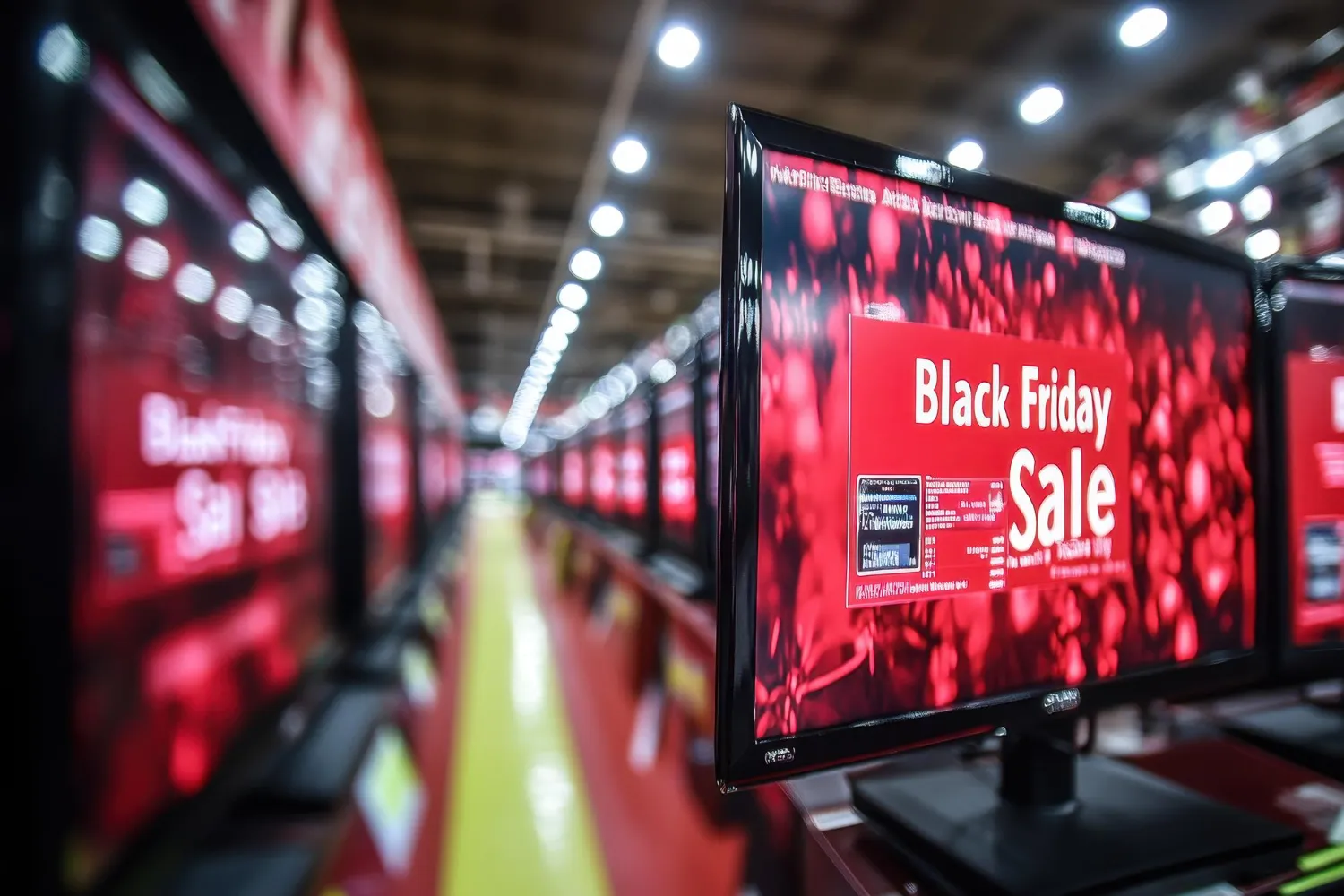
Two 65-inch televisions can carry the same 4K label and cost hundreds of dollars apart. The cheaper screen may suit a bedroom perfectly, yet struggle with reflections or fast-moving sports in a bright living room. Black Friday TV deals make those differences particularly important on November 27, 2026.
American shoppers face another complication this holiday season: fraudulent shopping advertisements. In a November consumer alert, the Federal Trade Commission warned that deceptive paid search results can lead buyers to fake stores. A convincing television listing is not evidence that the seller is legitimate.
For buyers comparing Black Friday TV deals, the useful starting point is the room, the content they watch and the equipment they already own. A larger discount cannot compensate for a screen that performs poorly in its intended setting.
OLED, QLED and Mini-LED are not interchangeable
OLED panels generate light at individual pixels. They can switch those pixels off to produce deep blacks, which makes them attractive for movies in darker rooms. Brightness varies by model, and prolonged exposure to static images can contribute to uneven pixel wear.
Most televisions marketed as QLED use an LCD panel with quantum dots and an LED backlight. Quantum dots help reproduce colors, but the label alone doesn’t indicate contrast or brightness. Mini-LED describes a backlight with smaller LEDs, often arranged into independently controlled zones. A television can use both quantum dots and Mini-LED lighting.
These distinctions matter when Black Friday TV deals place several display types in the same price bracket. Local dimming performance, reflections and viewing angles can differ significantly even within one display category.
| Display type | Potential advantage | What to inspect |
|---|---|---|
| OLED | Deep blacks and pixel-level light control | Brightness, reflections and static-image use |
| Quantum-dot LCD (QLED) | Color performance and varied price ranges | Backlight design and contrast |
| Mini-LED LCD | Potentially strong brightness and local dimming | Light halos, viewing angles and dimming behavior |
| Conventional LED LCD | Often suitable for basic viewing | Uniformity, contrast and reflections |
The table describes general engineering trade-offs, not laboratory results for individual televisions. No display technology guarantees superior picture quality in every room.
Why 4K and HDR do not settle the comparison
A 4K UHD television typically displays 3,840 by 2,160 pixels. Resolution describes image detail, not color accuracy or contrast. A lower-priced 4K television may therefore look different from a premium screen showing the same material.
High dynamic range (HDR) describes the ability to represent a wider range of light and color. Accepting an HDR signal does not guarantee that a panel can reproduce bright highlights convincingly. Brightness, black levels and tone mapping all influence the result.
When evaluating Black Friday TV deals, shoppers should also check the quality of lower-resolution content. A large television can make compression artifacts in some broadcasts more visible. Screen size should reflect seating distance and available space, not simply the largest discount.
Sports and gaming need different specifications.
A native 60 Hz panel refreshes up to 60 times per second, while a native 120 Hz panel can refresh up to 120 times per second. Marketing terms for motion enhancement do not necessarily reflect the panel’s native refresh rate.
For compatible gaming systems, 4K at 120 Hz and variable refresh rate can improve the experience. Check which inputs support those features and whether the television accepts the required signal. Input lag also matters for responsive controls. Sports viewers may care more about motion clarity and screen uniformity.
Black Friday TV deals aimed at gamers deserve extra scrutiny because a feature advertised for one input may not be available on every port. Buyers should count the connections needed for consoles, audio equipment and streaming devices before ordering.
The electricity bill belongs in the price comparison
The federal ENERGY STAR television guidance provides a starting point for comparing efficiency. The FFTC’sEnergy Labeling Rule also covers televisions.
Consider two hypothetical models with estimated annual consumption of 110 and 200 kilowatt-hours. At an illustrative electricity rate of 16 cents per kilowatt-hour, their annual energy costs would be $17.60 and $32.00. The difference reaches $72 over five years if consumption and rates stay constant.
Actual costs depend on viewing hours, settings and local electricity rates. The example does not represent a national rate or a measured product. It shows why Black Friday TV deals should be evaluated beyond the initial purchase price.
Read the model number before checking out.
Similar product names can conceal different panels, connections or included accessories. The FTC’s online shopping guidance recommends identifying the exact item when comparing offers. Confirm the full model number and size, then review delivery charges and any installation costs.
Check the written warranty for coverage and exclusions. For open-box or refurbished equipment, establish the condition and included stand or remote. The CPSC recall database is another useful check, particularly for older equipment.
Our separate Black Friday and Cyber Monday comparison explains the timing decision. For television buyers, however, the deciding factor is whether the screen meets their needs at the final price. Black Friday TV deals are worth considering when you can confirm the exact specifications, seller, and purchase terms. No live retailer prices or independent product tests are claimed in this analysis.
Technical answers for U.S. holiday television shoppers.
Is OLED or QLED better for a bright room?
It depends on the individual television. Compare sustained brightness, reflection handling and viewing angles rather than relying on the display label alone.
Does a Mini-LED TV always have better contrast?
No. Backlight zone design, panel characteristics and dimming software influence contrast and visible halos.
Is a 120 Hz TV necessary for watching movies?
No. A 60 Hz television can display movies, although motion handling and film cadence vary by model. A 120 Hz panel can be useful for compatible games and some motion-processing options.
Does HDR compatibility guarantee good HDR picture quality?
No. Signal support is only one factor. Panel brightness, contrast, color capability and tone mapping affect the visible result.
How can I compare energy costs for two televisions?
Compare their estimated annual electricity consumption under equivalent conditions and multiply by your local electricity rate. Actual costs depend on settings and viewing habits.
Have another question about this story? Email the newsroom.