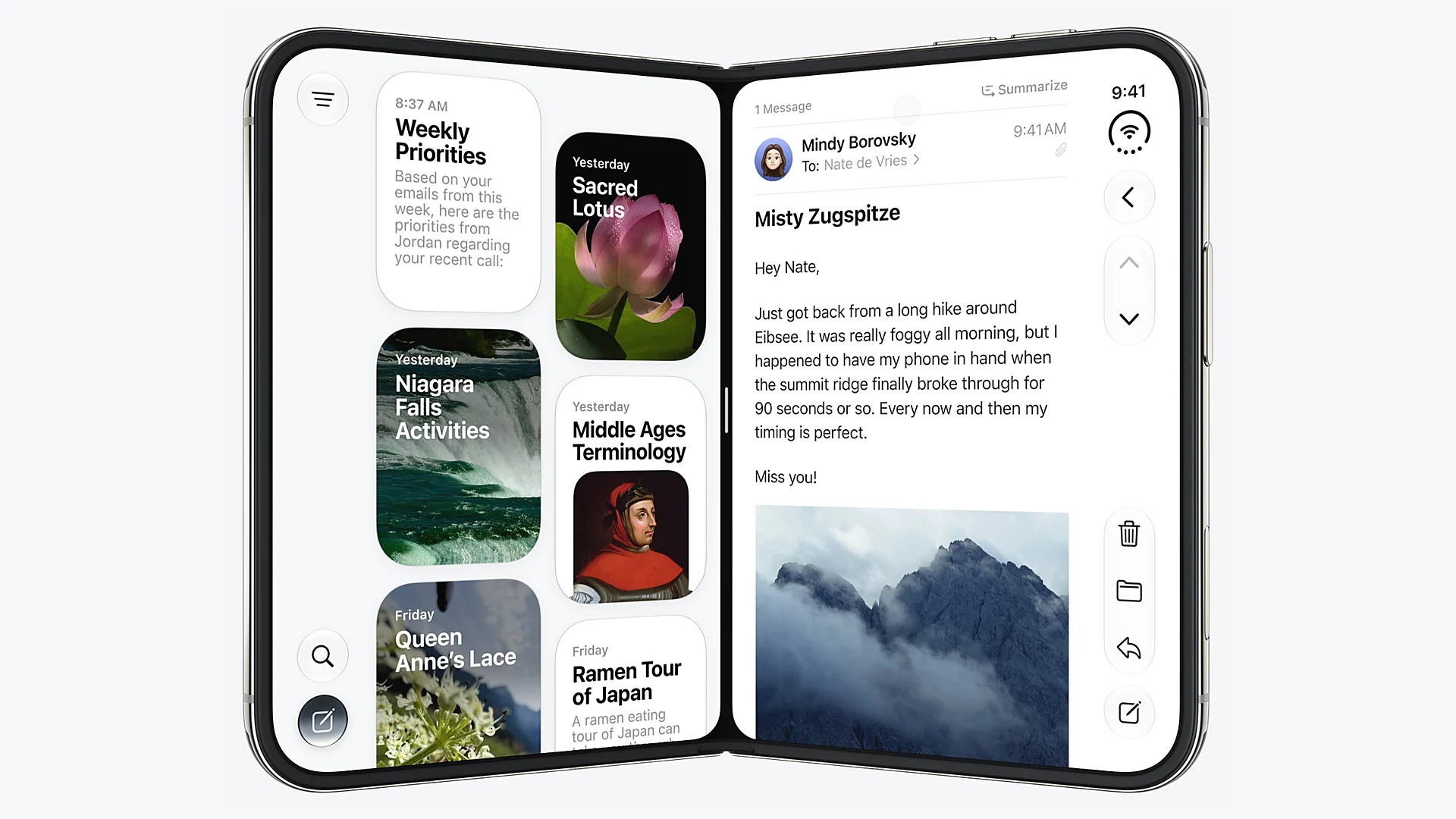
The iPhone Duo foldable technology combines a flexible 7.6-inch OLED, precision hinge, and smaller outer screen. Its software changes as the phone opens. Apple launched its first folding iPhone in October 2026, but the important engineering story extends beyond the larger screen. Its display layers must survive repeated bending. Meanwhile, the processor, batteries, cameras, and operating system serve two physical configurations.
Apple’s official specifications identify a 5.4-inch outer display, the A20 Pro processor, dual rear cameras, and two internal batteries. The hardware also carries compromises: a 254-gram body and no dedicated telephoto lens. The flexible inner surface needs careful handling. This analysis uses manufacturer documentation and independently reported repair findings; it is not a hands-on performance review.
The hinge and OLED layers are the heart of the design.
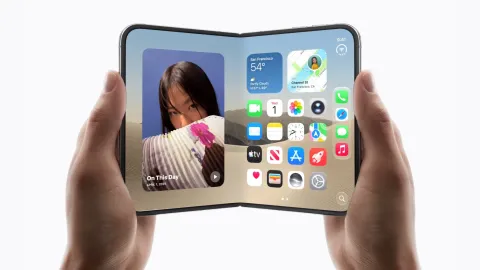
Most smartphones protect a rigid display panel under a comparatively stiff glass cover. A folding phone needs an assembly that bends repeatedly. The connections driving its pixels must remain intact. Apple uses a 7.6-inch folding Super Retina XDR OLED. It has 1878-by-2670 resolution and a stated 430 pixels per inch. Its external 5.4-inch OLED runs at 1398 by 2034 pixels and 460 ppi.
Apple describes more than 10 ultrathin inner-display layers. High-strength glass, a protective polymer layer, nano-textured finishing, and carefully selected adhesives each serve a different function. Flexible adhesive interfaces let layers move slightly during bending. That reduces concentrated strain, but it does not eliminate all mechanical stress or guarantee that the fold remains invisible.
The grade 5 titanium frame and hinge cover provide structural support. Apple says the hinge contains more than 100 components, with supports beneath the center of the folding panel and magnets assisting closure. In practical terms, the hinge must guide the screen through a controlled bend, keep the open surface supported, and avoid transferring excessive point pressure into fragile display layers.
Both screens support adaptive refresh rates up to 120Hz, Always-On functionality, and a stated peak outdoor brightness of 3,000 nits. These figures describe supported modes, not constant brightness under every application or temperature. The innerscreen’ss nano-texture primarily reduces reflections; it shouldn’t be mistaken for proof that the folding crease cannot be seen or felt.
iOS 27 makes the changing shape useful
A second display adds value only when applications respond sensibly to its size and orientation. Apple’s iOS 27 interface adapts controls, windows, and content as iPhone Duo opens, closes, or rests at an angle. Users can run two applications side by side with Split View or open separate windows of a supported app. App pairs reduce the steps needed to return to a recurring workflow.
The software also supports a partially folded viewing position, hands-free video calls, and StandBy displays. Apple’s documentation says StandBy can operate even without charging the phone. These functions depend on the software recognizing the current device configuration, but Apple has not published enough implementation detail to assign them to a particular hinge sensor or algorithm.
Apple moved Touch ID to the side button rather than using Face ID—placing authentication where a finger can reach it in either configuration. The inner display has an under-display FaceTime camera, giving video calls a less obstructed screen. Apple lists compatibility with Apple Pencil (USB-C), which may appeal to people who annotate documents on the expanded display.
What A20 Pro, vapor cooling, and the wireless chips do
The A20 Pro system-on-chip has a six-core CPU, seven-core GPU with Neural Accelerators, and a Dual 16-core Neural Engine. The CPU runs general application code; the GPU handles graphics and suitable parallel workloads; the Neural Engine accelerates supported machine-learning operations. Those functions are complementary, not interchangeable. Application optimization and memory access can matter as much as an accelerator’s theoretical compute capacity.
Apple says the processor uses 2-nanometer-class process technology and a package connected to a custom vapor chamber. As working components heat the fluid inside a vapor chamber, vapor moves heat toward cooler areas, where it condenses. This redistributes thermal energy and can reduce localized hot spots. Actual sustained performance still depends on workload, ambient temperature, and the device’s thermal limits.
Apple claims up to 35% greater sustained performance than the iPhone 17 Pro and says the A20 Pro offers more memory bandwidth than its predecessor. These are manufacturer comparisons, not results from independent testing conducted for this article. The larger folding screen also adds processing and power demands, especially during split-screen multitasking or high-frame-rate games.
Mobile AI has similar limits. The Neural Engine can run compatible models locally, while other features may use servers, network access, or account-based services. TechAmerica has separately examined the limits of on-device vision-language models. Apple describes Siri AI as a beta feature, and its language, regional availability, and server-side usage limits matter. Apple says Siri AI was not initially available in the European Union on iOS.
Separate connectivity silicon handles radios. Apple’s N1 enables Wi-Fi 7, Bluetooth 6, and Thread, while its C2 modem supports 5G connectivity. The U.S. specifications include mmWave bands, but network compatibility and performance remain carrier- and market-dependent. A faster wireless standard does not guarantee faster service where the network or access point does not support it.
The camera system uses computation instead of a dedicated telephoto lens
iPhone Duo has two rear 48-megapixel cameras: a 26 mm-equivalent main camera with an f/1.6 aperture and sensor-shift optical image stabilization, and a 13 mm-equivalent ultrawide with an f/2.2 aperture. Its advertised 2x optical-quality framing comes from the main camera system. That differs from a separate telephoto lens with its own optical focal length.
Apple’s Photonic Engine, Deep Fusion, and Smart HDR combine sensor information with image processing to control detail, dynamic range, and exposure. The result depends on light, motion, lens characteristics, and software decisions; a 48MP label alone cannot establish image quality. On the outer screen, Duo Preview lets subjects see their framing. Smart Take can time a hands-free group photo, while Kid Cue displays visual prompts to attract a child’s attention.
The outside front camera is a 12MP Center Stage unit. The under-display FaceTime camera is primarily specified for calls at up to 1080p. A hidden camera must image through display material, which creates optical design constraints, although this article cannot quantify Duo’s image-quality penalty without controlled samples. The rear camera reaches 4K Dolby Vision at 120 frames per second on the main camera under supported settings.
Compared with a conventional flagship, the key choice is physical: the folding screen and hinge occupy space that could otherwise accommodate a different camera arrangement. Apple’s original iPhone Duo launch report established the first-generation design; the distinctive question now is how its engineering choices affect use over time.
Why two batteries do not imply twice the endurance
Apple fits a rechargeable lithium-ion battery on each side of the hinge. Splitting the pack helps use internal volume distributed across the folding chassis. Charging controls and power management must coordinate the combined system while accounting for heat and the load of either display. Apple does not disclose a comparable official milliamp-hour capacity in its published U.S. specifications so that an exact capacity comparison would be speculative.
Apple rates video playback at up to 44 hours on the outer screen and 31 hours on the inner screen. Its stated mixed-use figure is up to 24 hours. The difference illustrates that screen size and active display area matter, but these are Apple-defined test conditions rather than a prediction for every owner’s day. Cellular signal, camera work, navigation, and games can change the result substantially.
With a suitable 60W-capable USB-C adapter, Apple says the battery can reach 50% in around 20 minutes. Wireless charging can reach 50% in around 30 minutes with a compatible 35W adapter and MagSafe arrangements. The phone supports MagSafe and Qi2 wireless charging up to 25W. Peak power figures and time-to-50% measurements should not be read as constant charging speed through a full cycle.
The specifications that actually change the experience
| Technology | What it enables | What to keep in mind |
|---|---|---|
| 7.6-inch folding OLED, 120Hz | Expanded documents, media, and paired apps | Flexible panel is mechanically more complex than fixed glass |
| Grade 5 titanium hinge | Supported screen movement and angled use | Moving assembly can be difficult and costly to repair |
| A20 Pro and vapor chamber | Graphics, AI acceleration, and managed heat distribution | Sustained speed depends on workload and temperature |
| Two 48MP rear cameras | Wide and ultrawide photography, 2x optical-quality framing | No separate telephoto lens |
| Dual-battery layout | Power storage across both folding halves | Inner and outer screen runtime differs in Apple’s tests |
| iOS 27 Split View | Side-by-side applications and saved workflows | App optimization affects the experience |
| Side-button Touch ID | Unlocking in folded or unfolded positions | Different biometric method from Face ID |
| eSIM-only and C2 modem | Space-saving cellular connection with dual eSIM | Carrier support and roaming options vary |
| USB-C with USB 3 | Up to 10Gb/s data and DisplayPort output | Actual transfer speed depends on cable and accessories |
Other relevant features include a second-generation Ultra Wideband chip, dual-frequency GNSS positioning, NFC, satellite assistance in supported regions, and IP68-rated water and dust resistance. IP68 is a defined laboratory ingress rating, not a promise against every splash, particle, drop, or hinge problem. The U.S. specification lists two active eSIM profiles and storage for eight or more profiles, with no physical SIM slot.
iPhone Duo vs. Galaxy Z Fold8 and Pixel 11 Pro Fold
The strongest direct comparison uses current book-style foldables, not ordinary slab phones. Samsung’s Galaxy Z Fold8 and Google’s Pixel 11 Pro Fold both use flexible OLED screens and Android-based multitasking. The table uses each manufacturer’s published U.S. specifications, not a common independent test. Diagonal measurements alone do not describe the same usable shape or screen area.
| Feature | Apple iPhone Duo | Samsung Galaxy Z Fold8 | Google Pixel 11 Pro Fold |
|---|---|---|---|
| Inner screen | 7.6-inch OLED, up to 120Hz | 7.6-inch AMOLED, up to 120Hz | 8-inch OLED, 1–120Hz |
| Outer screen | 5.4-inch OLED | 5.5-inch AMOLED | 6.5-inch OLED |
| Processor | Apple A20 Pro | Snapdragon 8 Elite Gen 5 for Galaxy | Google Tensor G6 |
| Weight | 254 g | 201 g | 8.4 oz (about 238 g) |
| Rear cameras | 48MP main + 48MP ultrawide | 50MP main + 50MP ultrawide | 48MP main + 10.5MP ultrawide + 10.8MP 5x telephoto |
| Published battery capacity | Not disclosed in U.S. specifications | 4,800 mAh typical | 4,806 mAh typical |
| Operating system family | iOS 27 | Android with One UI 9 | Android with Pixel software |
| Primary distinction | Apple ecosystem, 5.4-inch cover, iOS Split View | 201 g body, compact foldable profile | 8-inch inner, larger cover, dedicated 5x telephoto |
At 201 grams, Samsung’s Fold8 is 53 grams lighter than the iPhone Duo. Google’s larger 6.5-inch cover display may suit readers who rarely unfold their phones, while its dedicated 5x telephoto adds a camera option absent from the other two models in this comparison. Apple’s advantage for existing iPhone users may lie in iOS integration, app continuity, and Apple Pencil compatibility rather than a universally superior specification.
These differences do not justify a single overall winner. Camera quality needs comparable image samples; battery life requires standardized testing; and chipset performance depends on the application. In particular, comparing Apple’s 31-hour inner-screen video rating directly with a competitor’s unspecified or differently tested battery metric would mislead readers.
Which other phones use related technology?
Apple’s iPhone 18 Pro and 18 Pro Max use the A20 Pro chip, according to Apple, but they don’t share Duo’s folding display and hinge assembly. That makes them useful reference points for understanding what comes from silicon and what comes from the foldable chassis. The chip family is the same; thermal packaging, screens, and other hardware are not necessarily identical.
The Galaxy Z Fold8 and Pixel 11 Pro Fold also use foldable OLED panels, mechanical hinges, and software layouts adapted to larger screens. These are similar categories of technology, not evidence that the products have identical panels, suppliers, adhesives, or hinge mechanisms. Their different screen sizes and cameras demonstrate how manufacturers allocate space and optimize for different users.
Locally accelerated AI is another shared direction. The A20 Pro, Snapdragon platform, and Tensor G6 each provide hardware for machine-learning workloads, but supported models and cloud dependencies differ. A practical comparison should evaluate specific features, privacy permissions, languages, latency, and reliability, not assume equal capability just because an AI chip is present.
Early screen failures expose the hardest engineering trade-off.
Foldable displays have more moving interfaces than conventional screens. That risk became concrete after iPhone Duo reached buyers. Apple acknowledged reports of inner-display cracking affecting a small number of units in an October 26 statement, while saying affected customers should contact AppleCare. Reports do not establish the failure rate across all shipped phones or prove a single cause.
An independent iFixit teardown examined the hinge and display construction and assigned a provisional repairability score of 5 out of 10. Its analysis explored a possible stress concentration near a central support structure, but did not establish that hypothesis as the confirmed cause of reported cracks. It also found that fine particles could reach hinge moving parts during its exploratory dust procedure; that experiment was not an official IP certification test.
TechAmerica has previously reported the iPhone Duo screen complaints and Apple’s response. For prospective owners, the measurable questions are now defect incidence, display-replacement cost, service availability, and how well the hinge ages after repeated use. Those answers require longitudinal evidence beyond launch-day specifications.
What is confirmed next, and what remains unknown?
Apple’s current specification page lists Apple Pencil (USB-C) support, and its software documentation describes applications designed for the foldable layout. Developers can adapt interfaces to different sizes and orientations. Future iOS releases may refine those behaviors, but treat no unannounced feature, successor model, or redesign as confirmed.
It is reasonable to expect continued industry work on thinner folding panels, adhesive materials, battery packaging, and hinge durability. That is a technical direction, not a documented Apple product roadmap. As of this research date, Apple has not provided a verified public commitment for a named iPhone Duo successor or an exact long-term inner-display failure rate.
The practical decision depends on priorities. iPhone Duo offers a large screen in Apple’s mobile ecosystem, sophisticated processing hardware, and a distinctive small-cover design. In return, buyers accept the weight, a simpler rear-camera focal-length range, and the maintenance questions associated with folding hardware. Those are tangible trade-offs, not reasons to assume the technology succeeds or fails for everyone.