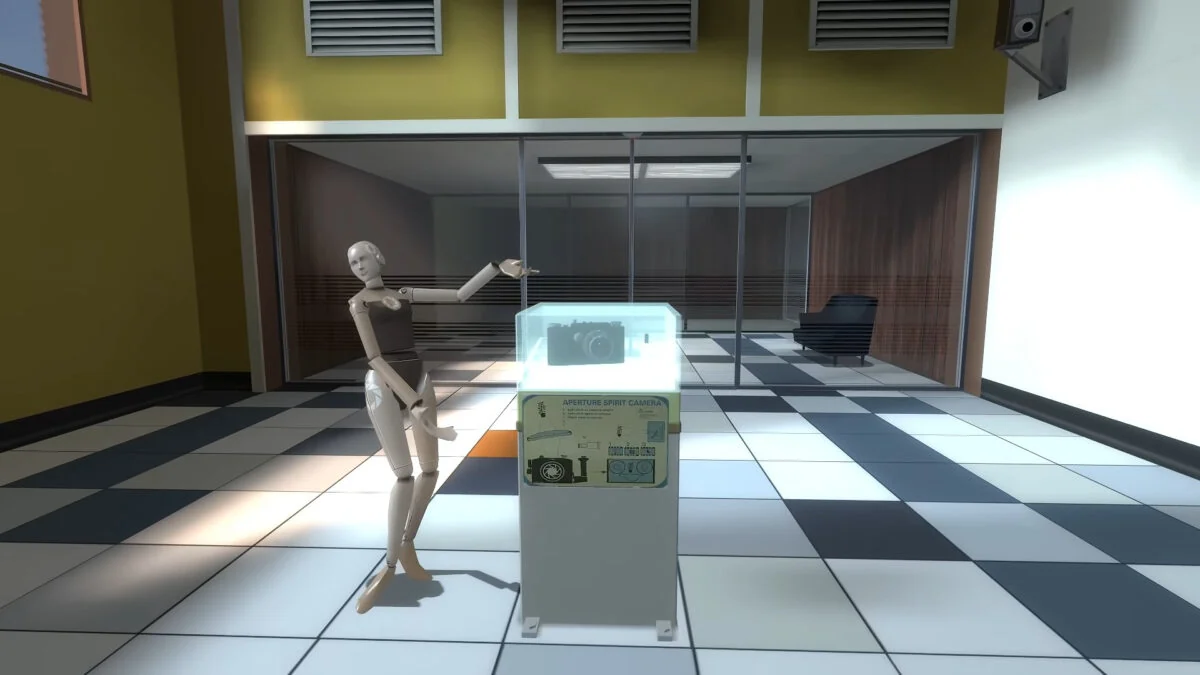
The Portal prequel F-Stop has resurfaced nearly two decades after Valve canceled the experimental game. Gaming enthusiasts have reportedly assembled a playable version using leaked development files. The reconstructed prototype reveals an unusual camera-based puzzle system that Valve explored before developing Portal 2.
The recovered game is not an official Valve release. Gameplay videos show a short campaign with unfinished elements, including missing textures and dialogue. However, the reconstruction offers a rare opportunity to examine an abandoned project from the studio’s earlier development history.
How the Portal Prequel F-Stop Was Reconstructed
The reconstruction became possible after several collections of development files surfaced online. A massive Steam data leak in August 2026 reportedly contained approximately 12 terabytes of material, including assets from canceled and early Valve projects.
Although the archive included many F-Stop assets, it lacked the source code and map data needed to rebuild the game. Those missing components reportedly appeared through the Valve Cut Content community in late October.
According to Kotaku’s reporting, community members combined the materials into a working version of the canceled project. The recovered files allow players to explore much of the original prototype.
The reconstruction remains incomplete. Some dialogue and visual assets are missing, and the software hasn’t received the final polish expected of a commercial release.
As PC Gamer reported, full gameplay recordings have begun appearing online. However, direct access to the reconstructed files remains limited.
A Camera Replaces the Familiar Portal Gun
The game’s central mechanic differs significantly from the Portal series. Instead of creating interconnected gateways, players use a special camera to manipulate objects and solve environmental puzzles.
Photographing an object allows players to capture it and place a version of it elsewhere. The system also supports scale changes, creating opportunities to overcome obstacles through creative object placement.
For example, a small object could become a larger platform or help players reach an otherwise inaccessible area. The puzzles emphasize experimentation with physical objects rather than the momentum-based movement associated with Portal.
The mechanic resembles ideas explored in the 2023 puzzle game Viewfinder. However, Valve developed its camera concept many years earlier.
Valve previously demonstrated parts of the system in 2020. Developer LunchHouse Software received permission from Valve to showcase the experimental technology. Its demonstration, covered by Engadget, showed how it could reproduce and resize photographed objects.
Why Valve Abandoned F-Stop
The project originated in 2007 during Valve’s Directed Design Experiments initiative. The company divided its developers into five teams and gave them approximately three months to explore new game concepts.
One experiment became F-Stop, a proposed prequel set within the Portal universe. It retained the fictional Aperture Science setting while introducing gameplay that differed substantially from the original game.
The project reportedly generated enthusiasm within Valve. However, internal testing produced a more mixed response, and the company eventually discontinued development.
Valve subsequently focused on Portal 2, which launched in April 2011. The sequel drew on some concepts, dialogue, and character ideas from the abandoned prototype.
Portal 2 remains part of Valve’s current PC gaming ecosystem. TechAmerica.ai recently reported that the game was included in the company’s Steam Achievement Sets beta, which introduces more flexible achievement tracking.
What the Leaked Build Reveals
Gameplay recordings suggest the recovered campaign can be completed in under an hour. Its short length reflects the project’s experimental origins rather than the scope of a finished commercial game.
The prototype also provides a glimpse of an earlier interpretation of Aperture Science. Its environments and characters show how Valve was experimenting with the fictional company’s identity before settling on Portal 2’s direction.
That historical perspective makes the reconstruction significant for game preservation. Canceled projects often remain inaccessible, leaving players with little evidence of how their ideas developed.
However, the recovered material does not establish what a finished F-Stop would have looked like. Valve could have changed its mechanics, narrative, and level designs considerably during further production.
Will Valve Officially Release F-Stop?
Valve has not indicated it plans to release the reconstructed game commercially. Community members assembled the available version from leaked development materials, not distributed through Steam.
This distinction matters because a playable prototype is not necessarily a finished game. Missing assets, technical problems, and incomplete systems may affect the experience.
The reconstruction nevertheless preserves a significant part ofValve’ss development history. It demonstrates how the studio explored unconventional puzzle mechanics before choosing a different direction for Portal 2.
Nearly 20 years after its cancellation, F-Stop offers longtime fans more than a curiosity. It provides a rare look at the creative experimentation behind one of PC gaming’s most recognizable franchises.