The MyBambu layoffs in 2025 affected an entire West Palm Beach office after the financial technology company lost its main funding source. A notice filed with Florida officials identified 141 positions at risk as Bambu Systems LLC, which operates as MyBambu, prepared to close the location.
The announcement came only months after the company moved into a larger office and publicized plans to create hundreds of jobs in South Florida.
MyBambu said the unexpected loss of funding forced it to prepare for an orderly shutdown. It also continued seeking emergency financing, leaving uncertainty about whether it could avoid the original closure plan.
MyBambu Layoffs 2025: Florida Filing Confirms 141 Positions
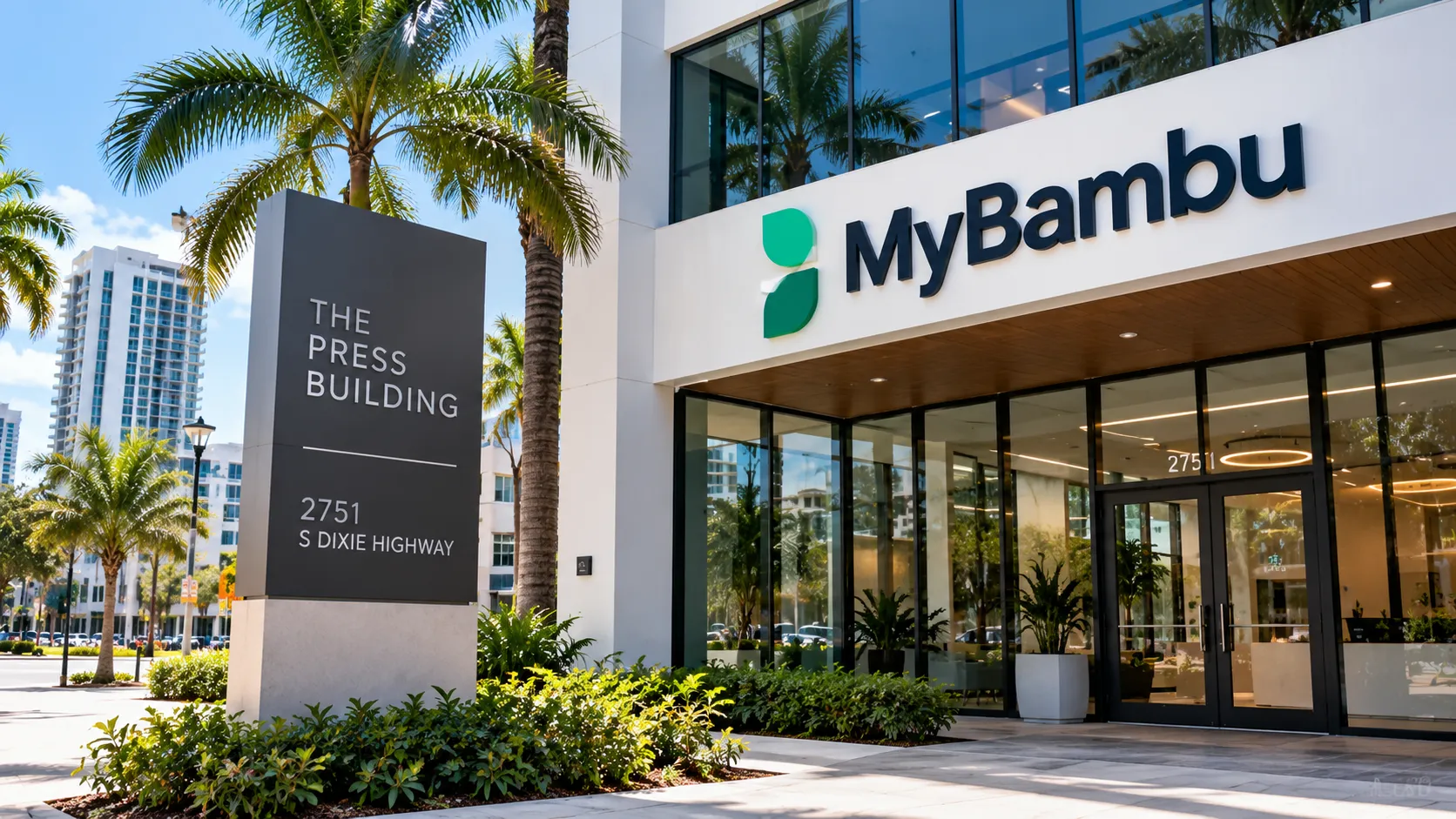
MyBambu informed the Florida Department of Commerce that it intended to permanently close its office at 2751 South Dixie Highway in West Palm Beach.
The notice, signed by CEO Douglas P. Quay and dated October 31, 2025, covered all 141 employees at the location.
The official Florida WARN database lists Bambu Systems LLC with 141 affected positions, a filing date of November 4 and an employment-separation period running from November 3 through December 31.
The company planned two groups of terminations.
Local reporting identified approximately 100 employees in the first group, with another 41 positions expected to end by December 31.
The original notice set November 3 as the first scheduled separation date, although some early news reports incorrectly identified October 31 as the start of the layoffs.
The company’s notification letter listed October 31.
The distinction matters because the timeline establishes when MyBambu announced its plans and when employees were expected to lose their jobs.
The notice identified the entire West Palm Beach workforce, not a companywide number covering every possible operation elsewhere.
Sudden Funding Loss Triggered the Planned Closure
The immediate reason for the restructuring was the loss of MyBambu’s principal source of operating funds.
In its closure notice, the company said it had unexpectedly learned that the funding source supporting its operations would no longer be available.
Management concluded that it lacked sufficient resources to continue operating under its existing structure.
The notice explained that the company had begun emergency fundraising efforts while assessing the resources needed for an orderly wind-down.
It expected to complete that process by December 31, 2025, unless circumstances changed.
The filing did not identify the funding provider or disclose the amount withdrawn.
It also did not provide an audited account of the company’s losses, cash reserves or outstanding liabilities.
Those details remain important limitations when assessing the financial circumstances behind the layoffs.
Although the company described the loss of funding as unexpected, that did not necessarily mean its financial difficulties had begun only days earlier.
Company Called the Layoff Notice Precautionary
MyBambu’s response to local news reports introduced another important qualification.
In a statement to WPTV, the company characterized the notification as precautionary because it was still trying to raise enough money to keep the office open.
That statement did not withdraw the 141-person filing.
Instead, it indicated that management hoped additional financing could change the outcome.
The company’s own letter also acknowledged ongoing emergency fundraising efforts.
The WARN filing therefore established a formal closure plan, while the contemporaneous company statement left open the possibility of avoiding some or all of the planned shutdown.
The publicly available filing does not establish the final employment outcome for every worker.
Employees Reported Financial Problems Before the Announcement
Former employees told local reporters that management had discussed financial difficulties internally before the November filing.
In a November 7 report, WPTV interviewed an employee who said management had discussed the need to reach financial stability earlier in 2025.
The employee also alleged that the company had encountered payroll difficulties.
Those accounts provided additional context, but they were not independently verified financial statements.
They also differed from the company’s emphasis on the unexpected loss of its longstanding funding source.
Both circumstances could have contributed to the crisis. However, the available information does not establish precisely when MyBambu became unable to finance its operations.
An employee interviewed by WPTV said he had been laid off on November 3, consistent with the first separation date in the company’s filing.
MyBambu Had Just Expanded Into a Larger Headquarters
The closure notice came shortly after a major office expansion.
In July 2025, MyBambu moved into approximately 35,000 square feet at the Press Building on South Dixie Highway.
Commercial real estate firm Savills announced the lease on July 31.
The transaction was presented as part of the growing concentration of financial services businesses in West Palm Beach.
At the opening, company executives spoke about expanding their workforce and bringing more employees into the office.
Local economic development officials said MyBambu intended to add approximately 200 jobs, potentially increasing its workforce to around 350 people.
That was a hiring projection, not proof that the company had already employed 350 people.
Contemporary commercial real estate reporting placed the number working at the new headquarters at approximately 160.
Just over three months later, the WARN filing identified 141 positions at the same address.
The rapid shift from expansion plans to closure reflected how quickly the company’s funding situation had changed.
It also meant that workers who had recently moved into the larger office faced uncertainty about their employment.
What Services Did MyBambu Provide?
MyBambu developed digital financial services, particularly for consumers who needed accessible banking and payment options.
Its products included mobile deposit accounts, debit cards and money transfers.
The company promoted bilingual services and international transfers, particularly for customers sending money to Latin America.
It also offered services to send goods and support families abroad.
MyBambu operated through a financial technology model in which the company provided a customer-facing app while regulated financial institutions supplied certain underlying banking services.
According to the company’s official disclosures, MyBambu itself was not a bank.
Community Federal Savings Bank, an FDIC-insured institution, issued its deposit accounts and Visa debit cards.
That distinction matters because closing a technology company and a regulated bank failing are not the same event.
The financial and legal responsibilities associated with customer funds depend on the underlying banking arrangements.
The company’s November employment filing did not explain how it would handle every existing account, card, or transfer.
What Happened to MyBambu Customer Accounts?
The closure announcement raised questions for people using the company’s financial products.
MyBambu’s publicly accessible website still displays product information and customer support details.
However, a functioning website or an app listing does not independently establish whether all account services remain operational.
The company has not provided a clearly verified, comprehensive public explanation resolving the status of every product following the November 2025 funding crisis.
Its published account terms identify Community Federal Savings Bank as the issuer of MyBambu deposit accounts and debit cards.
Customers seeking information about an existing account should use verified communications from the company or the financial institution responsible for that account.
The company’s published terms also identify procedures for account closure and returning remaining balances.
Those procedures should not be interpreted as evidence that all customers experienced the same outcome.
A workforce closure notice alone does not establish that customers lost deposits or that the partner bank failed.
The Layoffs Raised Questions About WARN Compliance
MyBambu’s decision also attracted attention because of the short interval between the notice and the first planned terminations.
The federal Worker Adjustment and Retraining Notification Act generally requires covered employers to provide advance written notice before qualifying plant closures and mass layoffs.
The law also includes exceptions that may apply in specific circumstances, including certain unforeseeable business events.
MyBambu’s letter cited the unexpected loss of funding and said it provided as much notice as its circumstances allowed.
On November 5, 2025, law firm Strauss Borrelli announced an investigation into whether affected employees had received legally required notice.
An investigation or allegation does not establish that the company violated the law.
No final legal determination was identified in the materials reviewed for this report.
The outcome of any WARN-related claim would depend on the applicable legal requirements and the facts surrounding the company’s funding problems.
Local Officials Said No Financial Incentives Were Awarded
MyBambu’s earlier expansion involved publicity with the Business Development Board of Palm Beach County and local officials.
The company was presented as part of the area’s growing financial services sector.
Following the closure announcement, WPTV asked whether public incentives had been used to attract or support the business.
The city of West Palm Beach and the Business Development Board said they had not awarded MyBambu financial incentives.
The organizations also said they were not responsible for managing the company’s business performance.
This distinction matters because the company’s expansion had been promoted as an economic development success.
The reported absence of incentives means the public announcements should not be treated as proof that the company received taxpayer-funded relocation grants.
What the MyBambu Closure Plan Means for Fintech Employment
MyBambu’s situation differs from conventional technology layoffs involving profitable companies seeking to improve margins.
The company’s filing identified a direct funding crisis as the reason it was preparing to close an entire office.
That left employees facing the possible loss of all positions at the location rather than a reduction limited to selected departments.
The announcement also followed an unusually short interval between opening a larger headquarters and deciding to wind down operations.
TechAmerica.ai documents other restructuring events in its 2025 technology layoffs report.
Further reporting on digital banking and financial technology is available in TechAmerica.ai’s Fintech section.
For MyBambu, Florida’s official records show that the November 2025 closure plan affected 141 positions.
The company’s emergency fundraising efforts initially left open the possibility of changing that outcome. Publicly available information does not provide a comprehensive final account of every employee departure or customer service.
The case highlights the financial vulnerability that can accompany rapid expansion when a business remains dependent on a major source of operating capital.