The Tenstorrent layoffs in 2025 affected 7.5% of the AI chipmaker’s workforce as the company changed its sales strategy and reassessed staffing requirements. Chief executive Jim Keller confirmed the reductions in December, saying the business was not cutting jobs because of financial difficulties.
The restructuring left Tenstorrent with approximately 1,000 employees. It also came as the company shifted more of its attention from large enterprise customers to individual developers and smaller businesses.
EE Times reported the layoffs on December 9, 2025. Keller described the changes as part of managing a company that had expanded rapidly while developing AI processors, software and computing systems.
Tenstorrent Layoffs 2025: Why the Company Reduced Staff
Tenstorrent’s restructuring affected employees across the business. The company did not identify a single department responsible for most of the job losses.
In an interview with EE Times, Keller said the reductions reflected decisions about employee skills, performance and team compatibility.
He rejected the suggestion that financial problems had forced the company to shrink.
Tenstorrent had expanded its workforce during a period of substantial investment in AI computing. That growth brought challenges as the company moved from developing hardware to producing and delivering systems to customers.
Keller also discussed the increasing use of AI-assisted programming. He said some employees adapted more effectively to the changes than others.
That does not mean AI software directly replaced the affected jobs. The company’s explanation focused on workforce management and changes in its business strategy.
Tenstorrent did not disclose an exact number of departing employees or provide a breakdown by country. The reported 7.5% reduction and remaining headcount indicate the scale, but they do not provide an independently confirmed employee total.
Tenstorrent Shifts Sales Toward Individual Developers
A significant part of the restructuring involved changes to Tenstorrent’s approach to selling AI computing technology.
The company had previously focused heavily on enterprise customers. Under its revised strategy, it placed greater emphasis on developers and smaller organizations that could experiment directly with its products.
The shift resulted in a smaller enterprise sales team.
Keller told EE Times that working with developers could help Tenstorrent learn more about how its hardware and software performed in different applications.
Large customers remained important to its long-term ambitions. However, the company wanted to build a broader developer community before concentrating entirely on major enterprise accounts.
Tenstorrent’s intellectual property licensing business continued to serve corporate customers through its existing sales organization.
The change reflects the challenge emerging AI hardware companies face. They need customers willing to adopt unfamiliar technology while competing against established products with mature software ecosystems.
Blackhole AI Chips Remain Central to Its Strategy
Tenstorrent continued developing its AI processors despite the workforce reduction.
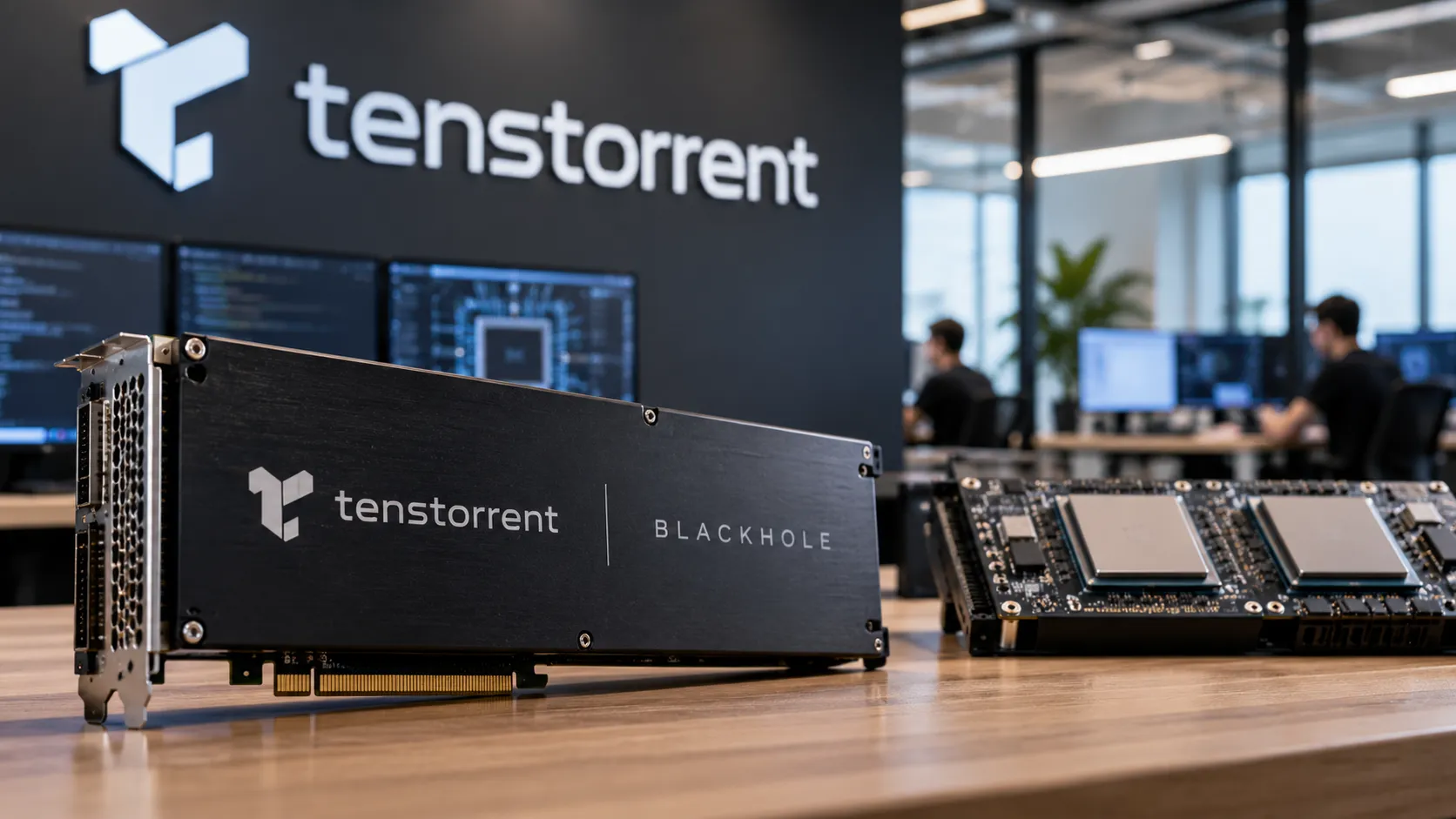
In April 2025, the company introduced its Blackhole hardware generation at an event in San Francisco. The products included accelerator cards and a desktop workstation designed for AI workloads.
Its official Blackhole launch announcement also introduced developer resources, documentation and software tools.
Blackhole products support Tenstorrent’s open-source software stack, including TT-Metalium, TT-NN, and TT-Forge.
The software is important because customers need more than computing hardware. They also need tools that allow existing AI models to run efficiently on unfamiliar processors.
At the time of the December layoffs, Keller said about 70 models ran on Blackhole-generation hardware.
The company aimed to support 100 models by the end of 2025. That figure was a stated development target, not a confirmed year-end result.
Tenstorrent also wanted to expand participation in its developer community, which could help identify software problems and improve compatibility.
Chiplet Roadmap Faces Changes in Development Schedule
Alongside its Blackhole products, Tenstorrent was developing a new generation of chiplet-based processors.
Chiplets are smaller semiconductor components designed to work together within a larger computing system. They let manufacturers combine different functions without putting every component on a single piece of silicon.
Tenstorrent’s approach emphasizes open interfaces and compatibility between components from different suppliers.
In July 2025, the company acquired Blue Cheetah Analog Design, a specialist in chiplet-to-chiplet communication technology.
The acquisition brought important interconnect expertise into Tenstorrent’s engineering organization.
Keller told EE Times that design changes tied to Blue Cheetah’s technology affected the schedule for its next-generation chips.
At the time, the company expected chiplet tape-out in the first quarter of 2026. Tape-out is the stage when a completed semiconductor design is prepared for manufacturing.
That was the schedule discussed in December 2025 and should not be mistaken for confirmation that production occurred on that date.
Tenstorrent subsequently continued work on its Open Chiplet Atlas initiative.
In October 2026, the company released an open-source beta of its Open Chiplet Atlas Harness, offering reusable technology for chiplet integration, security and system management.
Funding Provided Context for the Workforce Decision
The December layoffs followed a period of significant fundraising.
Tenstorrent had raised more than $693 million in a Series D round announced in December 2024.
The investment included Samsung Securities, AFW Partners, and several institutional and strategic investors.
The financing supported Tenstorrent’s efforts to develop AI processors and the computing systems built around them.
Its funding history helps explain Keller’s claim that the 2025 layoffs were not a response to immediate financial pressure.
However, raising capital does not eliminate the need for difficult staffing decisions. Hardware development involves substantial engineering, manufacturing and software costs, and companies may reorganize while continuing to invest.
The December cuts therefore occurred alongside the company’s efforts to refine its sales organization and accelerate product development.
Tenstorrent Raises $1.5 Billion in October 2026
Tenstorrent announced another major financing round on October 19, 2026, roughly ten months after the layoffs became public.
The company said it had secured $1.5 billion in Series E funding at a $6.2 billion post-money valuation.
According to its official announcement, the investment will support large-scale Galaxy server deployment, manufacturing expansion and the development of AI and CPU intellectual property.
Trace Capital and Innovation X led the financing.
TechAmerica.ai reported the new investment in its separate Tenstorrent funding article.
The funding does not establish the financial circumstances surrounding every layoff decision made in 2025. However, it shows that Tenstorrent continued attracting substantial investment after reorganizing parts of its workforce.
The company’s stated priorities remain AI computing hardware, open software and technology licensing.
What the Tenstorrent Restructuring Means
Tenstorrent’s workforce reduction illustrates a different kind of restructuring from the large cost-cutting programs announced by some technology companies.
The business continued developing advanced processors while reducing staffing in areas that no longer matched its immediate needs.
Its decision to prioritize developers also reflected the need to build software support and customer adoption around its hardware.
The consequences for affected workers were real, regardless of the company’s financial position.
At the same time, the available evidence does not support describing the layoffs as a shutdown, a financial crisis or a direct replacement of employees by AI.
Tenstorrent was among the technology companies that reported workforce reductions in 2025. TechAmerica.ai tracks other announcements in its 2025 technology layoffs report.
For Tenstorrent, the December announcement marked an organizational adjustment during an ongoing expansion into AI computing. Its subsequent financing shows how workforce reductions and business growth can happen within the same company, even as employees and products face shifting priorities.