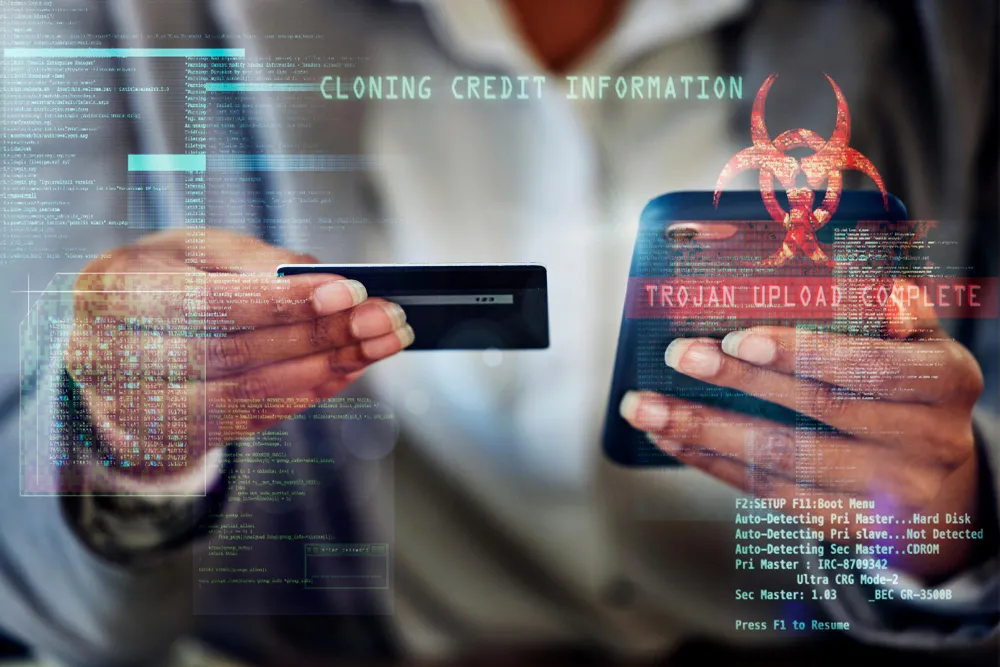
A customer receives a notification that their credit card has been added to a mobile wallet. The physical card is still in their possession, and they have not purchased a new phone. Minutes later, unfamiliar transactions appear. The problem may have started before the first payment, when someone successfully registered the customer’s card on a device they did not own.
This is the threat behind digital wallet provisioning fraud. Criminals who obtain stolen payment card information may attempt to enroll those credentials in mobile wallets under their control. If the enrollment is approved, they may gain access to a payment method that appears to be legitimately registered. Banks and payment networks are responding with stronger identity verification, device intelligence, and real-time fraud detection designed to identify suspicious enrollment attempts before unauthorized purchases occur.
How a Secure Digital Wallet Can Still Be Misused
Mobile wallets are designed to reduce exposure of sensitive card information during transactions. Instead of repeatedly transmitting the original payment card number, many wallet systems use a digital substitute called a payment token.
Tokenization makes intercepted payment information less useful because tokens can be restricted to particular devices, merchants, or payment environments. These restrictions reduce certain types of fraud involving stolen card details.
However, tokenization introduces an important security distinction. Protecting a payment credential during transactions is different from verifying whether the person requesting that credential is the legitimate cardholder.
If an unauthorized person successfully adds a stolen card to a wallet, the resulting token may be technically valid. The tokenization system has protected the underlying card number, but the enrollment decision may have allowed the wrong person to receive a usable payment credential.
This is why digital wallet provisioning fraud focuses on the moment a payment card is registered, rather than solely on the transaction that follows.
What Happens When Someone Adds a Card to a Wallet?
Adding a payment card to a mobile wallet involves several organizations working together. The exact process varies by payment network, card issuer, wallet provider, and device platform.
When a cardholder enters payment information or uses a supported card enrollment feature, the wallet provider requests a digital payment token.
A token service provider processes that request under the relevant payment network’s rules. The card-issuing bank may receive the information needed to determine whether to approve the enrollment, reject it, or subject it to additional verification.
If the request is approved and the applicable requirements are satisfied, the payment token can be provisioned to the wallet for supported transactions.
The EMVCo payment tokenization framework provides the technical foundation for replacing payment card numbers with tokens. It also describes how token service providers, token requestors, and card issuers interact within the payment ecosystem.
Verification is therefore critical to the process. A request using correct card details does not necessarily prove that the person submitting them is authorized to use the card.
Where Fraudulent Enrollment Attempts Begin
Criminals may obtain card information through phishing, compromised online accounts, data breaches, or other forms of payment credential theft.
Possessing those details does not automatically provide access to a digital wallet. Enrollment may require additional information or confirmation from the legitimate cardholder.
Fraudsters may therefore attempt to defeat the verification process through social engineering or compromised communications.
For example, someone might contact a cardholder while pretending to represent their bank. The caller claims that a suspicious transaction must be stopped and asks the customer to provide a verification code.
In reality, the code may relate to an attempt to add the customer’s card to another device. If the customer supplies it, the fraudster could complete the enrollment, depending on the bank’s other security controls.
This hypothetical scenario highlights a key weakness of relying exclusively on one-time passwords. A code can be correctly generated and delivered while still being disclosed to an unauthorized person.
Other attacks may involve compromised banking accounts, manipulated contact information, or previously trusted devices. The available attack paths depend on how an issuer verifies enrollment requests.
Digital Wallet Provisioning Fraud Detection Starts With Risk Signals
Banks need to distinguish ordinary enrollment activity from requests that warrant closer examination. Adding a card to a replacement phone is common and legitimate, so treating every new device as fraudulent is impractical.
Instead, financial institutions can evaluate multiple signals before deciding whether to allow a token request.
Potential risk indicators include:
- Device information: Whether the device has previously been associated with the customer or displays characteristics that warrant additional verification.
- Account history: Whether enrollment activity is consistent with the customer’s previous card and banking activity.
- Recent account changes: Whether contact details or other sensitive account information were recently modified.
- Enrollment frequency: Whether the same payment card has been submitted repeatedly or across multiple devices within an unusual period.
- Verification results: Whether the required identity checks were completed successfully and provide sufficient confidence.
- Related fraud signals: Whether other available information suggests account compromise or suspicious payment activity.
No single indicator establishes fraud. A legitimate customer may replace several devices, travel internationally, or update their contact information before adding a card to a wallet.
For this reason, banks often assess the combined risk rather than relying on one condition.
Visa describes this type of assessment in its digital payment authentication guidance. The company identifies token provisioning risk assessment as a way to evaluate the likelihood of fraud when payment credentials are added to digital wallets.
Risk analysis can help prevent unauthorized enrollment while allowing routine requests to proceed with fewer interruptions.
Why Identity Verification Must Be Stronger Than a Code
Additional authentication is often required when an enrollment request presents elevated risk. This may involve confirming the request through an existing banking application, using an approved identity verification process, or completing another issuer-supported challenge.
The purpose is to establish that the person requesting the token is entitled to use the underlying payment card.
However, verification strength depends on how it is performed. A one-time password delivered to a compromised communication channel may offer limited protection against an attacker who already controls that channel.
Similarly, biometric authentication on a device can help establish that someone has unlocked that device. It does not, by itself, prove that the device owner is the legitimate holder of a newly entered payment card.
Effective enrollment security must connect the person, payment account, and requested device through appropriate verification controls.
In the European Union, the European Banking Authority has clarified how strong customer authentication requirements apply to digital wallets under the revised Payment Services Directive, or PSD2.
Its digital wallet authentication guidance explains that enrolling a payment card in a digital wallet can create fraud risks and generally requires strong customer authentication under the relevant rules.
These requirements reflect European regulatory obligations. Authentication rules and implementation practices differ across jurisdictions and payment systems.
How AI Helps Banks Evaluate Enrollment Attempts
Fraud detection systems can process large volumes of payment and account activity, looking for combinations of signals that suggest unusual behavior.
Machine learning models may help identify patterns that would be difficult to capture through fixed rules alone. For example, a model could evaluate how a particular enrollment request compares with previously observed legitimate and fraudulent activity.
This broader use of data science allows financial institutions to convert account information, device signals, and historical activity into assessments that support decisions.
However, AI-based fraud scoring does not guarantee accuracy. Models can produce false positives by incorrectly flagging legitimate requests as suspicious. They can also miss fraudulent activity that resembles normal customer behavior.
Financial institutions need to evaluate their detection systems by focusing on reliable outcomes rather than assuming a more complicated model is automatically more effective.
Historical fraud labels may be incomplete, and criminal behavior changes as attackers discover how verification procedures work. Models therefore require monitoring and periodic evaluation.
Privacy and data protection also matter. Risk assessments should use information appropriate to the security purpose and handle it according to applicable legal requirements.
The Trade-Off Between Fraud Prevention and Customer Friction
Stronger verification can prevent unauthorized card enrollment, but unnecessary challenges can frustrate legitimate customers.
A customer replacing a broken phone may need immediate access to payment services. If the bank repeatedly rejects legitimate enrollment requests, the customer may be unable to use a card through their preferred mobile wallet.
Issuers must therefore balance two operational objectives: preventing fraudulent token issuance and maintaining reasonable access for authorized cardholders.
Risk-based verification offers one approach. Lower-risk requests may be approved using the available account and device information, while requests with greater uncertainty receive additional scrutiny.
Organizations can measure the effectiveness of these decisions through several outcomes, including confirmed fraudulent enrollments, legitimate requests incorrectly rejected, additional authentication rates, and successful completion of verification challenges.
Fraud losses alone do not capture the full customer experience. A system that rejects nearly every request could prevent some fraud while making a digital wallet service impractical for legitimate users.
Similarly, a low rejection rate is not necessarily evidence of effective protection. It could reflect insufficient detection of unauthorized activity.
Banks need a measurement approach that evaluates both security outcomes and the effects of verification on legitimate customers.
What Happens After a Fraudulent Token Is Approved?
Preventing suspicious enrollment is important, but banks also need ways to respond when an unauthorized token has already been issued.
Payment tokens can have lifecycle controls that allow authorized parties to manage their status. Depending on the network and implementation, a token may be suspended or deactivated without necessarily requiring every associated payment credential to be handled identically.
This distinction can help institutions respond to a compromised device while investigating the broader payment account.
Transaction monitoring remains relevant after provisioning. Banks may examine suspicious payment behavior, unexpected transactions, and indications that a newly enrolled device is being used fraudulently.
However, transaction monitoring should not replace enrollment security. By the time an unauthorized purchase is detected, the attacker may already have completed one or more transactions.
The earlier you identify a fraudulent enrollment, the more opportunity you have to intervene before financial losses occur.
What Customers Should Do About an Unknown Wallet Enrollment
Consumers can play an important role in identifying unauthorized activity, particularly when their bank sends notifications about newly registered devices.
Treat an unexpected alert that a card has been added to a wallet as a reason to verify the account’s status.
Customers should contact their card issuer through a trusted banking application, the number printed on their card, or another verified contact channel. They should not rely on a telephone number supplied in a suspicious text message.
If the enrollment was unauthorized, the issuer can advise on appropriate steps, which may include turning off an affected token, securing the account, replacing payment credentials, and reviewing recent transactions.
The Federal Trade Commission’s card theft guidance recommends reporting suspected unauthorized activity promptly. It also explains that legal protections vary between credit cards and debit cards and can depend on when the problem is reported.
Consumers should review account activity even when their physical cards have not been lost. Unauthorized digital payments can occur without the original card leaving its owner’s possession.
Anyone who discovers an unfamiliar payment should report it promptly. The Consumer Financial Protection Bureau provides additional guidance on unauthorized transactions and applicable investigation procedures.
Protecting Digital Payments Before the First Transaction
Payment tokenization has helped create a more secure foundation for mobile and online transactions by reducing reliance on original card numbers. But it cannot, on its own, establish that every person requesting a digital payment credential is authorized to receive one.
Digital wallet provisioning fraud exploits that distinction. Its central risk lies in the enrollment decision, where stolen card information, compromised communications, or manipulated account details may be used to obtain a functioning payment token.
Effective prevention requires cooperation among card issuers, wallet providers, payment networks, and token service providers. Device intelligence, appropriate identity verification, risk analysis, and token lifecycle controls each address different parts of the problem.
For banks, the objective is to distinguish suspicious requests from ordinary customer activity before credentials are activated. For consumers, unfamiliar enrollment alerts offer a chance to spot potential compromise before more serious financial damage occurs.
As digital wallet adoption continues, securing the moment a card is added to a device will remain as important as protecting the transactions that follow.