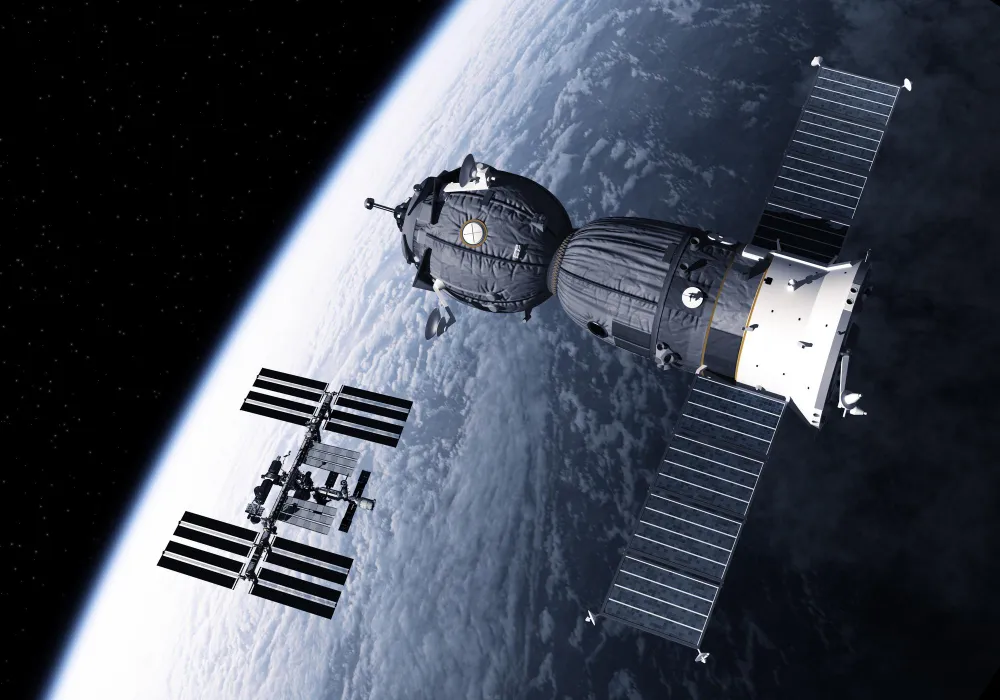
Autonomous satellite maneuvering is moving toward more capable spacecraft operations as engineers develop systems that can plan and execute orbital adjustments with less ground intervention. On October 1, 2026, the European Space Agency (ESA) launched GOMX-5, a small technology-demonstration satellite designed to test faster propulsion commissioning. The mission aims to make its propulsion system available for collision avoidance within 48 hours of deployment.
The mission highlights growing interest in making spacecraft more responsive. Traditional satellite maneuvers often require ground teams to calculate trajectories, approve commands, and communicate instructions. Autonomous systems aim to handle selected decisions onboard, potentially improving reaction times. However, navigation accuracy, propulsion limits, orbital safety, and software reliability remain significant engineering challenges.
How Autonomous Satellite Maneuvering Works
Autonomous satellite maneuvering allows a spacecraft to plan and execute selected orbital changes using onboard navigation, guidance, and control systems. Rather than relying on ground operators for every adjustment, onboard software can calculate a maneuver, verify operating conditions, and command the propulsion system within approved limits.
The process begins with estimating the spacecraft’s position and velocity. Navigation software combines available sensor measurements with mathematical models of orbital motion. Guidance algorithms then calculate a trajectory that satisfies the mission’s objectives.
A control system translates the planned trajectory into commands compatible with the spacecraft’s hardware. Thrusters generate the force required to change the satellite’s motion, while attitude-control equipment helps establish the correct orientation for a maneuver.
Distinguishing orientation from orbital movement matters. Reaction wheels can rotate a spacecraft to point its instruments or propulsion system, but they do not normally change its orbital trajectory. A meaningful orbital adjustment requires an external force, typically generated by propulsion.
NASA’s 2026 guidance, navigation, and control assessment explains the spacecraft subsystems involved in navigation, precision pointing, and orbital operations. These capabilities provide the foundation for more autonomous spacecraft behavior.
How Satellites Change Their Orbits
Satellites follow trajectories governed by gravity and other forces. Changing an orbit requires modifying the spacecraft’s velocity or using an external environmental force in a controlled way.
Engineers describe changes in velocity as delta-v. A spacecraft’s available delta-v depends on its propulsion system, propellant supply, mass, and mission design. Every powered maneuver draws from a limited operational budget.
For example, a satellite can perform a carefully timed engine burn to change its orbital altitude. A prograde burn increases its velocity at the maneuver point and can raise the opposite side of its orbit. Operators may need additional adjustments to establish the intended final trajectory.
Changing an orbit also affects orbital timing. A spacecraft in a higher circular orbit generally takes longer to complete one revolution than a spacecraft in a lower orbit. Operators can use these differences to adjust satellite spacing and relative positions.
Autonomous software must account for these relationships when planning repositioning. An incorrect maneuver could place a spacecraft outside its intended operating region or create additional collision risks.
Satellite Propulsion Technologies and Their Limitations
Different propulsion systems provide different combinations of thrust, efficiency, and operating requirements. The appropriate technology depends on spacecraft size, available power, required response time, and mission duration.
Chemical Propulsion
Chemical propulsion systems generate thrust by accelerating gases produced through chemical reactions or propellant decomposition. They can provide relatively high thrust, making them suitable for maneuvers that require rapid velocity changes.
However, chemical systems carry finite propellant supplies. Tanks, valves, and related equipment also contribute to spacecraft mass and complexity. Mission planners must reserve enough resources for essential operations and, when required, eventual disposal.
Electric Propulsion
Electric propulsion systems use electrical energy to accelerate propellant. Ion thrusters and Hall-effect thrusters are examples of technologies that can provide efficient propulsion over extended operating periods.
Electric systems generally produce lower thrust than many chemical alternatives. They may therefore require longer operating periods to achieve a comparable velocity change. This can limit their suitability for urgent orbital adjustments.
NASA’s 2026 in-space propulsion assessment examines chemical, electric, and propellantless technologies used or investigated for smaller spacecraft. The report emphasizes that system selection depends on mission requirements and verified performance.
Not every satellite uses conventional thrusters for all adjustments. Some low-Earth-orbit spacecraft can exploit atmospheric drag differences by changing orientation. Such techniques have limited authority and depend on orbital conditions.
NASA Demonstrates Autonomous Orbital Maneuvers
NASA’s Starling mission has provided practical evidence that spacecraft can coordinate orbital adjustments with less ground intervention. The project uses a group of small satellites to investigate autonomous navigation, communication, and distributed operations.
In March 2025, NASA described a successful demonstration involving its Starling swarm and an independently operated satellite constellation. The experiment tested automated coordination during a potential close approach.
According to NASA’s mission report, Starling accepted responsibility for maneuvering through a coordination service. Its onboard system then planned and executed an orbital adjustment associated with the test.
The demonstration showed how spacecraft operators could exchange information and coordinate selected actions without relying entirely on lengthy manual procedures.
However, the result should not be interpreted as proof that satellites can independently resolve every collision scenario. Real operations involve changing orbital predictions, different spacecraft capabilities, and potential conflicts between operators.
How Onboard Navigation Supports Autonomous Decisions
Reliable maneuvering requires a spacecraft to know where it is and how its orbit is changing. Navigation systems may use Global Navigation Satellite System signals, onboard sensors, optical measurements, and mathematical estimation techniques.
In low Earth orbit, suitable satellite navigation receivers can help estimate position and velocity. Optical navigation becomes valuable when spacecraft need to measure the relative positions of nearby objects or operate where conventional navigation signals are less accessible.
NASA is developing an onboard software architecture called Autonomous Navigation, Guidance and Control (autoNGC). The system is intended to support trajectory corrections, station-keeping, and autonomous maneuver planning with reduced reliance on ground commands.
Accurate navigation is essential because small errors can grow as trajectories are projected forward. Software must account for uncertainty in sensor measurements and the physical forces affecting a spacecraft’s orbit.
Greater onboard processing can reduce the need to send every navigation calculation to Earth. TechAmerica.ai has previously examined related advances in onboard AI for satellites, including local data analysis and autonomous decision support.
Not every autonomous navigation system uses machine learning. Established estimation algorithms and physics-based control methods remain important because they can provide predictable behavior under defined conditions.
Where Autonomous Satellite Maneuvering Is Useful
One practical application is station-keeping, which involves maintaining a spacecraft within its intended orbital region—satellites experience disturbances from atmospheric drag, gravitational variations, and other forces. Periodic adjustments help maintain the required trajectory.
Another application involves satellite constellations. Groups of spacecraft may need to maintain spacing, adjust orbital positions, and coordinate operations. Autonomous planning could reduce the workload associated with managing numerous satellites.
Formation flying introduces additional requirements. Spacecraft must maintain specified relative positions while accounting for differences in orbital motion. Precise control may be necessary for distributed scientific instruments or coordinated observations.
In December 2025, ESA reported that its Proba-3 mission had demonstrated autonomous precision formation flying. Two spacecraft used onboard navigation and control systems to maintain an exceptionally stable formation without continuous ground guidance.
Future applications may include spacecraft inspection, orbital servicing, scientific formations, and controlled repositioning. However, close-proximity operations require especially careful testing because a navigation or control failure can create a collision risk.
Why Collision Avoidance Requires More Than Autonomous Navigation
Satellite collision avoidance begins with identifying potential close approaches between orbital objects. Tracking information estimates future positions and determines whether an encounter requires further assessment.
An autonomous spacecraft may be able to plan an avoidance maneuver, but it still needs sufficiently reliable information about surrounding objects. Incomplete tracking data or inaccurate orbital predictions can lead to unnecessary or ineffective adjustments.
Coordination becomes especially important when both spacecraft can maneuver. If two independent systems react without considering each other’s intentions, their actions could conflict.
Autonomous systems therefore need clear rules for maneuver responsibility, updated trajectory information, and safeguards against incompatible decisions. Ground-based traffic coordination remains relevant even when individual spacecraft gain greater onboard autonomy.
Rapid propulsion availability is also important. ESA’s October 2026 GOMX-5 mission update describes its goal of commissioning propulsion shortly after launch so the spacecraft can perform collision-avoidance maneuvers when necessary.
That commissioning objective should not be confused with a demonstrated ability to make fully autonomous collision-avoidance decisions. Propulsion readiness and autonomous maneuver planning are related but distinct capabilities.
Technical Challenges Facing Autonomous Spacecraft
One major limitation is the finite amount of propulsion available. Every maneuver may consume propellant, electrical energy, or both. Excessive adjustments can reduce a spacecraft’s operational lifetime or limit its ability to perform later mission activities.
Navigation uncertainty creates another challenge. Errors in position estimates, sensor readings, or environmental models can affect maneuver calculations. Autonomous software must recognize when available information is insufficient for a safe decision.
Hardware reliability is equally important. Thruster malfunctions, valve problems, processor faults, or sensor failures can prevent planned maneuvers from working as expected. Spacecraft need appropriate fault-detection and recovery procedures.
Communication limitations also affect operations. Autonomous systems can act without waiting for every ground command, but they still need to exchange information about spacecraft status, planned trajectories, and unexpected events.
Cybersecurity must be considered when transmitting or updating navigation and propulsion commands. Unauthorized changes to maneuver instructions could compromise spacecraft safety. Access controls, authenticated communications, and verified software updates help safeguard against them.
Artificial intelligence adds another layer of uncertainty when machine learning influences operational decisions. A model may encounter conditions that differ from its training data. Safety-critical control functions therefore require careful validation and clearly defined operating boundaries.
A Practical Roadmap for Autonomous Satellite Maneuvering
Organizations developing autonomous spacecraft systems should start with clearly defined maneuvering requirements. Gradual testing helps establish whether automation improves responsiveness without creating unacceptable operational risks.
1. Define Mission and Maneuver Requirements
Identify the orbital adjustments the spacecraft must perform, such as station-keeping, formation maintenance, or collision avoidance. Establish acceptable navigation errors, maneuver response times, and available propulsion resources. Define which operations require ground authorization.
2. Integrate Navigation, Planning and Propulsion
Select compatible sensors, processors, control software, and propulsion hardware. Confirm that onboard algorithms can estimate spacecraft motion and produce commands within equipment limits. Evaluate power consumption, thermal requirements, and fault tolerance.
3. Validate Maneuvers in Controlled Tests
Use simulations and hardware-in-the-loop testing to evaluate navigation accuracy, maneuver planning, and execution behavior. Introduce sensor errors, propulsion faults, and unexpected orbital conditions. Verify that the system can reject unsafe commands and enter an appropriate protective state.
4. Demonstrate and Expand On-Orbit Autonomy
Begin with closely monitored orbital operations. Compare onboard decisions with independent ground calculations and assess actual maneuver performance. Increase autonomous authority only after testing demonstrates reliable operation under the intended conditions.
This roadmap is a general engineering approach, not a formal mission certification standard. Requirements vary according to spacecraft size, operating altitude, propulsion design, and the consequences of a maneuvering failure.
The Future of Autonomous Satellite Maneuvering
Future spacecraft may perform more navigation and maneuver planning onboard, particularly during missions where communication with Earth is delayed or intermittent. Greater autonomy could support complex satellite formations and distributed scientific missions.
Improved onboard processors and navigation algorithms may also let spacecraft evaluate more maneuvering options in shorter timeframes. However, additional computing capability must operate within strict limits on power, mass, and reliability.
Autonomous coordination between multiple spacecraft is another important research direction. Satellite groups could exchange position estimates and planned trajectories to maintain formations or reduce operational conflicts.
More capable propulsion technologies may expand the range of available maneuvers. The benefits will depend on thrust, efficiency, hardware maturity, and the ability to operate safely over extended missions.
Space traffic coordination will remain essential as spacecraft gain greater independence. Automated systems must operate predictably alongside other satellites, including those managed by different organizations.
Autonomous satellite maneuvering offers a path toward spacecraft that can respond more quickly to changing orbital conditions. Its practical value will depend on reliable navigation, suitable propulsion, validated control software, and effective coordination. The objective is not to remove human oversight entirely, but to give spacecraft carefully defined autonomy that improves mission performance without compromising orbital safety.