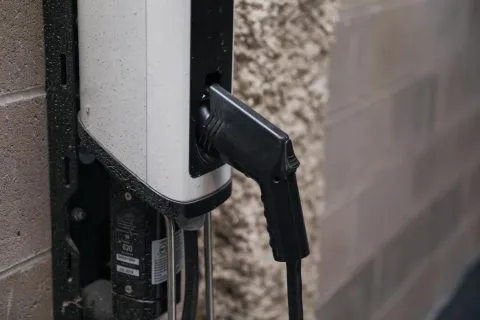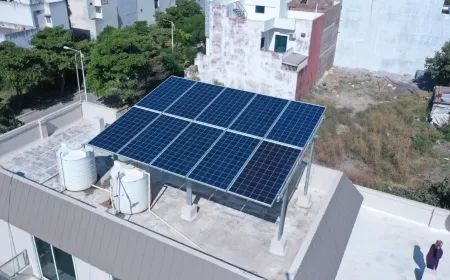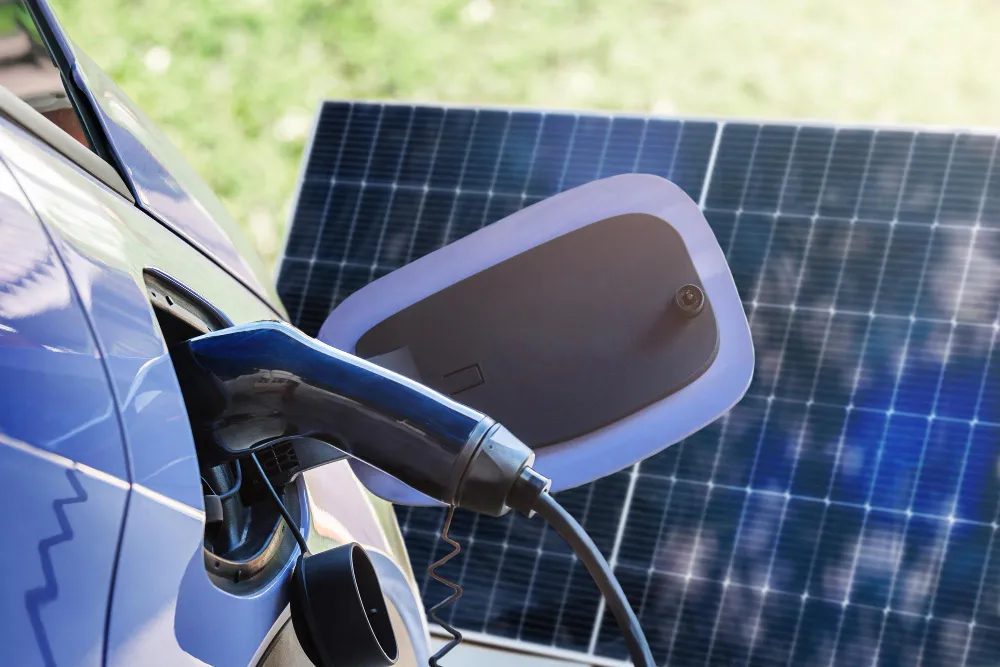
Solar EV charging sounds simple: park an electric vehicle at home and use roof-generated electricity to recharge it. The challenge is that solar panels do not deliver a fixed amount of power. A cloud can reduce output within minutes, while an oven or air conditioner can suddenly draw electricity that would otherwise be available for the car.
A solar-aware charging system can respond to those changes by measuring household energy flows and adjusting the vehicle’s charging current. The technology may reduce electricity exported to the grid and increase on-site use. Whether that saves money depends on when the car is parked, the utility’s rates and how the equipment is integrated. A wall charger described as solar-ready does not necessarily perform this work without additional meters and controls.
What solar EV charging means in a connected home
In a typical grid-connected installation, rooftop panels generate direct-current electricity. An inverter converts it to alternating current used by household circuits. The EV charging station then provides controlled AC power to the vehicle, and its onboard charger converts it to DC for the traction battery. These are separate functions, even when an application presents them on one screen.
Generally, no dedicated stream of electricity travels straight from a roof panel into the vehicle. Solar generation, household appliances, the charging load and the utility grid interact through the home’s electrical system. A home can draw electricity from the grid at one moment and export surplus generation at another.
The key idea is timing. If panels are producing more power than household loads require, charging the car can use some of the excess locally. The official explanation of solar photovoltaic systems describes the inverter and storage components that make this possible.
How a smart charger detects surplus solar power
A charging station cannot reliably identify surplus generation merely by knowing that the roof has solar panels. The control system needs measurements of electricity production, household consumption or the power flowing through the grid connection. Compatible current transformers, revenue-grade meters or an integrated energy monitor may provide those readings.
One arrangement measures solar output and the load used elsewhere in the house—another monitors whether the property imports from or exports to the grid. The controller interprets that information and requests a charging current that fits its operating rules and the available electrical capacity.
Meter placement and configuration matter. A sensor fitted to the wrong conductor or installed in the wrong orientation can misreport import as export. A connection that loses meter data should follow a defined fallback rather than assume unlimited solar energy remains available.
Why appliances change how much power the car can use
Consider a hypothetical sunny afternoon when a roof produces 5 kilowatts, and the rest of the home consumes 1.5 kilowatts. About 3.5 kilowatts remain before accounting for system losses and other constraints. The controller may match part of that excess with the car’s charging demand instead of letting it all flow outward through the meter.
If an electric dryer then starts and adds 2 kilowatts of household demand, the available excess falls sharply. Unless the charger changes its current or uses grid electricity, the car’s demand may exceed the remaining solar surplus. That is why an effective system needs current measurements that refresh frequently enough for the actual loads.
The worked example is not a prediction for a specific house. Solar output, inverter limits, phase connections and meter placement affect the real result. Even a well-controlled system can briefly import grid energy while it reacts to a changing load.
How charging current responds to passing clouds
Many AC charging arrangements have a practical lower current threshold. A commonly used minimum is around 6 amps, which represents about 1.4 kilowatts at 240 volts before losses. The precise behavior depends on the vehicle, charging equipment and control implementation. A controller cannot always reduce charging smoothly to a few hundred watts.
When sunlight falls below the amount needed to sustain charging, the system has choices. It can pause, continue with a contribution from the grid or draw from a compatible home battery. Frequent stopping and restarting may be inconvenient, so controllers often use delays or thresholds to prevent rapid switching during changing cloud cover.
Solar tracking also differs from ordinary charging-speed adjustment. The vehicle must respect the maximum current signaled by the charging equipment, but the car may impose a lower limit or delay its response. A displayed solar surplus does not guarantee the battery will absorb every available watt.
Solar-only, solar-first and scheduled charging are different
A solar-only preference aims to charge when measured surplus production is sufficient. Its appeal is higher use of on-site generated electricity, but it can leave a vehicle short of the desired charge after several cloudy days. Such a setting is practical only when the driver’s travel schedule allows it.
A solar-first mode can prioritize excess generation while letting the grid fill gaps. A deadline-based plan may charge more quickly before a morning departure, even if solar output is weak. Scheduled charging can instead target lower-priced utility periods. Each setting solves a different problem and may produce a different bill.
Users should know what happens when their chosen mode cannot finish in time. The best interface explains whether charging is paused, supplemented by grid electricity or waiting for the next scheduled period. A vague label such as green charging does not reveal these operational details.
Can you charge an EV with solar panels but no home battery?
Yes. A grid-connected solar installation can serve a car while sunlight is available, without a separate stationary battery. The main limitation is that the vehicle usually needs to be parked and plugged in when the roof is producing useful power. Drivers who leave home throughout the sunny part of the day may have little opportunity for direct solar self-consumption.
Without storage, excess production can be exported under the uutility’sinterconnection arrangement. The driver may then charge from the grid after returning home. A billing credit for earlier exports can offset some of that cost, but financial offset is different from physically charging with solar electricity at night.
The homeowner’s solar guidance explains why compensation for exported power varies by state and utility. Whether midday charging is worthwhile depends partly on that compensation, not just how much energy the panels generate.
What changes when a home battery is installed?
A stationary battery can store part of the day’s solar production and discharge it later. That may support evening EV charging or preserve energy for essential household loads. The home energy controller must decide how to divide available electricity among the car, household consumption, storage and grid exports.
Those choices can conflict. Draining a home battery to charge the car may reduce grid purchases but leave less reserve for an outage. Additional charging and discharging also involve conversion losses and battery wear. Some systems let the owner set a minimum backup reserve or decide whether the car may consume stored energy.
Adding a battery is therefore not automatically the cheapest way to charge an EV. Its value depends on electricity tariffs, export payments, the driver’s parking schedule and the household’s need for backup. For broader reporting on electric mobility and energy storage, readers can explore the clean-energy coverage.
Why load balancing is a separate safety problem
Surplus-solar tracking asks how much locally generated electricity is available. Electrical load balancing asks whether the property’s wiring and service can safely support the combined demand. A house can have excellent solar production and still require a charging limit because of its branch circuit, panel capacity or other equipment.
Dynamic load management may reduce EV charging when household demand rises, even when the panels continue producing. It relies on properly installed monitoring, suitable protective devices and configuration that follows applicable electrical requirements. A wireless connection or phone setting cannot substitute for approved current limits and a professionally designed circuit.
The official home EV charging guide recommends checking residential capacity, local permits and installation requirements. A system capable of delivering 48 amps must not be configured at that level simply because the equipment supports it; the installation and vehicle must also permit it.
What wireless monitoring can and cannot tell you
Connected chargers may use local wireless communication, internet access or an energy gateway to display sessions and coordinate settings. Monitoring can show electricity delivered to the car, household import or export and, in a properly instrumented system, the estimated contribution from rooftop generation.
These measurements should not be confused. The energy delivered through a charging cable is not necessarily the energy stored in the battery, because conversion and thermal losses occur. A solar percentage shown in an app may be calculated from energy-flow accounting rather than from the physical origin of individual electrons.
Meter accuracy, timestamp alignment and network outages affect reports. Users should ask which values come from actual sensors, which are estimated and whether protective charging limits remain active when connectivity fails. Updates, account access, and retained usage data add maintenance and privacy considerations.
When is using solar power cheaper than grid charging?
The comparison is not simply between free sunlight and paid electricity. Solar panels, inverters and charging hardware have installation and maintenance costs. Sending a kilowatt-hour to the car also means you can’t export it at the same time. The value of that forgone export is part of the calculation.
If a utility pays relatively little for excess production while charging a higher price for later imports, using surplus energy during the day may be financially attractive. Where export compensation is generous and overnight prices are low, charging from the grid at night may compare differently. Fixed fees, time-of-use periods and incentive terms can change the result.
A reasonable evaluation uses actual meter records: electricity generated, electricity consumed at home, energy delivered to the vehicle and utility import or export prices. Estimates based only on a rooftop array’s maximum output can exaggerate savings, particularly when the car is absent during peak sunlight.
Does a solar charger work when the power grid fails?
Not necessarily. Most conventional grid-tied solar installations shut down when utility power fails, preventing unsafe backfeeding into a disconnected network. A house doesn’t become an independent power station just because it has panels and a smart EV charger.
Charging during an outage requires a suitably designed backup system, appropriate inverters and isolation from the utility supply. A stationary battery and protected backup circuits may be part of that design. The supported EV charging load must fit the backup system’s available output, which may be far below the charging station’s ordinary maximum.
The federal guidance on solar and resilience explains why properly configured storage and inverter controls are needed for many outage scenarios. Bidirectional vehicle-to-home charging is a separate capability and should never be assumed from ordinary solar-aware AC charging.
What to verify before choosing solar-aware EV charging
Start with the daily driving requirement, the times the car is parked, and several weeks of actual rooftop generation and household consumption if those records are available. These reveal whether surplus electricity regularly coincides with a charging opportunity. A vehicle parked away from home all day may benefit more from scheduled grid charging than from a complex solar-tracking feature.
Next, check the existing inverter, energy meter and charging controller for documented compatibility. Determine whether additional current sensors, communications equipment or software commissioning are required. The electrical contractor should verify the branch circuit, permitted charging current, cable routing and protective functions for the specific property.
Solar EV charging works best when it is treated as coordinated home energy management rather than a special kind of charging plug. Accurate measurements, sensible fallback settings and a realistic charging schedule can make better use of rooftop generation. They cannot promise free energy, uninterrupted charging or independence from the grid under every condition.