
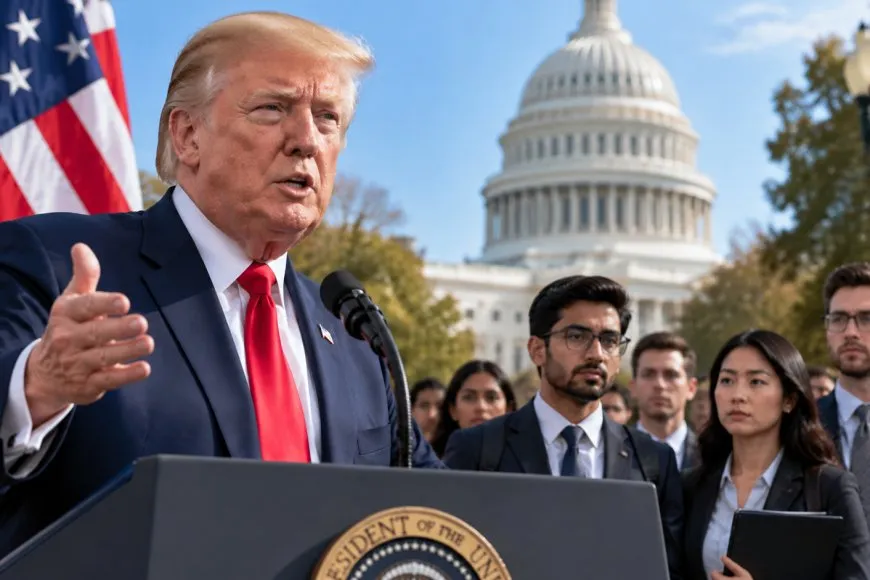
President Donald Trump has repeatedly argued that foreign workers on H-1B visas are displacing American workers. Labour economists and immigration researchers say that claim leaves out a lot.
"They are taking jobs that should go to Americans," Trump said in remarks that drew wide attention earlier this year. “We have brilliant people in this country. They do not need to be replaced.”
Many Americans share that concern. But researchers who have spent years studying the data say the full story is far more layered.
What the research actually shows
Most economists who study immigration find that high-skilled foreign workers tend to work alongside American employees rather than push them out.
A widely cited study published by the National Bureau of Economic Research found that each additional skilled foreign worker in a metropolitan area was associated with roughly 1.83 additional jobs for other workers in the same area.
“he research consistently shows that skilled immigrants expand the economy,” said one labour economist who studies immigration policy. They are not simply filling a fixed number of positions that Americans would otherwise hold.”
Some economists disagree. The Economic Policy Institute has argued that in specific job categories and wage ranges, a large supply of foreign workers does put measurable downward pressure on pay for American workers competing for similar roles.
The disagreement between these camps is not mainly political. It comes down to how researchers define a labour market, how they account for worker mobility, and how they read wage data across different time periods.
Where the concern has real weight
Policy researchers draw a clear line between two very different uses of the program.
The first is a company sponsoring a specific individual for a specific position because that person has skills the employer genuinely cannot find among available domestic candidates. Most economists consider this use broadly positive.
The second involves staffing firms that bring in large numbers of visa holders and place them at client companies, often at wages near the legal minimum. Critics argue that this model is used to reduce labour costs rather than to fill genuine gaps.
According to official data published by the Department of Labour, the top users of H-1B visas by petition volume are consistently dominated by staffing and consulting companies rather than direct-hire technology employers.
In several documented cases, American employees were required to train their replacements before receiving severance. Those situations, while not typical of the overall program, have drawn bipartisan criticism and fueled long-running public frustration.
“These are two entirely different things being discussed as though they are one,” one policy researcher said. “Direct hiring at a technology company is almost certainly good for the broader economy. The staffing model raises legitimate and serious questions.”
How the H-1B program works
The H-1B visa program was created under the Immigration Act of 1990. It allows employers to temporarily hire foreign nationals in speciality occupations that require at least a bachelor’s degree or its equivalent in a specific field.
Each year, 65,000 H-1B visas are available through a general lottery cap, with an additional 20,000 reserved for individuals who hold a master’s degree or higher from a United States university. In recent years, the number of applications received has been three to five times the number of available visas.
Employers are required to pay H-1B workers a prevailing wage as determined by the Department of Labour. That wage requirement is at the centre of the current policy debate.
What the technology industry argues
Technology companies argue that foreign-born talent is essential to American competitiveness. A 2022 report by the National Foundation for American Policy found that immigrants founded or co-founded more than half of the current billion-dollar startups in the United States.
Industry groups also contend that restricting skilled immigration does not create more opportunities for Americans. It moves work to other countries instead.
“If we cannot hire the engineers we need in the United States, we hire them in Canada or Germany,” one industry representative said. “The positions do not stay here either way.”
The Information Technology Industry Council and other major technology advocacy organisations have submitted formal comments to the Department of Labour expressing concern about proposed wage changes they say would reduce access to global talent.
Who feels the pressure most?
Experts say the workers most exposed to the program’s negative effects are not the most senior American professionals, who remain in strong demand regardless of immigration levels. The greater pressure falls on mid-level workers competing for roles that are also commonly filled by visa holders at or near the minimum wage.
According to the most recent data from United States Citizenship and Immigration Services, the median salary for approved H-1B petitions is approximately $108,000 per year. However, salaries vary widely by occupation, employer type, and geographic location.
The Department of Labour has proposed raising those minimums by roughly 30 per cent. That proposal is currently in the public comment period. Members of the public and affected organisations may submit formal comments through the official federal rulemaking portal.
What Congress has done and not done
Congress has debated H-1B reform legislation for years without passing comprehensive changes. Multiple bills have been introduced in both chambers that would tighten eligibility, raise wage floors, or change the lottery selection process. A full list of introduced legislation is available through Congress.gov.
The Congressional Research Service has published detailed nonpartisan analyses of the H-1B program and proposed reform options that are freely available to the public.
The bottom line
Whether skilled foreign workers take jobs from Americans is not a clear question.
“It is true in specific and documented ways that deserve serious policy attention,” said one researcher who has studied the program for more than a decade. “It is not accurate as a broad description of what skilled immigration does to the American labour market overall”
Most experts agree the program has real structural problems, particularly around the staffing model and wage floors, that better policy could address. Whether Washington moves in that direction remains an open question.
For workers and employers who want to track the regulatory process in real time, the Department of Labour maintains an official page with regularly updated performance data on foreign labour certification.
This article is original reporting and analysis by TechAmerica.ai. All links point to official government, academic, or nonpartisan policy sources. This article does not constitute legal or economic advice.