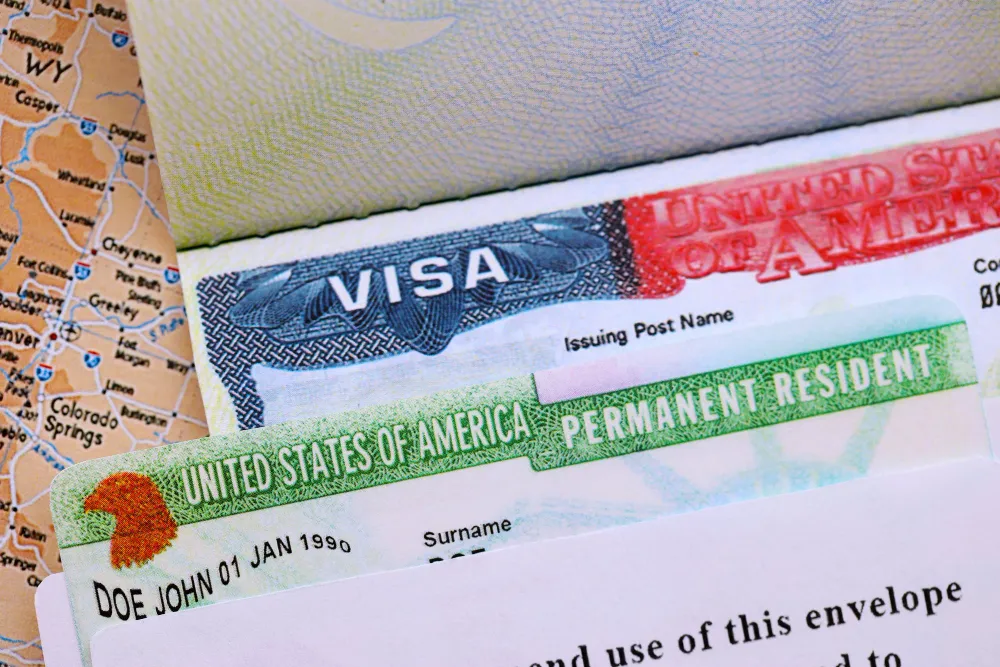
An H-1B transfer allows an eligible worker to change U.S. employers through a new immigration petition. Despite the name, the existing approval does not move from one company to another. The prospective employer must establish that the new job and the worker qualify under the H-1B program.
In many cases, workers can begin their new employment before U.S. Citizenship and Immigration Services (USCIS) approves the petition. This provision is known as H-1B portability. The filing date, requested start date, immigration history and annual cap rules determine whether it is available.
Regulatory review: November 29, 2026. Filing fees and immigration policies can change. Check the linked government resources before making employment or travel decisions.
Who qualifies for H-1B transfer portability?
Portability comes from section 214(n) of the Immigration and Nationality Act. The implementing requirements appear in 8 CFR 214.2(h)(2)(i)(H).
- The worker previously received H-1B status through lawful admission or another authorized process.
- The new employment petition is genuine, properly submitted and requests the appropriate amendment or extension before the authorized stay ends.
- The worker has not engaged in unauthorized U.S. employment between the most recent admission and the new filing.
When these conditions are satisfied, employment may begin once the petition is properly filed, provided its requested start date has arrived. A job offer, certified Labor Condition Application (LCA), or shipment tracking number does not establish portability eligibility.
A receipt notice provides useful confirmation of the filing. However, it is not an approval notice. If the case is rejected because of a defective submission, the worker may lack the protection they expected.
Does an H-1B transfer require another lottery?
Many workers who already used a cap number can change employers without entering the annual selection process again. The employer must check the worker’s prior cap history and remaining H-1B eligibility period.
| Employment situation | Cap implications |
|---|---|
| Previously counted worker changing private employers | Generally no new cap selection within the applicable H-1B period. |
| Cap-exempt employer to another qualifying cap-exempt employer | May remain exempt if the new position meets the exemption. |
| Never counted, moving from a university to a cap-subject company | Normally requires cap selection unless a separate exemption applies. |
| Concurrent cap-exempt and cap-subject employment | A specific exemption may apply while qualifying cap-exempt work continues. |
Some universities, affiliated nonprofits and research organizations qualify for cap exemptions. Employment at a nonprofit does not automatically qualify. Workers leaving concurrent cap-exempt employment should obtain advice before assuming their other petition remains usable.
H-1B transfer process step by step
- Confirm the new position. Review the job description, required qualifications, compensation, hours and physical or remote work locations.
- Review immigration history. Identify the current admission expiration date, previous approvals, cap history and any pending immigration applications.
- Obtain an appropriate LCA. The employer meets applicable wage and notice requirements and secures a certified LCA covering the proposed work.
- File the petition. The new employer submits Form I-129, supporting evidence and applicable fees to USCIS.
- Confirm the legal start date. Determine whether portability applies or approval is necessary before the employee begins the new role.
- Track the decision. Respond to requests for evidence and review the approval notice, including any attached admission record.
The Department of Labor’s LCA program guidance explains the certification process. Certification does not determine whether the worker qualifies for H-1B status. USCIS makes that decision when it evaluates the petition.
H-1B transfer document checklist
The required evidence depends on the job, immigration history, and requested period of employment. The following checklist helps workers and employers prepare.
| Document | Purpose |
|---|---|
| Passport and visa stamp, if applicable | Establish identity and identify travel documentation needs. |
| Latest Form I-94 and earlier admission records | Review admission classification and authorized stay. |
| Prior Form I-797 notices | Document petition decisions, validity dates and immigration history. |
| Recent pay statements and employment verification | Help establish maintenance of status and the employment timeline. |
| Degrees, transcripts, evaluations and licenses | Support qualifications for the proposed specialty occupation. |
| Offer letter and detailed job duties | Describe the new position, work arrangement and qualifications required. |
| Certified LCA and wage documentation | Establish applicable labor obligations and covered employment. |
| Form I-129 and supporting company records | Document the petitioner’s eligibility and proposed employment. |
| Termination records or prior pending petitions, if relevant | Help evaluate deadlines and more complicated portability cases. |
Form I-797C commonly communicates receipt or another procedural action. An I-797 approval notice records an approved petition. An I-797A generally includes a new I-94, while an I-797B does not grant an extension of stay through an attached I-94. Verify the actual notice rather than assuming all approvals have the same effect.
Workers can retrieve their electronic admission record through the CBP I-94 website. An I-94 issued by USCIS with a later extension may not appear in the CBP travel record. Review both documents if applicable.
H-1B transfer fees and who pays them
The following amounts reflect the October 26, 2026 edition of the USCIS fee schedule. They are not a universal total for every petition.
| Fee | Amount | Applicability |
|---|---|---|
| Form I-129 base fee | $780 paper; $730 online | Regular H-1B petitioner; online filing where available. |
| Reduced I-129 base fee | $460 | Qualifying small employers and nonprofits. |
| Asylum Program Fee | $600; $300; or $0 | Regular employers, qualifying small employers and nonprofits, respectively. |
| Fraud Prevention and Detection Fee | $500 | Generally required for a change-of-employer petition. |
| ACWIA training fee | $750 or $1,500 | Depends on employer size and statutory exemptions. |
| Public Law 114-113 additional fee | $4,000 | Applies to covered employers with at least 50 U.S. employees and more than half in H-1B or L-1 status, subject to current rules. |
| Optional premium processing | $2,965 | Form I-907 for H-1B petitions. |
| Consular visa application | $205 | Only if a new H-category visa application is required; other charges may apply. |
For example, a regular employer filing on paper and subject to the $1,500 training fee would pay $3,380 in the base filing, asylum program, fraud prevention and training fees. This assumes no additional covered-employer fee or exemption. Optional premium processing would raise that illustrative total to $6,345. Attorney, dependent and consular costs are separate.
Employer filing obligations are not automatically employee expenses. The Department of Labor’s worker protections prohibit certain fee reimbursements, penalties for leaving early and improper wage deductions. A worker who voluntarily requests premium processing for personal convenience may be treated differently from an employer requiring expedited processing for business reasons.
Special H-1B payment requirements and entry restrictions have also been subject to litigation and policy changes. Do not add a separate $100,000 payment to every transfer budget. Confirm the operative requirements for the specific petition and travel circumstances before filing.
The State Department fee schedule lists consular charges separately. A domestic employer change does not itself require a consular visa fee.
How long does an H-1B transfer take?
There is no fixed end-to-end H-1B transfer timeline. The employer needs time to collect documents, meet wage obligations and prepare the petition. The Department of Labor reviews LCAs within seven working days for completeness and apparent errors. Additional preparation or corrections can extend the timeline.
Regular USCIS processing depends on the petition type and processing office. Use the official processing time tool rather than relying on an old average.
Premium processing generally requires USCIS to take adjudicative action on an H-1B petition within 15 business days. An action may be an approval, denial or request for further evidence. A request for evidence can extend the total time. Premium service does not guarantee approval or accelerate a consular appointment.
When can you resign and start the new job?
Consider a software engineer with valid H-1B status through August. The new employer properly files a qualifying petition on June 10 with a requested start date of June 24. If the worker meets portability requirements, June 24 is the earliest authorized start under that filing.
The engineer should confirm the filing and status history before resigning. Waiting for the new approval may reduce uncertainty, but it is not universally required. The appropriate decision depends on the case and the consequences if the petition fails.
If the new case is denied, employment based on that pending case must stop. A prior valid approval may still support employment under its original terms if the worker remains eligible and the former employer is willing to employ them. Never assume an old approval can be used after withdrawal or expiration.
H-1B transfer after employment ends
As of the regulatory review date, 8 CFR 214.1(l)(2) retains a discretionary grace period after employment ends. It can protect eligible workers and dependents for up to 60 consecutive days, limited by the authorized validity period. It generally applies only once per authorized validity period.
The grace period is not automatic permission to work. A qualifying petition or another independent authorization is needed for employment. Document the actual termination date, review the I-94 and obtain advice before the applicable deadline.
On September 11, 2026, DHS published a proposal to remove the grace period. A proposed regulation does not itself repeal the existing rule. Recheck the effective regulation before relying on this provision.
Multiple pending petitions and the six-year limit
A worker may sometimes move to another employer while an earlier portability petition remains pending. The regulations contain specific provisions for these successive filings. A later petition can depend on an earlier one, especially after the worker’s original authorized status expires.
If an earlier extension or amendment is denied, the later extension or amendment may also fail unless a previously approved H-1B period remains valid. Workers considering a second pending employer change should have the entire sequence reviewed.
Changing employers does not restart the usual six-year H-1B maximum. Time spent abroad may be recoverable in qualifying cases. Certain employment-based green card milestones can also support extensions beyond six years. The new employer should document remaining eligibility before requesting a new period.
Travel during a pending H-1B transfer
The visa stamp permits an application for admission. It is not the document that establishes the authorized length of employment inside the United States.
The State Department’s H visa guidance explains that a compliant employer change does not automatically invalidate an existing valid H-1B visa. Reentry still depends on the relevant petition evidence, passport, visa requirements and admission rules.
Before leaving the United States, confirm whether departure affects the pending extension or amendment request. Ask which petition notice will support reentry and whether visa issuance is necessary. Check any current entry restrictions. Review the new I-94 after returning, because an admission decision may affect authorized stay dates.
What happens to H-4 dependents and green card applications?
Spouses and children in H-4 status do not receive new validity dates automatically when the principal worker changes employers. Review each dependent’s I-94 and consider a separate Form I-539 filing when an extension is needed.
Eligible H-4 spouses may apply for employment authorization using Form I-765. Eligibility can depend on an approved I-140 or certain H-1B extensions beyond the normal six-year limit. The spouse must check their own status, EAD expiration and continued eligibility.
An employment-based green card case has separate rules. Changing H-1B employers does not automatically move an employer-sponsored labor certification or immigrant petition. A previously established priority date may be retainable under applicable conditions.
Some applicants with a qualifying adjustment application pending for at least 180 days may change to a permanent job in the same or a similar occupational classification. Review the USCIS Supplement J instructions. This immigrant job portability provision is distinct from temporary H-1B portability.
Remote work, wage changes and worker protections
A transfer petition covers specific employment conditions. Later material changes, including certain worksite moves, may require a new LCA and amended petition. The employer should evaluate remote work locations, duties and compensation before implementing the changes.
Employers must meet applicable required wage and working-condition obligations. Workers should retain pay records and avoid arrangements involving false job descriptions, unpaid employer-imposed bench time or improper repayment demands. Report suspected labor violations through the Department of Labor.
Before accepting an offer involving an H-1B transfer, confirm the cap history, filing deadline, legal start date, fees, travel plans and dependent documents. For additional background, read our H-1B eligibility guide and U.S. immigration coverage.
This article provides general educational information and does not constitute legal advice. Individual cases involving status gaps, denials, pending petitions or travel should be reviewed by a qualified U.S. immigration attorney.
Answers to common questions about H-1B transfer.
Can I change employers on an H-1B visa without a new lottery?
Generally, yes, if you were previously counted against the cap and remain eligible. Moving from cap-exempt employment to cap-subject employment may require a new selection unless an exception applies.
Can I start working before my H-1B transfer is approved?
Eligible workers may start once the new petition is properly filed or on the requested start date, whichever is later. Portability conditions must be met.
Does my current employer need to approve the transfer?
No. The new employer files its own petition. However, you should coordinate your resignation, immigration records and start date to avoid a status gap.
How much does an H-1B transfer cost?
Costs depend on employer size, exemptions, filing method and additional charges. Under the October 26, 2026 fee schedule, an ordinary paper filing with the $1,500 training fee, $600 Asylum Program Fee and $500 fraud fee totals $3,380, before optional services and other applicable charges.
How long does premium processing take?
For H-1B petitions, USCIS generally must take adjudicative action within 15 business days under premium processing. This does not guarantee approval or a final decision within that period.
What if my new employer’s petition is denied?
Stop working under the denied portability filing. Whether you can return to a former employer, remain in the country or file another petition depends on your remaining immigration eligibility and the status of prior approvals.
Can I change employers after being laid off?
Potentially. Current regulations retain a discretionary grace period of up to 60 days, limited by the authorized validity period. Confirm the applicable deadline and file a qualifying petition in time. A 2026 proposal to remove this period is not itself effective law.
Can I travel while the transfer is pending?
It depends on your visa, petition, admission record and pending extension or amendment request. Review the reentry requirements and any current entry restrictions before departure.
Does changing employers reset the six-year H-1B limit?
No. A new petition does not restart the usual six-year limit. You may be able to recapture qualifying time abroad and qualify for certain green card-related extensions.
Do H-4 dependents need new applications after an employer change?
Not necessarily. Check their individual I-94 dates and whether they need an extension or EAD renewal. The new principal petition does not automatically extend their status or work authorization.
Can I change jobs while a green card application is pending?
Sometimes. Separate immigrant job portability rules may apply when a qualifying adjustment application has been pending at least 180 days, and the new permanent job is in the same or a similar occupational classification. Review the case before changing employers.
Can I transfer again before the first employer change is approved?
Successive portability filings can be possible, but a later extension may depend on the outcome of an earlier filing. The risks increase when the original authorized period has expired. Obtain case-specific legal advice.
Have another question about this story? Email the newsroom.