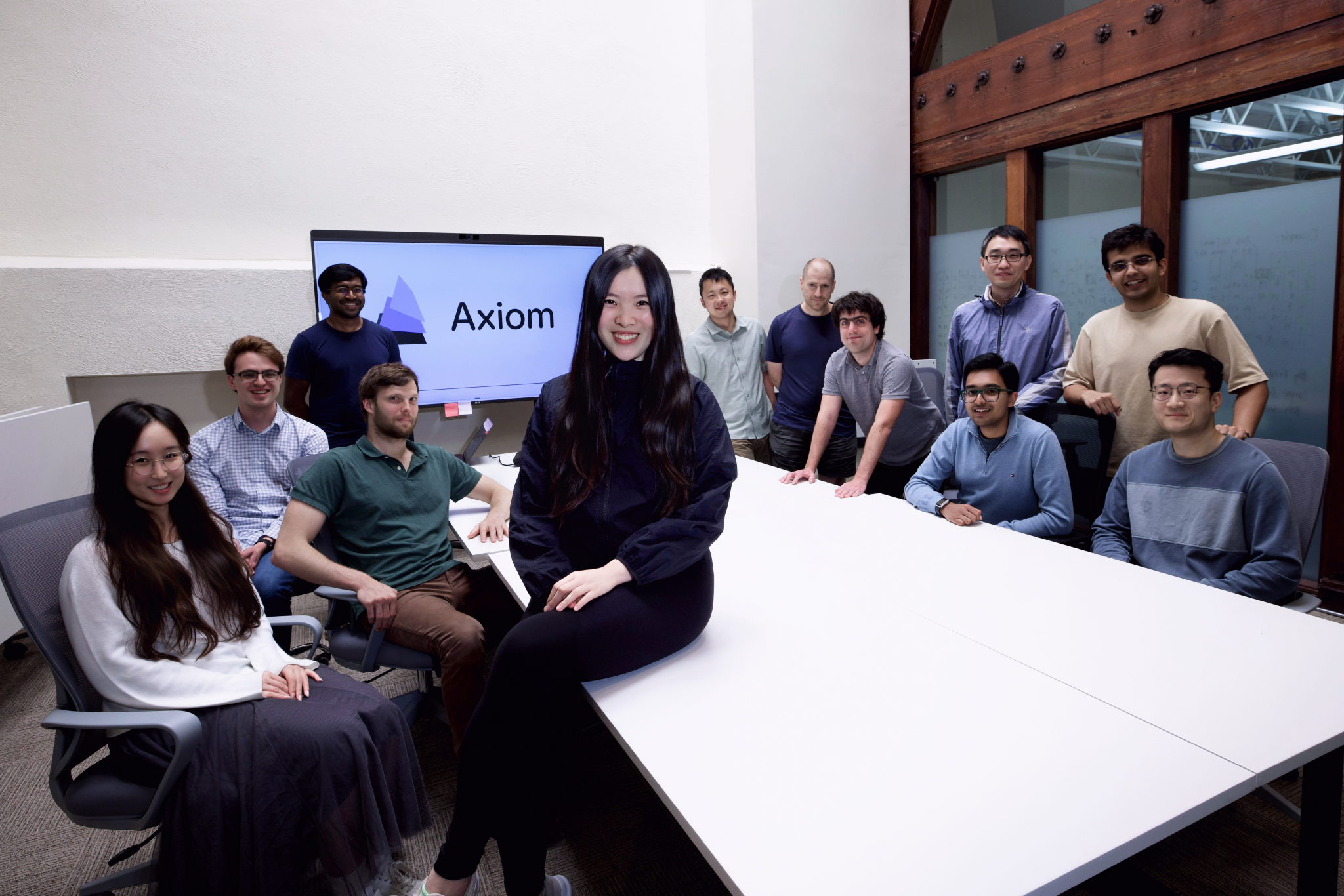
The Axiom Math Stacks Project release marks a major effort to make advanced mathematics computer-verifiable. On November 4, 2026, the startup announced that its AI agents had converted the Stacks Project into approximately 16 million lines of Lean code.
The company says its formalization preserves the reference’s mathematical structure and allows individual results to be checked using a proof assistant. The release addresses a growing concern about AI-generated mathematics: producing convincing arguments without establishing whether they are correct.
Axiom Math Stacks Project Converts 7,654 Pages Into Lean Code
The original Stacks Project is an open-source reference for algebraic geometry. Started in 2005 by Columbia University mathematician Johan de Jong, it contains 7,654 pages covering mathematical foundations and advanced research.
Columbia mathematician Peter Woit previously described the project’s importance when discussing de Jong’s recognition for mathematical exposition. An earlier account of the Stacks Project also explained its carefully organized dependencies between definitions and theorems.
The project shares the historical Bourbaki mathematical program’s emphasis on systematic mathematical foundations. Both approaches organize complex mathematics around definitions, logical relationships and reusable results.
Axiom Math used coordinated AI agents to translate the reference into Lean, a programming language and interactive theorem prover. The company announced the release through its official social media account and provided access to the formalized Stacks library.
AI Agents Work Together on Mathematical Verification
The startup divided the project among multiple AI agents working in parallel. The agents identified mathematical dependencies, generated formal statements and organized their work into a reusable library.
Axiom CEO Carina Hong said maintaining consistency across such a large mathematical structure was a central challenge. Technical staff member Ashvin Swaminathan said the agents operated within a general hierarchy while selecting individual tasks independently.
Unlike conventional language models that generate plausible mathematical explanations, Lean checks whether formal proofs follow valid logical rules. This makes the resulting code mechanically verifiable, although it does not automatically establish that every translation preserves its original meaning.
A recent research paper on AI proof translation demonstrated this limitation. The researchers found that Lean could accept mathematically valid code even when it differed from the original natural-language argument.
TechAmerica previously examined similar concerns involving OpenAI’s mathematical proof verification. The reporting highlighted why machine-checked results still require independent examination.
Formal Verification Could Extend Beyond Mathematics
Axiom’s work could eventually support applications where correctness is essential, including software development and hardware engineering. Formal verification already plays a role in semiconductor design, where engineers must establish whether systems satisfy defined requirements.
An industry discussion of formal verification in chip design describes its importance as integrated circuits become more complex.
Researchers have also explored formal methods in other fields. The Catala programming language, for example, translates certain legal rules into executable programs and uses verification techniques to improve reliability.
Investors see commercial potential in these approaches. In October 2026, Menlo Ventures announced a $200 million investment in Axiom at a $1.6 billion valuation.
Hong founded Axiom in 2025 after leaving Stanford’s doctoral program. Earlier Forbes reporting detailed the company’s efforts to recruit mathematical AI researchers and develop specialized models.
Human Review Remains Essential for AI Mathematics
Computer-checked proofs offer stronger logical guarantees than unchecked AI-generated explanations. However, researchers must still confirm that formal statements correctly represent their intended mathematical claims.
Mathematician Terence Tao has discussed the opportunities and limitations of AI-assisted research in his published views on AI in mathematics. His broader discussion emphasizes the continuing importance of mathematical understanding and human judgment.
The same distinction applies to commercial software. As Wired’s reporting on software verification explores, mathematical proof techniques are attracting attention as developers seek more reliable AI-generated code.
TechAmerica has also covered Stanford’s automated proof verification research, which combines AI-generated mathematical reasoning with formal checking and human review.
Axiom’s release provides a substantial new foundation for machine-assisted mathematics. Its longer-term value will depend on independent review, the accuracy of its formal translations and whether researchers can reliably build new results on the library.