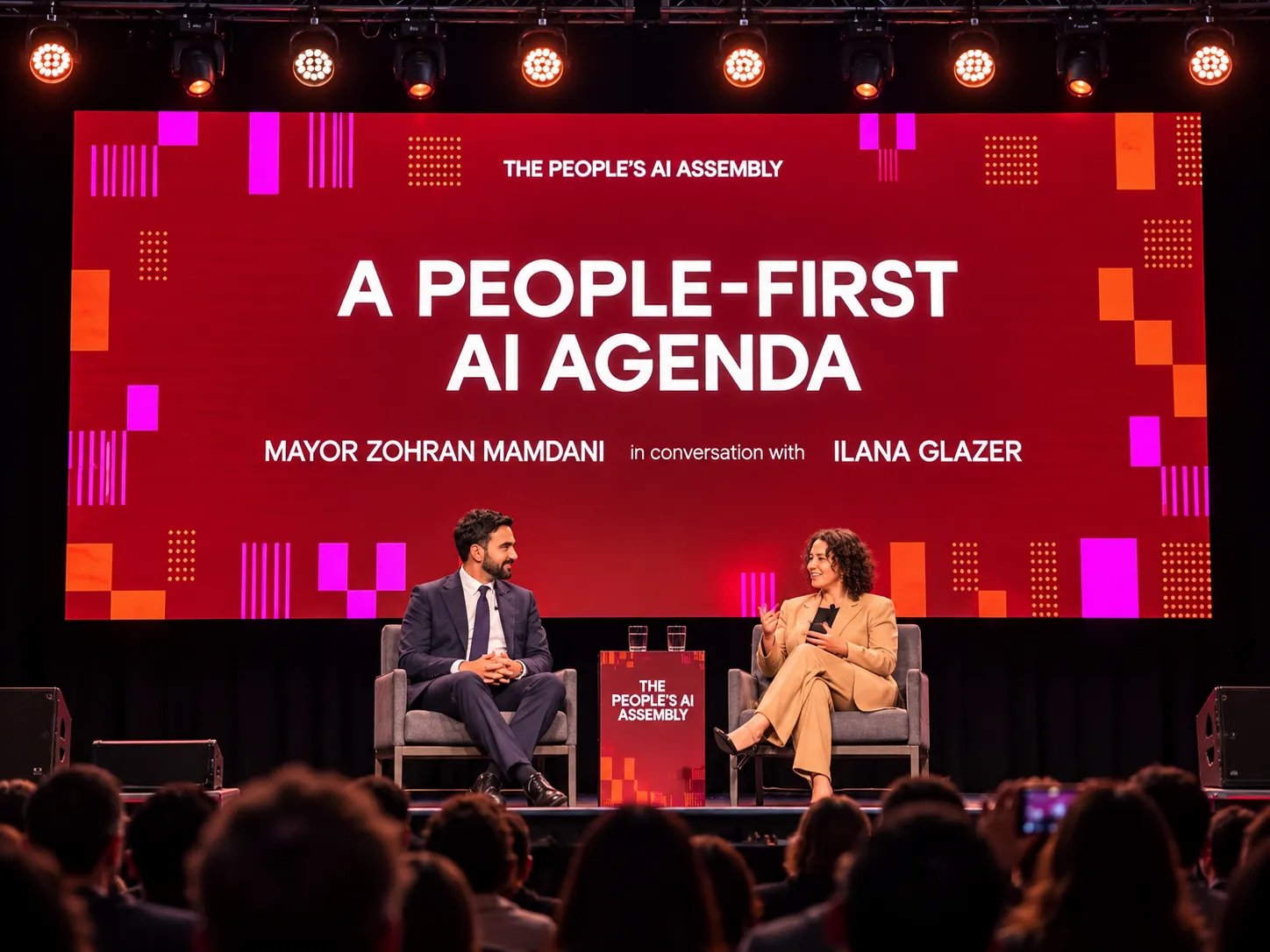
Mamdani AI regulation proposals took center stage Monday night as New York City Mayor Zohran Mamdani criticized the federal government’s approach to artificial intelligence. Speaking at The People’s AI Assembly in Manhattan, he urged residents to challenge the assumption that AI adoption is inevitable.
The October 19 event, hosted by the AI Now Institute at Webster Hall, featured a conversation between Mamdani and actor and activist Ilana Glazer. Their discussion covered AI’s influence on education, employment, housing and public accountability.
Mamdani argued that communities should have greater influence over how AI enters everyday life. He also questioned whether technology companies should determine their own safety standards without meaningful public oversight.
Mamdani AI Regulation Push Targets Schools and Housing
New York has already introduced restrictions on AI use in public schools. In September, Mamdani and Schools Chancellor Kamar Samuels announced a one-year moratorium on student-facing generative AI from prekindergarten through eighth grade.
The policy affects nearly 600,000 students and includes exceptions for certain accessibility and educational needs. High schools will offer limited supervised AI pilots and lessons on evaluating the technology critically.
Glazer, who is a parent, questioned why schools were increasingly expected to adopt AI. Mamdani responded that its introduction should remain a public choice rather than an unavoidable development.
His administration has also proposed requiring landlords and real estate platforms to disclose AI-altered property listings. The measure, part of a broader housing reform initiative, aims to protect prospective renters from misleading images. The proposal addresses concerns about deceptive AI-generated listings.
New York Mayor Criticizes Federal AI Oversight
Mamdani accused Washington of failing to establish adequate safeguards as AI companies expand their products. He argued that national discussions increasingly emphasize competition with China while giving less attention to potential social harms.
He also cited the February 28 attack on an elementary school in Minab, Iran, which killed more than 150 people, including at least 123 children. A Bloomberg investigation, citing officials involved in a Pentagon inquiry, identified outdated intelligence and excessive reliance on AI among contributing factors.
The Pentagon has not publicly released its complete findings. The incident illustrates concerns about depending on automated systems in decisions involving human lives.
Mamdani’s criticism comes as President DonaldTrump’ss administration advances its Super Intelligence Task Force. The federal initiative is examining AI risks and governance, although the administration has generally favored a lighter regulatory approach.
The mayor argued that governments must retain authority over technology companies rather than allowing developers to define their own accountability standards. His position contrasts with federal policies emphasizing technological competition and industry-led safeguards.
The debate is becoming more urgent as companies such as Anthropic and OpenAI prepare for potential public listings. Their growing commercial influence has intensified questions about transparency, public responsibility and independent oversight.
For Mamdani, local measures addressing schools and housing offer examples of how governments can establish boundaries. He called for a broader national framework that gives communities greater influence over AI deployment and its consequences.