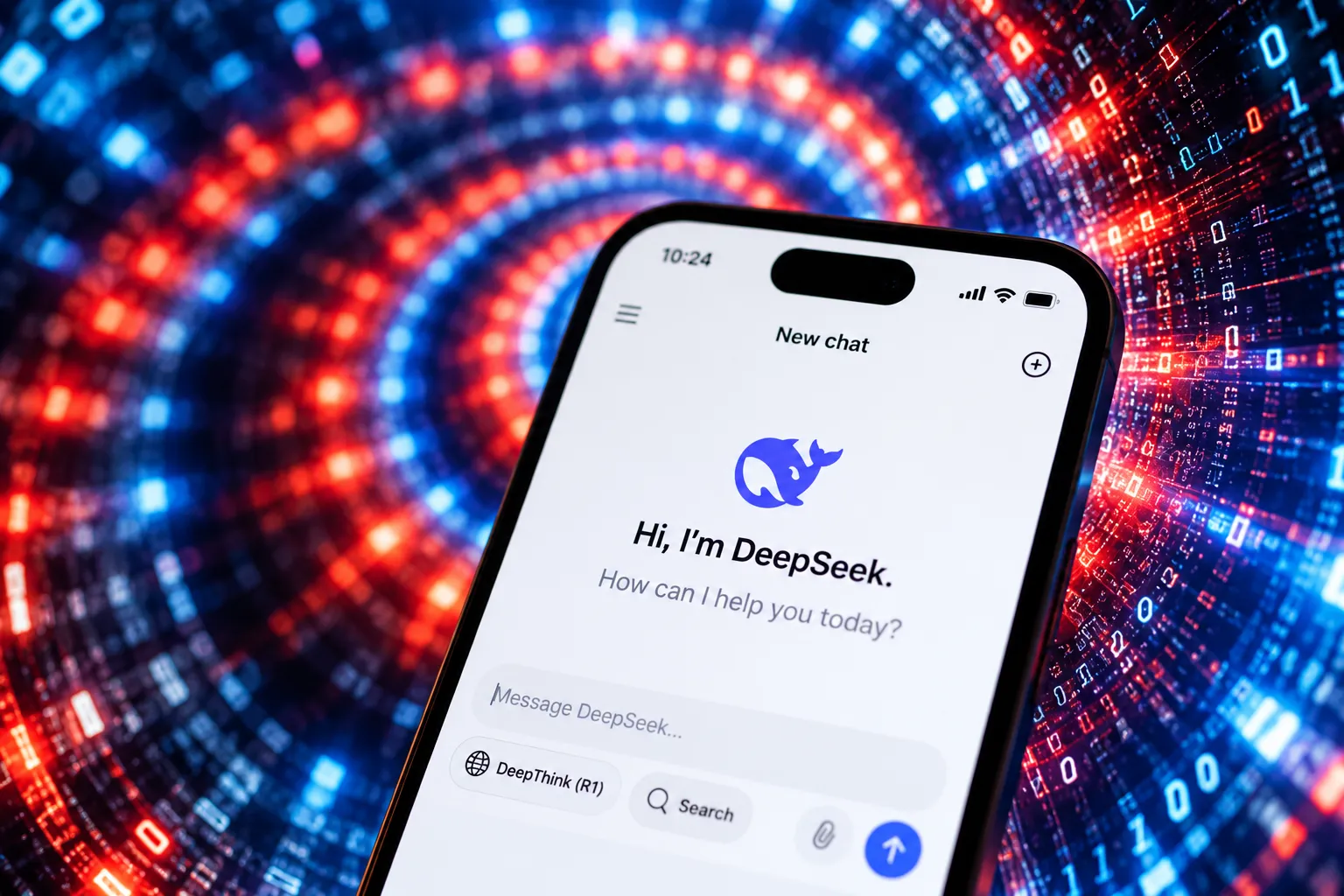
The US DeepSeek ban requires federal civilian agencies to stop purchasing technology developed by the Chinese AI company and remove affected products from government systems. The Department of Homeland Security cited national security and data privacy concerns.
The Federal Register notice, published October 20, covers DeepSeek’s products, affiliated companies and certain third-party services built using its technology. The underlying order was issued July 24.
Federal agencies must exclude covered products from future purchases and remove existing implementations. The order also allows agencies to request exceptions, subject to DHS approval.
US DeepSeek Ban Raises Data Security Concerns
DHS warned that DeepSeek’s operations in China could expose sensitive government information to Chinese authorities. The department cited China’s legal framework and the potential accessibility of information submitted through DeepSeek’s services.
The order also raises concerns about vulnerabilities in the company’s software and the security implications of using its models. These are the government’s stated risk assessments, not evidence that every DeepSeek deployment has compromised government data.
China rejected the restrictions. During an October 20 Foreign Ministry briefing, spokesperson Mao Ning accused Washington of politicizing technology and trade through an overly broad interpretation of national security. She said Beijing would defend Chinese companies’ legitimate interests.
The dispute comes as both countries consider further technology restrictions. China has reportedly proposed export controls covering 23 AI-related technologies, including advanced models and chip designs.
DeepSeek Faces Scrutiny Over AI Model Distillation
DeepSeek has faced increasing scrutiny since its R1 reasoning model challenged established American AI developers in January 2025. Its lower-cost approach intensified competition in open-weight AI development.
In September, U.S. security agencies accused six Chinese AI companies of systematically extracting capabilities from American models. A joint cybersecurity advisory identified DeepSeek, Alibaba, Moonshot AI, MiniMax, StepFun and Z.AI.
The agencies alleged that these companies used large-scale model distillation to acquire proprietary capabilities. Distillation involves training one model using another’s outputs. The technique is widely used in AI research, although unauthorized extraction can violate providers’ terms.
OpenAI separately raised concerns about DeepSeek in a February submission to Congress. The company reported observing activity it believed indicated attempts to extract capabilities from its models.
Anthropic also described unauthorized distillation campaigns involving Chinese AI laboratories. TechAmerica.ai previously covered Anthropic’s findings on alleged attempts to extract Claude’s reasoning and other capabilities.
The latest federal restrictions extend Washington’s efforts to limit DeepSeek’s role in government technology. They also highlight the growing tension between access to competitive AI models and concerns about data protection, software security and national interests.