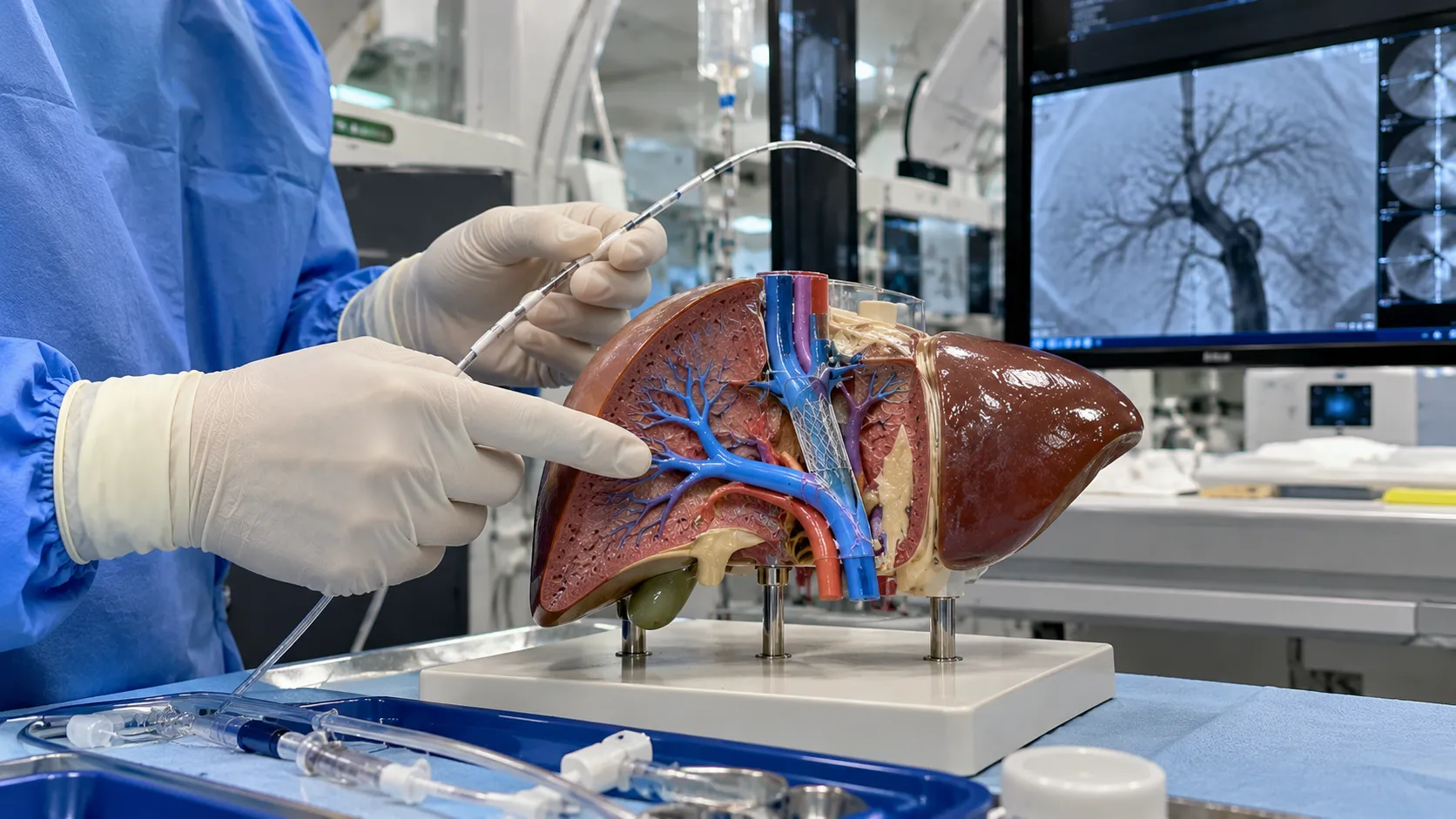
BD has launched the Liverty TIPS stent graft in the United States for patients with complications of portal hypertension. The company announced commercial availability on Oct. 28, following FDA approval on Sept. 25. The device gives physicians additional sizing options when creating a shunt through the liver.
Portal hypertension involves elevated pressure in the veins carrying blood from the digestive organs to the liver. It often develops alongside cirrhosis, when scarring obstructs normal blood flow. Complications can include bleeding from enlarged veins and persistent fluid buildup in the abdomen. A transjugular intrahepatic portosystemic shunt, or TIPS, creates an alternative route between the portal vein and a hepatic vein. A stent keeps that passage open, allowing some blood to bypass the liver and reducing pressure.
An interventional radiologist typically performs the procedure using imaging guidance. The treatment addresses complications caused by elevated pressure; it does not reverse the underlying liver scarring.
Liverty TIPS stent graft offers multiple sizing options
BD is emphasising flexibility in selecting the shunt’s diameter and covered length. Physicians must consider the patient’s anatomy, blood flow, and treatment goals when placing the implant.
According to the company’s announcement, the system includes:
-
Expandable diameters ranging from 6 to 10 millimetres.
-
Covered stent lengths ranging from 4 to 10 centimetres.
-
A fully sheathed, triaxial delivery system designed to support controlled placement.
-
Radiopaque markers that help physicians see the device under fluoroscopy.
BD says the delivery system can also track through liver tissue without a separate sheath. The company describes the available covered lengths as the longest on the market. That is a manufacturer claim, rather than evidence that the device produces better clinical outcomes than competing products. Diameter selection has clinical significance beyond fitting the implant. According to an American College of Gastroenterology guideline, larger shunt diameters are among the factors associated with hepatic encephalopathy after TIPS. That makes the amount of blood diverted through the shunt an important consideration alongside pressure reduction.
ARCH met its effectiveness target but missed its safety target
The FDA review describes ARCH as a prospective, multicenter, single-arm study. It treated 177 patients at 26 sites. The results were compared with predefined performance goals rather than a randomised group receiving another device.
At six months, 113 of 125 evaluable patients (90.4%) were free from shunt dysfunction. The result met the study’s effectiveness goal. However, 51 patients in the modified analysis population were not evaluable for that endpoint. Reasons included death, liver transplantation, shunt reintervention, withdrawal of consent and loss to follow-up. The 90.4% result therefore applies to the evaluable group, rather than everyone treated. The safety finding was less straightforward. At 30 days, 151 of 176 evaluable patients, or 85.8%, were free from major complications. Although numerically above the 85% benchmark, the result did not meet the prespecified statistical test.
The FDA nevertheless approved the device after reviewing its overall benefits and risks. The findings do not establish superiority over another stent graft. Participants are scheduled for follow-up through 24 months.
Patient selection remains important.
TIPS can help control complications of portal hypertension, but it carries risks. These include bleeding, infection, vessel injury and subsequent narrowing or blockage of the shunt.
RadiologyInfo also identifies worsening liver failure and hepatic encephalopathy as concerns. Encephalopathy can occur when substances the liver normally clears accumulate in the bloodstream.
The procedure therefore requires assessment of the patient’s liver function and overall condition. An expandable device does not eliminate those underlying risks or make every patient suitable for treatment. Other recent catheter-based device approvals include Abbott’s Amplatzer Paraclose for leaks around replacement heart valves. Edwards’ PASCAL Precision received approval for tricuspid valve repair. Both address heart conditions, while Liverty treats complications of portal hypertension. The U.S. rollout follows European CE marking in April, as MassDevice reported. BD’s announcement did not disclose U.S. pricing or a hospital-by-hospital rollout schedule.