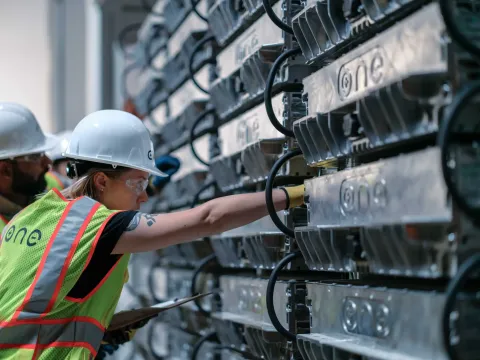
Molten Industries has begun graphite production at a demonstration facility in Oakland, California, with an annual capacity of about 300 metric tons. The startup aims to manufacture battery-grade graphite domestically, reducing dependence on Chinese suppliers.
The five-year-old company uses methane from natural gas to produce graphite and hydrogen. Its process could offer an alternative to conventional synthetic graphite manufacturing, which remains heavily concentrated in China.
According to Benchmark Mineral Intelligence, China controls approximately 74% of the graphite anode supply chain and 97% of synthetic graphite anode production.
Molten Industries graphite production reaches demonstration scale
The Oakland facility is designed to produce enough graphite annually for approximately 300 megawatt-hours of batteries, equivalent to roughly 4,300 electric vehicles.
Most of the material will go to customers testing it in battery cells. The company has not publicly identified those customers.
Co-founder and CTO Caleb Boyd said the facility’s production costs should be competitive with Chinese graphite after U.S. import tariffs. He expects future facilities to compete without relying on tariffs, although those cost projections remain unverified.
The company plans to replicate its Oakland production system at a larger facility. A location and construction timeline have not been announced.
How methane becomes battery-grade graphite
Molten Industries uses electrically heated reactors to break methane into carbon and hydrogen without introducing oxygen.
During the process, methane molecules separate into carbon and hydrogen. The carbon is processed into graphite suitable for battery anodes, while hydrogen is collected as a separate product.
Molten sells the hydrogen to a neighboring customer, providing an additional revenue source. The company claims its graphite production process uses three times less electricity than conventional methods.
Earlier efforts to commercialize methane decomposition encountered problems when carbon accumulated inside reactors. Molten says its technology addresses that challenge while producing graphite with the characteristics battery manufacturers require.
Hydrogen research led to graphite manufacturing
Molten was founded by Stanford materials science researchers Caleb Boyd and Kevin Bush, who initially focused on producing hydrogen from natural gas.
Conventional hydrogen production often relies on steam methane reforming, which generates carbon dioxide. The founders investigated methane decomposition as another production method.
During development, they discovered that their process could produce high-quality graphite rather than lower-value carbon byproducts. That finding shifted the company’s commercial focus toward battery materials.
The technology could support efforts to diversify American battery supply chains. TechAmerica.ai previously examined Sila’s expansion of domestic battery material manufacturing, another project intended to reduce reliance on imported anode materials.
Molten also sees potential demand from thermal energy storage systems, which can use graphite to retain heat.
The Oakland plant demonstrates production at a limited commercial scale. Wider adoption will depend on battery qualification testing, consistent product quality and whether larger facilities can achieve the company’s projected costs.