The Big Tech rally gathered momentum on Wednesday, November 4, as investors responded to Democratic victories in the U.S. midterm elections. Amazon, Apple, Microsoft, Alphabet and Meta were on track to add more than $750 billion in combined market value. The gains reflected expectations that tighter oversight of new data centers could slow infrastructure spending and strengthen established technology companies.
The market reaction followed a period of concern about the financial demands of artificial intelligence. Large cloud providers have committed substantial resources to computing infrastructure, raising questions about cash flow and investment returns. Wednesday’s advance suggested investors were reassessing whether a slower expansion of AI facilities could relieve some of those pressures.
Big Tech Rally Lifts Amazon, Apple and Cloud Giants
Amazon shares climbed 7.4%, reaching a three-month high, according to market figures reported by Reuters. Apple advanced nearly 7% to a record high. Meta Platforms, Alphabet and Microsoft gained between 2% and 6.3%, contributing to a broad recovery among major technology stocks.
The combined increase was approaching $750 billion in market capitalization during Wednesday’s session. That figure represented a potential gain based on prevailing share prices, not a confirmed closing valuation. It also reflected changes in investor expectations rather than new revenue or profits generated by the companies.
Apple’s participation was notable because its AI investment strategy differs from those of the largest cloud infrastructure operators. The company has avoided the same scale of data center spending, although rising memory prices have created costs across the technology sector. That pressure also affects consumer hardware markets, as discussed in TechAmerica’s coverage of gaming PC RAM prices.
Why the Midterm Elections Changed Investor Expectations
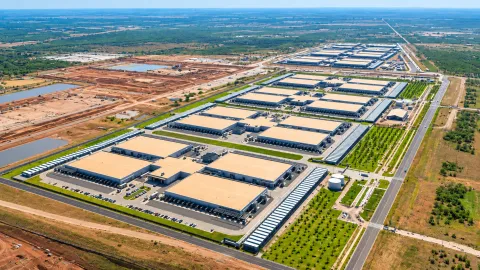
Democrats secured control of both chambers of Congress in the November 3 elections, while candidates opposing rapid data center expansion won key races. The results renewed attention to how local and state governments could influence AI infrastructure construction. Texas was particularly significant because of its substantial pipeline of proposed facilities.
New data centers require large electricity supplies, reliable grid connections and access to water for certain cooling systems. Communities have increasingly questioned the facilities’ effects on utility costs, water resources and surrounding neighborhoods. Political opposition could lead to additional reviews, construction conditions or delays, although election results alone do not establish new restrictions.
For established cloud providers, slower construction could have competing financial consequences. Delayed projects might reduce near-term capital expenditure and preserve cash. Meanwhile, existing facilities could become more valuable if available computing capacity remains scarce.
The investment argument remains conditional. Restrictions could also prevent companies from expanding services quickly enough to meet customer demand. Investors must therefore distinguish between lower spending requirements and the potential revenue lost when capacity cannot increase.
AI Infrastructure Spending Has Become a Financial Concern
Artificial intelligence requires specialized processors, high-speed networking equipment, storage systems and extensive cooling infrastructure. Building and operating these systems demands considerable capital before revenue from new services can offset the initial investment. The financial challenge becomes more complicated when customer demand and technology requirements change rapidly.
According to Reuters, major technology companies planned more than $740 billion in spending in 2026, compared with about $400 billion in 2025. The increase reflects the scale of competition to develop and operate AI services. It also helps explain why investors have become more sensitive to cash flow and financing requirements.
The International Energy Agency’s 2026 analysis provides further context. It found that capital expenditure among five major technology companies exceeded $400 billion in 2025 and was expected to rise approximately 75% this year. The agency also warned that electricity infrastructure, manufacturing capacity and financing conditions could constrain data center expansion.
Capital expenditure is not automatically evidence of financial weakness. Companies routinely invest ahead of expected demand, particularly when infrastructure takes years to develop. However, sustained spending becomes more difficult to justify when investors cannot clearly assess future returns.
Microsoft stood out among its peers in the Reuters analysis, which cited $18.6 billion in cash flow. Nevertheless, the broader concern extends beyond individual balance sheets. Investors increasingly want evidence that AI investment can translate into durable revenue growth without indefinitely escalating infrastructure costs.
Smaller Data Center Companies Face a Different Risk
The same developments that supported major technology shares weighed on smaller infrastructure companies. Applied Digital and Iren fell between 6% and 13% as investors considered the possibility of slower data center construction. Their declines highlighted a widening distinction between established cloud operators and businesses financing rapid capacity expansion.
Smaller infrastructure developers often rely on substantial borrowing or outside capital to build facilities before receiving their full expected revenue. Delays in construction, electricity access or customer deployment can complicate repayment schedules and investment plans. These risks matter most when companies spend heavily relative to current sales.
CoreWeave and Nebius also operate in a competitive environment shaped by demand for specialized AI computing. Their business models differ, but access to infrastructure and financing remains central to expansion. A slower construction market could affect companies differently depending on existing capacity, contractual commitments and funding arrangements.
Established providers have an advantage because they already operate extensive facility networks. However, their existing capacity does not guarantee that every workload can be accommodated. Specialized AI applications may require newer processors, different cooling systems and higher power density than older data centers were designed to support.
Texas Emerges as a Critical Market for AI Data Centers
Texas has become a major location for proposed data center projects because of its land availability, energy infrastructure and growing technology investment. The state’s importance was evident in Wednesday’s market response. Investors were closely examining whether the election results could alter the pace of new construction.
Dan Ives, a technology analyst at Yorkville Ives, estimated that Texas could account for approximately 25% to 30% of planned data center capacity measured in gigawatts. The estimate, Reuters reported, illustrates the state’s importance to future infrastructure investment. It should not be interpreted as a confirmed share of currently operating facilities.
Electricity availability remains a practical constraint regardless of political developments. The International Energy Agency estimates that global data center electricity consumption could rise from 485 terawatt-hours in 2025 to approximately 950 terawatt-hours by 2030. Its forecast also identifies power equipment, grid access and advanced semiconductor manufacturing as potential bottlenecks.
These limitations help explain why developers cannot expand capacity simply by purchasing more AI chips. Facilities must also secure electrical connections, cooling equipment and suitable locations. Construction delays can therefore result from technical and commercial constraints even without additional regulation.
What Slower Data Center Growth Could Mean for AI
A more measured construction pace would not necessarily reduce demand for artificial intelligence. Businesses continue exploring AI applications in software development, search, customer service and enterprise operations. The underlying computing requirements could remain substantial even if investment schedules slow.
For example, modern search services combine language models with document retrieval and other computing systems. TechAmerica has examined these requirements in its reporting on AI search infrastructure. Expanding such services requires more than additional model training, including reliable systems to process and retrieve information.
Slower infrastructure growth could also encourage companies to use existing computing resources more efficiently. Techniques such as workload scheduling, model compression and more efficient inference can reduce the hardware needed for certain tasks. However, wider adoption and the introduction of more demanding applications may offset efficiency gains.
There is also a competitive consideration. Companies with existing facilities may gain negotiating power when computing capacity is scarce. Smaller developers could face greater barriers to entry, potentially affecting cloud service prices and access to advanced AI hardware.
What Investors Will Watch After the Big Tech Rally
The sustainability of Wednesday’s gains will depend on developments beyond the election results. Investors will monitor whether proposed restrictions become enforceable policies and how quickly construction plans change. Quarterly earnings, capital expenditure guidance and customer demand will remain important indicators of the AI industry’s financial direction.
Lower infrastructure spending could improve cash flow, but it would not resolve every concern about the economics of artificial intelligence. Cloud providers still face rising equipment costs, competition for advanced chips and pressure to demonstrate profitable applications. Their ability to balance those demands will influence future investment decisions.
The contrasting performance of major technology companies and smaller data center developers underscores the market’s changing assessment of AI growth. Investors are no longer responding only to expectations of expanding computing demand. They are also examining which companies can finance that expansion and generate returns from the infrastructure already operating.
Wednesday’s rally showed how quickly those expectations can shift after political developments. Yet the longer-term outcome remains uncertain, particularly because potential construction restrictions have not been translated into uniform national policy.