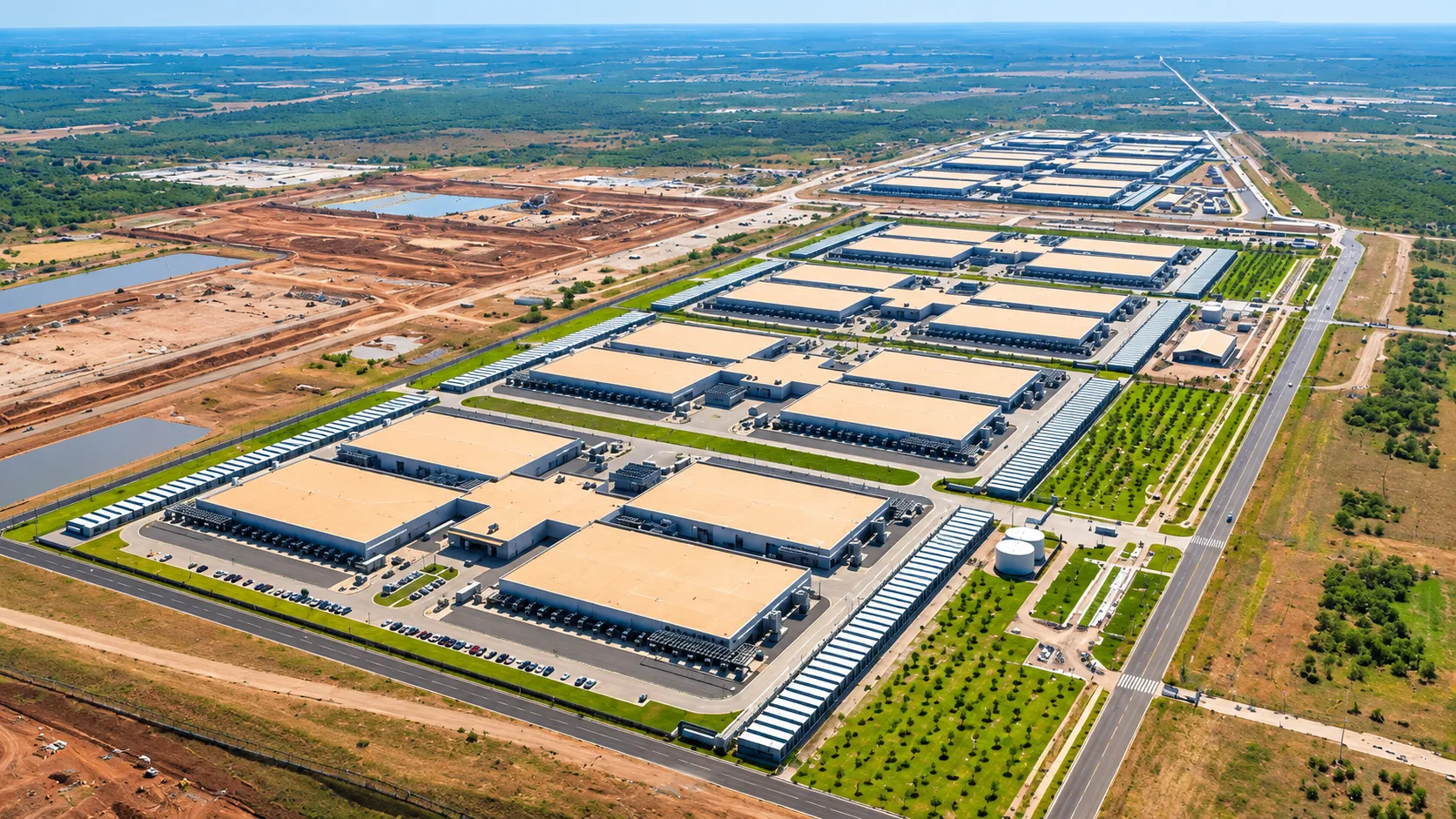
OpenAI data center plans are entering a new phase as the company promises greater transparency, stronger community protections and more local economic benefits. On November 5, 2026, OpenAI announced new policies for its future U.S. computing facilities following widespread voter opposition to data center development during the midterm elections.
The measures include restrictions on nondisclosure agreements with public officials, public reporting on electricity and water consumption, and earlier access to construction plans. OpenAI also pledged to cover the energy infrastructure costs associated with its facilities. The commitments reflect growing pressure on technology companies to demonstrate that expanding artificial intelligence infrastructure will not impose disproportionate costs on nearby communities.
OpenAI Data Center Plans Face Growing Political Resistance
Public opposition to large data centers has become a significant political issue in the United States. Residents have raised concerns about electricity prices, water consumption, noise, construction traffic and the use of public incentives to attract technology investments.
Those concerns gained prominence in the November 3 midterm elections. According to a tally from Ballotpedia, 40 of 41 data center-related ballot measures went against development interests. Democratic candidates also won governorships in Texas, Georgia and Ohio after campaigning for stricter oversight or restrictions on new facilities.
The results highlighted a growing political challenge for the technology industry. Although data centers support AI development and cloud computing, their local economic benefits remain disputed. The prospect of tougher permitting rules has also raised investor concerns about construction delays and rising development costs.
OpenAI’s response follows earlier reporting by TechAmerica.ai about the company’s proposed AI compute campuses. The terminology emphasizes computing infrastructure and economic activity rather than conventional data center operations. However, changing the name alone does not resolve concerns about resource consumption or accountability.
New Transparency Rules Target Secret Development Agreements
One of the most consequential changes concerns negotiations between technology developers and local governments. OpenAI says it will no longer use broad nondisclosure agreements with public officials when discussing future locations, while retaining narrow protections for legitimate security and proprietary information.
Such agreements have attracted criticism because they can restrict public scrutiny before communities learn that major infrastructure projects are being considered. OpenAI’s revised approach aims to let residents review development proposals and understand their potential consequences earlier.
In its November 5 infrastructure policy announcement, OpenAI introduced a National Community Compact and a Compute Campus Policy Blueprint. The compact establishes expectations for future campuses that OpenAI owns and operates. Each location would have a community engagement process, a local contact and annual public reporting.
The company also committed to publishing construction plans, conducting independent noise studies and disclosing site-level electricity and water use. These measures could help residents evaluate environmental impacts and hold developers accountable for their commitments.
However, an important limitation remains. Much of OpenAI’s infrastructure is developed or owned by partners, including Oracle. The company’s direct commitments for owned and operated campuses do not automatically establish identical obligations for every partner-controlled facility.
Electricity Costs Become a Central Concern
Electricity demand is among the most contentious aspects of AI infrastructure expansion. Modern computing facilities require substantial power for advanced processors, cooling equipment, networking systems and supporting infrastructure.
Rapid development can require utilities to expand generating capacity, substations and transmission networks. Surrounding communities ask whether these investments will raise electricity bills for households and other businesses.
OpenAI says its future campuses will pay the full cost of the power they consume and the infrastructure needed to supply it. The company also proposes financial assurances intended to protect other utility customers if major projects are delayed, reduced or canceled.
These commitments build on the company’s Grid Protectors Program, announced November 2. Under that initiative, OpenAI plans to work with utilities to reduce computing demand when electricity networks face unusually high pressure.
At its planned Effingham County facility in Georgia, OpenAI says an agreement with Georgia Power permits the utility to reduce electricity deliveries by up to 1,000 megawatts during periods of elevated demand. Such arrangements could improve grid flexibility, although they cannot replace investments in additional generation and transmission capacity.
TechAmerica.ai previously examined how AI data center energy costs are placing growing pressure on infrastructure investment. The challenge extends beyond securing enough electricity. Developers must also demonstrate that new facilities can operate without shifting unreasonable financial risks to existing customers.
OpenAI Promises Jobs and Community Investment
OpenAI is also seeking to counter the perception that large computing campuses create relatively few permanent jobs after construction ends. The company argues that equipment maintenance, infrastructure upgrades and hardware replacement will support continuing employment.
Chief Global Affairs Officer Chris Lehane told reporters that data center equipment typically needs replacement every three to five years. He also said a planned facility in southern Ohio is expected to create 2,500 long-term jobs with an average annual salary of $80,000. Those figures are company projections, not independently verified employment outcomes.
Beyond direct employment, OpenAI has outlined investments intended to address priorities identified by surrounding communities. In Effingham County, Georgia, the company cited a $4.8 million grant to support free school meals for approximately 14,000 students. In Pike County, Ohio, OpenAI and SB Energy announced a joint $6 million commitment addressing childcare needs.
The company’s framework also calls for cooperation with trade unions, community colleges and training providers. These partnerships are intended to help residents qualify for construction, electrical, mechanical and operational positions.
Employment remains an important test of the industry’s promises. As TechAmerica.ai reported in its coverage of the AI data center workforce shortage, operators struggle to recruit workers with specialized technical skills. Local hiring programs will need measurable outcomes to demonstrate whether nearby residents benefit from these projects.
Environmental Reporting and Public Oversight
OpenAI’s new framework extends beyond electricity and employment. The company says future facilities it owns and operates will develop water management plans, prioritize cooling systems that reduce water consumption and publish information about their environmental effects.
Water use has become a recurring concern because cooling systems can place additional pressure on local supplies. The environmental impact varies considerably depending on cooling technology, climate, facility design and electricity generation.
Independent noise assessments and public construction plans could also help communities evaluate operational impacts before projects are completed. Residents would gain more information about traffic, lighting and other effects associated with large industrial facilities.
Nevertheless, disclosure does not automatically establish environmental compliance or eliminate resource pressures. Local regulators must still assess whether proposed projects satisfy applicable requirements and whether developers fulfill their commitments.
OpenAI’s policy blueprint goes further by encouraging lawmakers to establish broader industry rules. It recommends public reporting requirements, greater transparency around tax incentives, and mechanisms to recover public benefits when developers fail to deliver promised outcomes.
What the New Strategy Means for AI Infrastructure: OpenAI’s announcement represents a shift in how the company intends to secure public acceptance for large infrastructure projects. Rather than emphasizing computing capacity alone, it presents energy protections, community participation, and economic benefits as essential parts of development.
The timing is significant. Technology companies are investing heavily in facilities needed to train and operate increasingly sophisticated AI systems. Yet local resistance could complicate the schedules and economics of projects that depend on access to electricity, land, permits and public infrastructure.
The new commitments may establish expectations that other developers face pressure to match. However, their effectiveness will depend on measurable results, transparent reporting and whether voluntary promises become enforceable requirements.
For communities considering future AI campuses, the central questions remain practical: who pays for infrastructure, how environmental impacts are controlled and whether promised employment and investment actually materialize.
OpenAI has now outlined how it intends to address those concerns. Whether its approach changes public opinion will depend less on corporate announcements than on how individual projects perform over time.