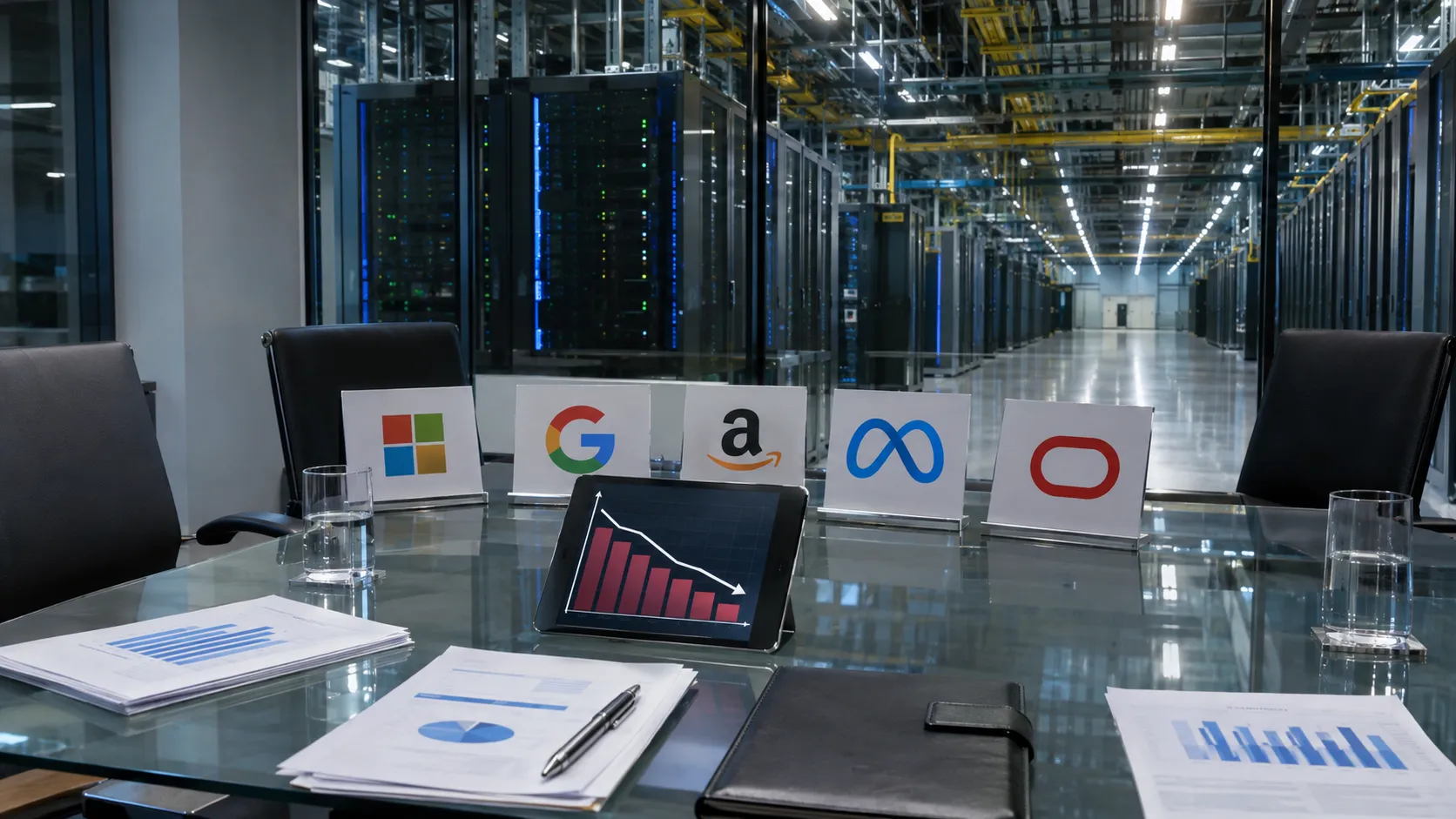
Big Tech AI spending has pushed shareholder cash returns to their lowest share in at least 15 years, even as the largest U.S. technology companies generate record operating cash flow. Microsoft, Alphabet, Amazon, Meta and Oracle returned just 9.3% of their operating cash to shareholders during the first nine months of 2026, compared with 27.4% a year earlier.
The five companies generated $542.9 billion in operating cash flow, up 29% year over year. However, their combined capital expenditures doubled to $556.9 billion, according to a Reuters analysis of LSEG data and corporate financial reports. Spending exceeded operating cash flow for the first time since 2011.
Big Tech AI Spending Outpaces Cash Generation
Unprecedented investment in AI infrastructure has changed how technology companies allocate cash. The five companies reported a combined free cash flow deficit of $14 billion during the first three quarters, reversing a $143.5 billion surplus recorded a year earlier.
Share repurchases have absorbed much of the adjustment. Combined buybacks dropped 83% to $13.6 billion from $81.8 billion a year earlier. Dividend payments moved in the opposite direction, rising to $37 billion from $33.9 billion. Companies generally treat dividends as recurring commitments, making buybacks easier to reduce when spending increases.
Alphabet and Meta made no share repurchases during the first nine months of 2026, after spending a combined $66.5 billion on buybacks during the corresponding period last year. Amazon has not repurchased shares since 2022 and does not pay a dividend. Microsoft accounted for nearly all remaining repurchases among the five companies.
AI Infrastructure Costs Put Pressure on Balance Sheets
Technology companies are spending heavily on data centers, computing hardware and the infrastructure needed to support artificial intelligence services. These investments require substantial upfront funding, while the associated revenue and profits may take longer to materialize.
Amazon’s third-quarter capital spending reached $75.9 billion, compared with $42.4 billion in operating cash flow. The company also raised $48.1 billion in long-term debt during the quarter. Amazon expects approximately $220 billion in capital spending for the full year, underscoring the scale of its infrastructure expansion.
Alphabet also reported negative free cash flow and raised approximately $29 billion through debt financing and $12.4 billion through share sales. Across the five companies, total shareholder payouts of $50.6 billion occurred despite negative combined free cash flow, effectively drawing on cash reserves or external financing.
The pressure has become increasingly visible across technology stocks. A recent Nasdaq technology selloff reflected investor concerns about whether rising AI infrastructure costs will deliver adequate financial returns. Separately, S&P Global Ratings revised Meta’s credit outlook to negative, citing uncertainty surrounding capital spending and future free cash flow.
Fewer Buybacks Create a New Earnings Challenge
The decline in share repurchases carries consequences beyond reduced shareholder payouts. Companies that retire shares through buybacks reduce their outstanding share counts, which can increase earnings per share without a corresponding rise in total profit.
Alphabet reduced its share count by 9.5% between the end of 2020 and 2025, according to ING figures cited by Reuters. That reduction alone contributed roughly 2% annually to earnings-per-share growth. Without comparable buybacks, future per-share earnings growth will depend more heavily on improvements in underlying profitability.
At the same time, expanding data center investments are expected to increase depreciation expenses as new facilities and equipment enter service. Those accounting costs could further pressure reported earnings, even if demand for AI computing continues to grow.
The wider market already shows a considerable difference in shareholder distributions. MSCI found that technology and communication services stocks delivered a shareholder yield of 0.28% in July, compared with 1.99% for the remainder of the U.S. equity market. The two sectors represented approximately 43.5% of U.S. market value.
Investors Face a Longer Wait for AI Returns
Little indicates that infrastructure spending will ease immediately. Amazon has maintained its substantial 2026 investment outlook, while other major technology companies have signaled further increases in AI-related capital expenditures.
For shareholders, the financial tradeoff is becoming clearer. Companies are directing more cash toward future computing capacity while reducing the buybacks that previously supported per-share earnings. The central question is whether those investments can eventually generate enough additional profit and cash flow to justify their cost.
The shift does not necessarily indicate weakening technology businesses, given the group’s record operating cash generation. It does, however, mark a significant change in how it uses that cash. Investors are receiving less through repurchases today while accepting greater uncertainty over when Big Tech’s AI investments will produce sustained financial returns.