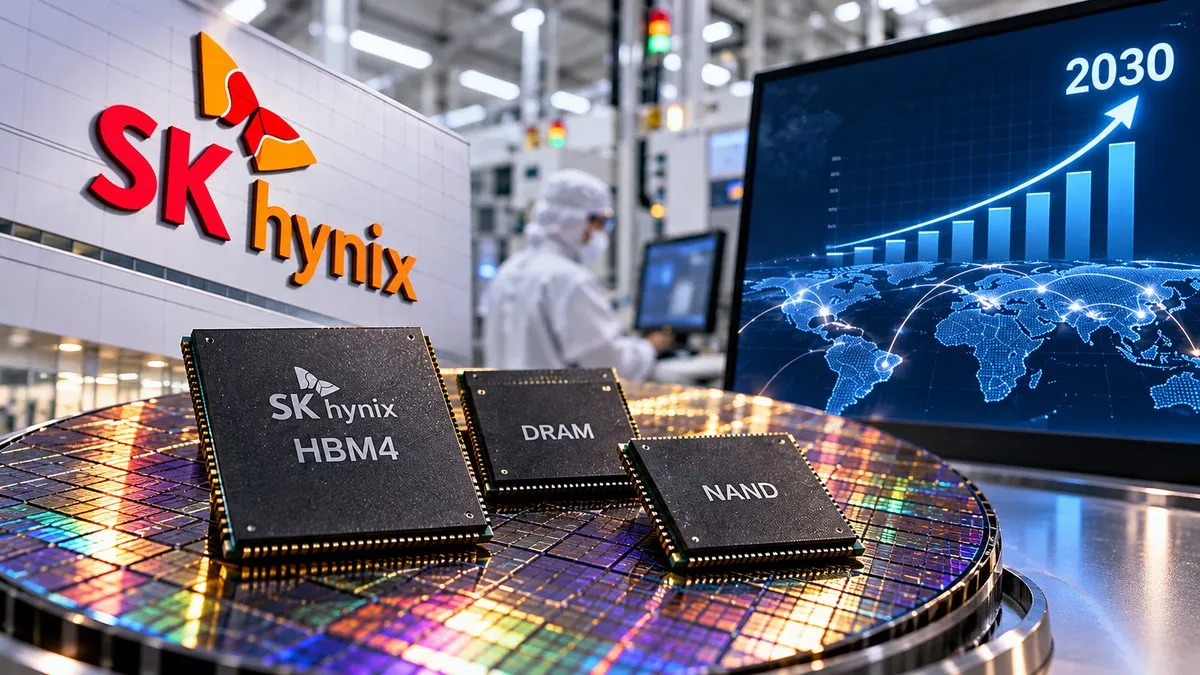
The SK hynix memory shortage could persist through 2030 as artificial intelligence companies expand their demand for advanced chips. The South Korean semiconductor manufacturer issued the warning on October 28, 2026, alongside record third-quarter earnings. Revenue reached 104.6 trillion won, while operating profit climbed to 83.3 trillion won.
The results reflect strong sales of high-bandwidth memory (HBM), server DRAM, and advanced storage products. SK hynix expects demand to continue exceeding production capacity despite plans to expand manufacturing. The company cited technical challenges and the lengthy construction timelines for new semiconductor factories.
SK hynix Memory Shortage Forecast Extends Through 2030
SK hynix expects the global memory market to remain undersupplied through the end of the decade. The forecast reflects rising investment in AI infrastructure, including data centers operated by major technology companies.
According to the company’s official earnings announcement, memory demand is expanding beyond a small group of leading AI developers. Enterprises and governments are also investing in AI systems that require substantial computing capacity.
The company expects enterprise and personal AI applications to support near-term demand. Over time, autonomous vehicles, robotics, and other forms of physical AI could further increase memory requirements.
Manufacturing capacity cannot expand immediately to meet that demand. Advanced semiconductor processes require specialized equipment, extensive testing, and substantial investment. New production facilities also take years to build and bring into operation.
The forecast is an industry outlook, not a guarantee that every type of memory will remain scarce until 2030. Supply conditions may vary across high-bandwidth memory, conventional DRAM, and NAND flash products.
Record Q3 Earnings Reflect Strong AI Memory Demand
SK hynix reported third-quarter revenue of 104.6155 trillion won, up 32% from the previous quarter. Operating profit rose 38% to 83.3338 trillion won. The company recorded an operating margin of approximately 80%.
Compared with the same quarter in 2025, revenue increased 328%, while operating profit rose 632%. Net profit reached 39.7756 trillion won, giving the company a net margin of approximately 38%.
Quarterly revenue exceeded 100 trillion won for the first time in SK hynix’s history. The company attributed the results to higher memory prices and growing sales of premium products used in AI infrastructure.
The financial results also strengthened its balance sheet. Cash and cash equivalents reached 114.5 trillion won at the end of September. Borrowings declined to 15.8 trillion won, leaving net cash of approximately 98.7 trillion won.
These figures are preliminary results reported under Korean financial reporting standards. SK hynix said the final numbers remain subject to independent audit.
HBM4 Production Expands as AI Server Demand Grows
High-bandwidth memory remains an important part of SK hynix’s growth strategy. HBM places multiple memory chips in a stacked package to deliver high data-transfer speeds. The technology is widely used alongside advanced AI processors.
SK hynix said shipments of its newer HBM4 products increased during the third quarter. The company expects HBM4 to surpass HBM3E in both shipment volume and revenue during the fourth quarter of 2026.
Server DDR5 memory also contributed to growth. Demand for high-capacity memory continues to rise as data center operators expand infrastructure for AI training and inference.
To increase production, SK hynix plans to bring its M15X facility to maximum capacity by the end of 2026. The expansion is intended to support additional HBM4 manufacturing.
The company also plans to expand its sixth-generation 10-nanometer-class DRAM process, known as 1c. It expects the technology to support more advanced DDR5 and LPDDR5 SOCAMM products for AI servers.
These investments could improve supply over time. However, SK hynix has not said it will eliminate the projected industry shortage before 2030.
NAND Flash and Data Center Storage Remain Priorities
SK hynix is also increasing production of advanced NAND flash memory. The company reported stronger sales of 321-layer triple-level cell (TLC) products used in enterprise solid-state drives.
It expects 321-layer technology to account for more than half of its domestic NAND production capacity during the fourth quarter. The transition should support greater availability of high-capacity enterprise storage products.
The company is also developing high-bandwidth flash (HBF) technology. HBF is intended to improve storage access for memory-intensive AI applications. However, SK hynix has not announced broad commercial availability for the technology.
AI infrastructure requires both fast working memory and substantial storage capacity. Large datasets and model files must be stored, retrieved, and processed efficiently. Improvements across DRAM and NAND products therefore remain important for data center operators.
Long-Term Supply Contracts Cover More Than Half of Future Capacity
SK hynix has signed long-term agreements with 14 major customers, including leading cloud service providers. The contracted volumes represent more than 50% of its planned production capacity for 2027 and 2028.
These agreements give the company greater visibility into future demand. They also include pricing mechanisms that respond to market conditions within agreed ranges.
The company expects capital investment to increase significantly in 2027. Its planned Yongin semiconductor facility will enter full-scale operation, while additional infrastructure projects will advance in South Korea and overseas.
SK hynix said investment decisions will remain tied to customer demand, profitability, and production efficiency. The company intends to expand capacity without committing to an inflexible spending schedule.
Elsewhere in the industry, memory supply concerns have already reached consumer electronics. TechAmerica.ai previously reported that Samsung expects memory shortages to worsen through 2027, reflecting broader pressure on semiconductor manufacturing.
What the Memory Shortage Could Mean for Consumer Devices
SK hynix’s warning has implications beyond AI data centers. DRAM and NAND memory are also used in smartphones, laptops, gaming systems, and other consumer electronics.
Strong demand from enterprise customers can influence component availability and pricing across the wider market. However, the company did not publish specific consumer product price forecasts through 2030.
For device manufacturers, prolonged supply constraints could make memory procurement more difficult. The impact would depend on product specifications, supplier agreements, and changing market conditions.
TechAmerica.ai has also examined how AI-related memory shortages are influencing Android development. The issue highlights how growing data center investment can affect other parts of the technology industry.
SK hynix’s record earnings show how strongly AI investment is benefiting leading memory suppliers. Its outlook also suggests that expanding production will take time. Whether shortages persist through 2030 will depend on future demand, manufacturing investment, and the industry’s ability to increase supply.