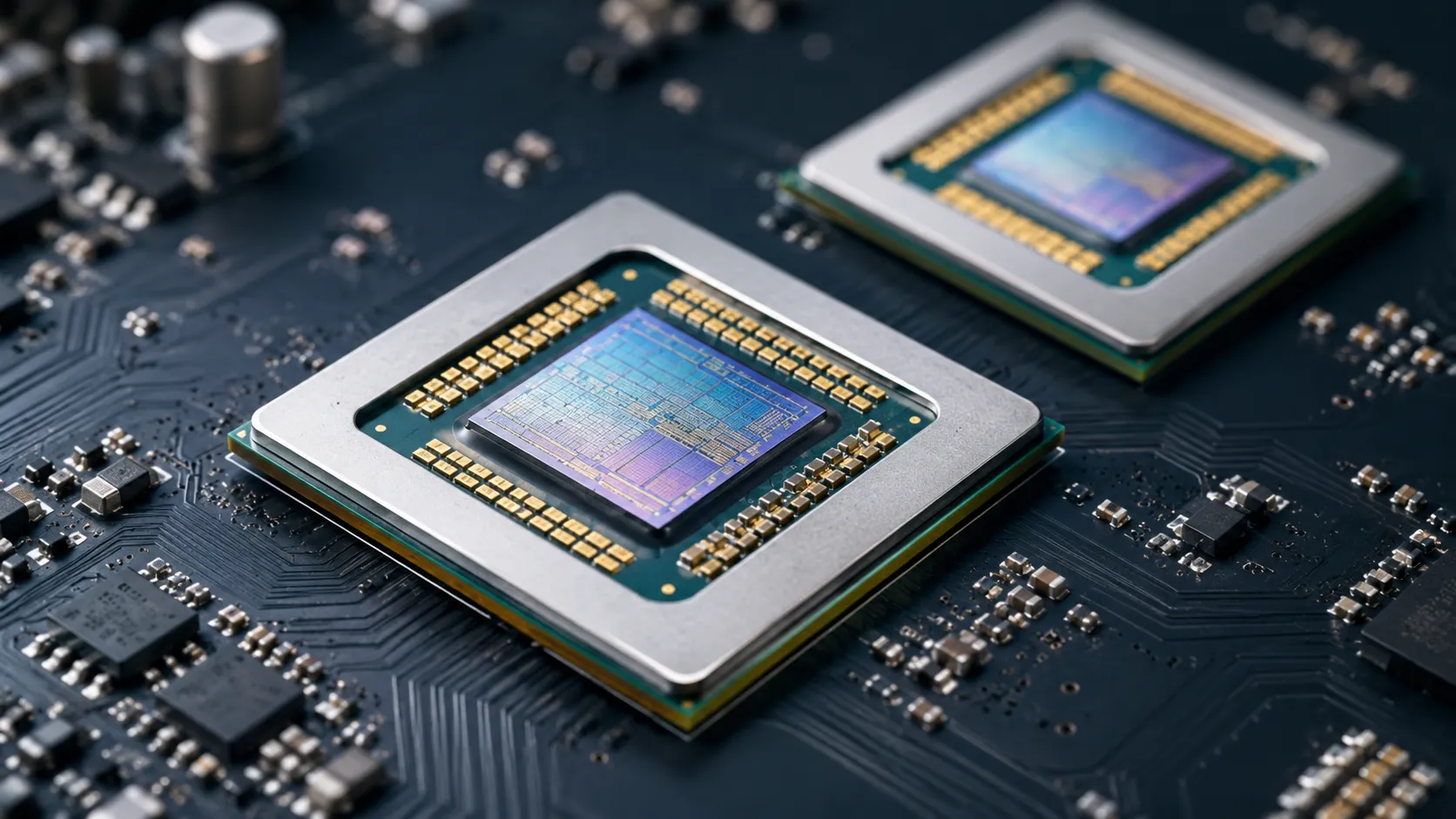
Google has expanded its custom artificial intelligence hardware lineup with two specialized Tensor Processing Unit systems. Google announced the latest AI chips on Nov. 9, 2026, targeting confidential data processing and memory-intensive AI applications. The move strengthens Alphabet’s effort to challenge Nvidia as enterprise demand for AI computing grows.
The additions, TPU 8tx and TPU 8i Max, build on Google’s existing eighth-generation processors. Rather than introducing entirely new chip architectures, Google has adjusted how processors, memory, networking and security components work together. This approach lets the company address different AI workloads without developing separate silicon designs for every application.
Google AI Chips Target Different Enterprise Workloads
Google’s new systems address two increasingly important requirements: protecting sensitive information during AI processing and handling larger amounts of data within individual tasks. Both are becoming more significant as businesses deploy AI agents that perform complex, multistep operations.
According to Google’s official announcement, the new configurations expand its eighth-generation portfolio to four systems. The previously announced TPU 8t focuses on large-scale model training, while TPU 8i supports low-latency reasoning and inference.
TPU 8tx Adds Hardware-Level Protection
The TPU 8tx is designed for government agencies and businesses operating under strict data protection requirements. These include organizations processing financial information, confidential documents or proprietary AI models. Its architecture combines Google’s TPU technology with fifth-generation AMD EPYC processors.
Traditional encryption protects information at rest and in transit, but processing often requires exposing data in system memory. The 8tx introduces hardware-level confidential computing capabilities to help protect sensitive information while applications run. Google says the system also isolates model weights and private data during AI inference.
The configuration supports model fine-tuning, reinforcement learning and smaller-scale training. Organizations can perform these operations without transferring sensitive workloads between separate computing clusters. Google claims the 8tx delivers up to twice the speed of TPU 8t in latency-sensitive operations, with minimal performance overhead from its security features.
Those performance figures are company claims, not independently verified results. Actual performance will depend on software, model architecture and workload configuration. Confidential computing also does not eliminate every potential security risk or replace organizational access controls.
TPU 8i Max Doubles Computing and Memory Resources
The TPU 8i Max addresses a different infrastructure limitation. Advanced AI applications increasingly require large context windows, allowing models to analyze extensive documents, software repositories and other complex information within a task.
Google combines two TPU 8i processors in one package to increase available resources. According to its technical announcement, the configuration provides twice the computing capacity, on-chip SRAM and high-bandwidth memory throughput of a standard TPU 8i.
Additional memory bandwidth can reduce bottlenecks when processors exchange large amounts of information. This is particularly relevant for coding assistants, mathematical reasoning systems and AI applications supporting scientific research, including drug discovery.
The dual-chip design also increases computing density within the existing rack footprint. That could help data center operators support more demanding workloads without proportionally expanding physical infrastructure. However, double the theoretical computing resources does not guarantee twice the application performance.
Google Expands Its Challenge to Nvidia
Google originally developed TPUs to accelerate its internal services, including machine learning applications and its Gemini models. The company has increasingly extended access to enterprise customers through Google Cloud and direct data center deployments.
This expansion creates additional competition for Nvidia, whose GPUs remain widely used for AI training and inference. Google’s strategy emphasizes specialized processor configurations, integrated networking and software designed around specific enterprise requirements.
TPUs are not direct replacements for Nvidia GPUs in every environment. Organizations must consider framework compatibility, software maturity, infrastructure costs and workload portability when selecting accelerators. Google’s broader support for PyTorch and open-source serving tools aims to reduce some of those adoption barriers.
Google says its TPU business now serves nearly 100 customers. The latest systems demonstrate how the company is expanding beyond general AI acceleration toward configurations optimized for particular operational needs.
What the New TPUs Mean for AI Infrastructure
The TPU 8tx and 8i Max reflect growing demand for secure computing and larger AI context windows. Their introduction also highlights the importance of system-level design, where memory, networking and security can matter as much as raw processor performance.
For enterprise customers, key questions will include deployment availability, application compatibility, operating costs, and demonstrated performance. Google has outlined the systems’ technical capabilities, but the announcement does not establish a universal performance advantage over competing accelerators.
The additions give Google a broader hardware selection for enterprise AI workloads. Their longer-term impact will depend on customer adoption and how effectively the systems perform outside Google’s own infrastructure.