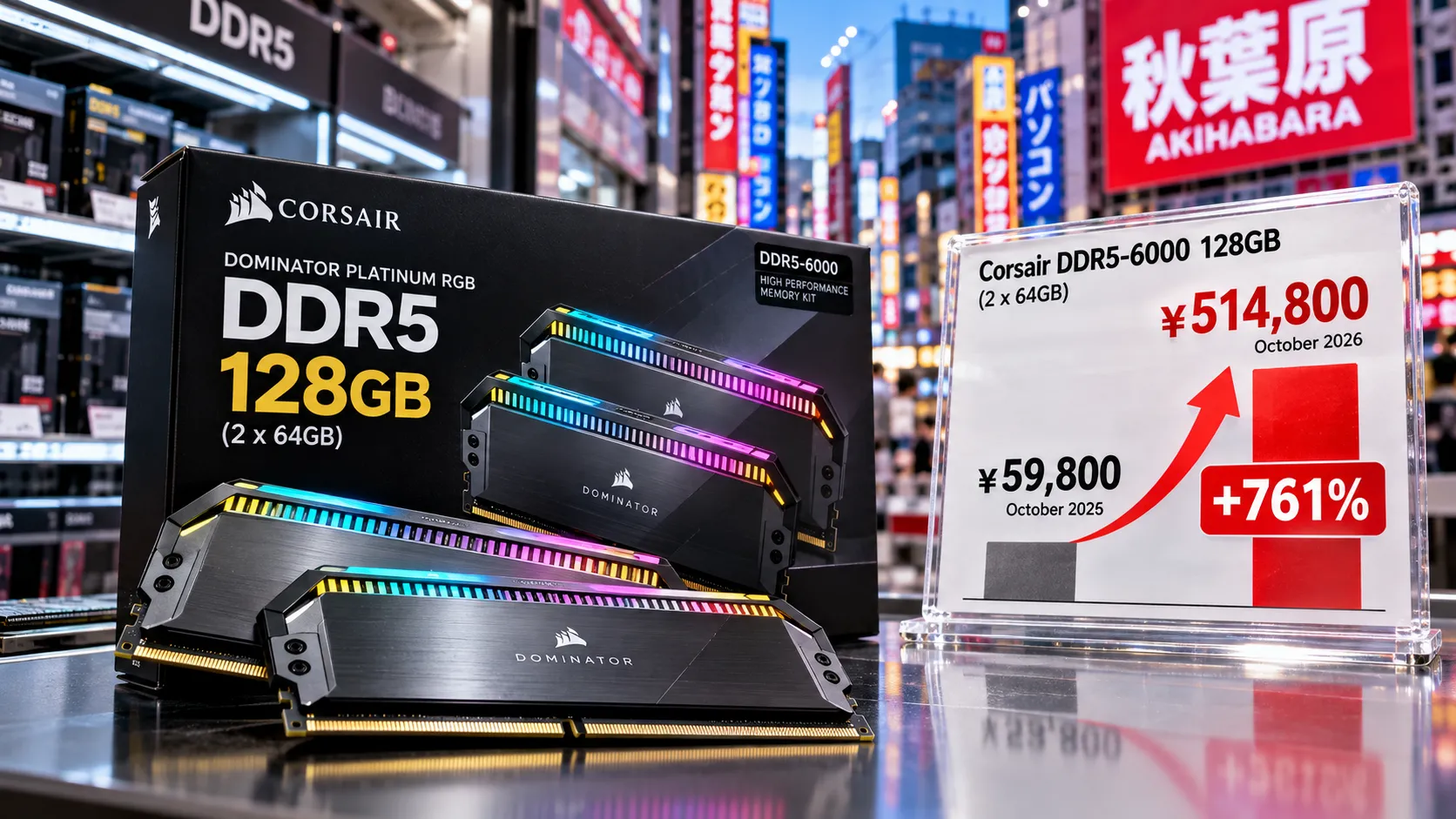
DDR5 RAM prices in Japan have climbed sharply, with one Corsair 128GB memory kit rising 761% in just over a year. The DDR5-6000 kit was listed at ¥514,800 during an October 17–24 retail survey in Tokyo’s Akihabara electronics district. The same configuration cost ¥59,800 when researchers first recorded its price in October 2025.
The increase adds ¥455,000 to the cost of a single memory kit. Other DDR5 configurations have also become more expensive, although the increases vary considerably by product. The findings highlight mounting costs for PC builders who need high-capacity memory for demanding applications.
DDR5 RAM Prices in Japan Reach ¥514,800 for 128GB
The latest figures come from AKIBA PC Hotline’s retail survey, published October 29, 2026. Researchers tracked memory prices at electronics stores in Akihabara, one of Japan’s major computer hardware markets.
The most striking example was a Corsair DDR5-6000 kit containing two 64GB modules. It returned to stock at ¥514,800 after previously being unavailable. That price is up 760.9% from the ¥59,800 recorded on October 4, 2025.
The rise has accelerated recently. On September 12, 2026, the same Corsair configuration was listed at ¥316,980. Its October price was ¥197,820 higher, representing a 62.4% increase in roughly six weeks.
The figures describe one specific product, not the average price of all DDR5 memory. High-capacity kits can have different pricing patterns because of their specifications, availability, and manufacturer configurations.
The survey also captures advertised retail prices at particular moments. Those prices can change as stores receive shipments, adjust inventory, or introduce promotions.
Smaller DDR5 Kits Are Also Becoming More Expensive
The price increases extend beyond 128GB configurations. AKIBA PC Hotline recorded higher prices across several mainstream memory categories during its late-October survey.
A Crucial DDR5-5600 128GB kit was listed at ¥399,980. Some retailers were already charging prices in the ¥440,000 range. The survey also found substantial increases compared with earlier historical lows for this configuration.
For buyers considering 64GB of memory, the situation was less extreme but still expensive. A Crucial DDR5-6400 kit containing two 32GB modules reached ¥139,980. That represented a ¥4,000 increase from the previous survey.
A 64GB DDR5-5600 configuration was listed at ¥104,980, up ¥7,000. Meanwhile, a 64GB DDR5-4800 kit climbed ¥11,000 to ¥125,800.
Smaller 32GB kits also experienced increases. Crucial DDR5-6400 memory reached ¥65,800, while a Corsair DDR5-6000 configuration was listed at ¥72,980. Both were more expensive than during the previous survey.
Researchers also observed fewer stores carrying certain configurations. Availability for the DDR5-5600 64GB category fell to approximately half its previously recorded level.
These observations suggest that buyers face pressure across several memory capacities. However, they do not establish that every DDR5 product has increased by the same percentage.
Why Are DDR5 Memory Prices Rising?
The Japanese retail figures come amid growing pressure on the global memory industry. Demand from artificial intelligence infrastructure has increased interest in advanced DRAM products. Manufacturers are also investing heavily in memory technologies used by data centers.
High-bandwidth memory, commonly known as HBM, is particularly important for AI accelerators. It is not interchangeable with desktop DDR5 memory. However, both technologies operate within the broader semiconductor manufacturing industry.
Production decisions can affect how manufacturers allocate investment, equipment, and manufacturing capacity. Strong demand for higher-value server products may influence the availability and pricing of other memory categories.
TechAmerica.ai previously examined these pressures in its coverage of the SK hynix memory supply outlook. The South Korean chipmaker expects supply constraints to persist as investment in AI infrastructure continues.
Those industry developments provide context for the price increases in Japan. However, the Akihabara survey does not establish how much of the Corsair kit’s 761% increase resulted directly from AI demand.
Local inventory conditions, distribution costs, supplier pricing, and currency movements may also influence retail prices. The survey records these changes but does not isolate each factor’s contribution.
What Higher RAM Prices Mean for PC Builders
The latest prices create a difficult purchasing environment for people assembling or upgrading computers. Memory is essential, and the required capacity depends on the applications a system must run.
Many gaming PCs can operate effectively with 32GB of RAM. Higher capacities may help with professional video editing, virtual machines, complex development environments, and large local AI workloads.
However, installing more memory does not automatically improve performance. Users benefit most when additional capacity addresses an actual memory limitation. Purchasing 128GB without a clear workload requirement may offer little practical advantage.
Compatibility is another consideration. Buyers should verify motherboard support, processor memory specifications, and how many memory modules their systems can accommodate. High-capacity configurations may also have different supported operating speeds.
For existing systems, keeping installed memory may make sense when current capacity meets everyday needs. Buyers building a new computer should compare prices across several compatible kits rather than relying on a single retailer.
TechAmerica.ai has previously explored the wider causes of rising consumer memory prices in its analysis of why RAM has become more expensive. The issue extends beyond individual gaming components and reflects changes across the semiconductor supply chain.
Will DDR5 RAM Prices Continue Rising?
The October survey confirms substantial increases in several Japanese retail listings. It does not establish how long those prices will remain elevated or whether every market will follow the same pattern.
Memory pricing can change with manufacturing output, customer demand, available inventory, and competition among suppliers. Additional production could eventually improve availability, but new semiconductor capacity takes time to develop.
The Corsair 128GB kit provides an unusually dramatic example of the current situation. Its price increased from ¥59,800 in October 2025 to ¥514,800 in October 2026. That is more than eight times its earlier price.
For PC buyers, the immediate concern is the cost of obtaining enough memory for their needs. The Akihabara figures show that both high-capacity and mainstream DDR5 configurations have become more expensive. Whether those increases continue will depend on future supply conditions and retail pricing.