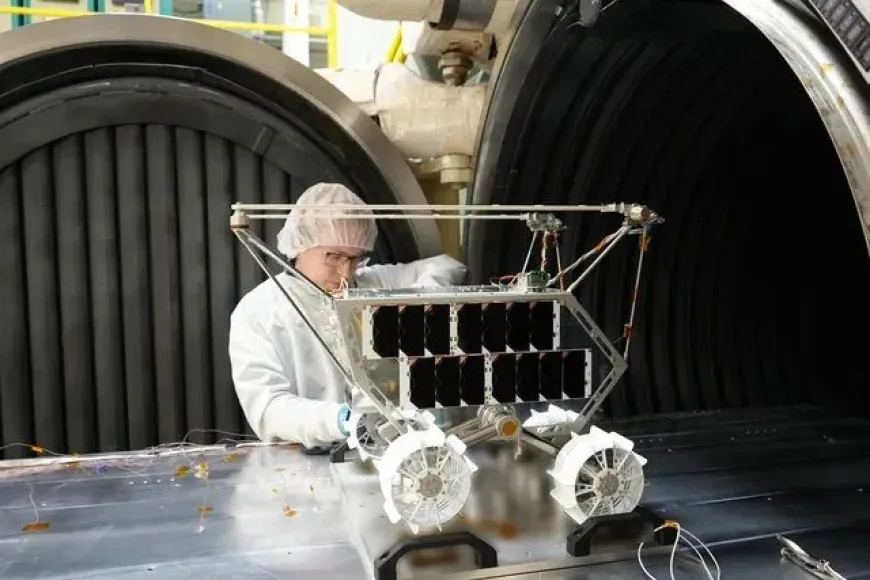
Nvidia’s push to expand the reach of its AI hardware is heading beyond Earth. Lunar Outpost, a startup developing robotic systems for lunar infrastructure, announced that its next moon rover will use Nvidia’s Jetson platform to power its lidar system. This move could make it the first GPU to operate on the lunar surface.
The company said it is evaluating Nvidia’s compact AI computing platform alongside its existing flight computer as it prepares future robotic missions designed to operate in one of the harshest environments known.
"We're taking the Nvidia Jetson and comparing it to our flight compute platform that has a little bit more spaceflight heritage," Lunar Outpost CEO Justin Cyrus said. "We're really pushing towards trying to adopt these more capable GPU-powered systems in these extreme environments."
Supporting NASA’s lunar ambitions
The announcement comes as NASA continues working with private companies to explore the Moon ahead of planned astronaut missions that could begin as early as 2028. Through its commercial lunar exploration program, the agency is funding companies that can deliver scientific instruments to the Moon, helping researchers study the terrain and search for valuable resources such as water.
Nvidia recently expanded its space ambitions through a partnership with Firefly Aerospace, whose lunar lander became the first privately built spacecraft to complete a successful robotic moon landing. Under that agreement, Nvidia’s Jetson platform will process imagery aboard a satellite orbiting the Moon, supporting mapping efforts and tracking the increasing number of robotic missions operating on the lunar surface.
Lunar Outpost’s next rover will travel aboard an Intuitive Machines lunar lander and is designed to carry scientific instruments into craters and other locations that are difficult to study from orbit. A later mission will explore Reiner Gamma, a mysterious region known for its unusual magnetic properties that has puzzled scientists for decades.
Both missions are expected to launch aboard SpaceX Falcon 9 rockets before the end of the year.
Why Nvidia’s Jetson matters in space
Although Nvidia is widely known for AI processors such as Blackwell and Vera Rubin, its Jetson platform plays a different role. Designed to be compact and energy efficient, Jetson enables robots to process sensor data locally, allowing them to understand their surroundings and react without depending on remote computing.
Cyrus said Lunar Outpost’s autonomy software has evolved from relying primarily on deterministic programming to combining traditional systems with physical AI, enabling robots to make more intelligent decisions while still maintaining reliability.
"Our autonomy stack was a bit more deterministic five years ago, and now it's a combination of deterministic and physical AI," Cyrus said. "We still run both in parallel, and then it's our job to figure out where physical AI can actually plug into our stack and help us do things that no one's done before."
Extreme conditions present major challenges.
Running advanced AI hardware on the Moon is significantly more difficult than operating computers in Earth orbit. Electronics on the lunar surface must withstand intense cosmic radiation, dramatic temperature swings and long lunar nights while consuming very little power.
"Your system has to survive lunar night and has to do so on very low power," Cyrus said.
If Jetson performs successfully, Lunar Outpost expects its robotic vehicles to become more capable of processing their surroundings, making autonomous decisions, and supporting NASA’s long-term goal of establishing a sustained human presence on the Moon. The company believes intelligent robotic workers will be essential for building infrastructure before astronauts can live and work there permanently.
"What we at Lunar Outpost are currently working on is how do we go from exploration to permanence, how do we actually build that outpost on the moon?" Cyrus said. "We do think combining our deterministic models plus the physical AI layer—that's what allows us to make a human presence in space sustainable, actually having that robotic workforce."
Looking ahead, Lunar Outpost plans to launch several additional autonomous rovers, including Pegasus, a larger vehicle intended to transport astronauts. Pegasus is expected to fly aboard Blue Origin’s future lunar rocket, although that timeline remains uncertain following an anomaly that delayed the launch vehicle’s return to service.
Cyrus said the company remains aligned with NASA’s current schedule despite the delays, adding that progress continues on the launch infrastructure. For Lunar Outpost and other companies pursuing permanent lunar operations, more powerful launch vehicles will be key to delivering larger robotic systems, scientific equipment and eventually the infrastructure needed to support a lasting human presence beyond Earth.