Ray-Ban Meta smart glasses are no longer a single uniform wearable. Meta now offers camera-equipped frames, an audio-only design, performance-oriented Oakley models and a pair with an in-lens display. They share parts of the Meta AI ecosystem, but their sensors, control methods and practical limits differ. This independent technical analysis examines the documented hardware and software across those models rather than treating every frame as a miniature augmented-reality headset.
The distinction matters when someone asks what an AI-enabled pair of glasses actually does. A microphone and camera can send spoken questions and selected visual information to an assistant. A display can return text, maps and image previews to one eye. An electromyography wristband adds a third kind of input. None of those features, by itself, proves fully autonomous computing, continuous scene understanding or reliable offline intelligence.
How Ray-Ban Meta Smart Glasses and Meta AI Work
The basic camera-and-audio architecture combines an image sensor, microphones and speakers near the ears. Short-range radios, rechargeable cells and a companion smartphone application complete the system. The wearer initiates a voice request or captures a photograph. The glasses perform local sensing and control, while the phone and network can provide additional processing and connectivity. The exact division of tasks depends on the product, firmware, account, region and AI feature.
A wake phrase such as “Hey Meta” activates the interaction path. Speech recognition identifies the request, and an assistant interprets it. A response returns through the speakers or, on the display model, the lens. A visual question may require a camera frame rather than an entire recorded video. This is different from saving a photo to the wearer’s media gallery, even though both operations use the camera hardware.
Meta uses the name Meta AI for its assistant experience. In 2026, Meta introduced Muse Spark as a foundation model for a rebuilt Meta AI experience. It also announced Muse, a more autonomous personal agent. Those names are not interchangeable. An AI model, a consumer assistant and a task-completing agent describe different software layers. Meta has not published a complete model-routing map for every glasses model and language.
Meta Smart Glasses Models Covered and Their Technical Roles
Comparison 1: Device Types and Release Status
| Model or family | Category | Distinct technical role | Documented status by Nov. 2026 |
|---|---|---|---|
| Ray-Ban Meta (Gen 1) | Camera + audio | Original 12MP camera and five-mic architecture | Released; earlier generation |
| Ray-Ban Meta (Gen 2) | Camera + audio | 3K video and longer typical battery rating | Released |
| Ray-Ban Meta Gen 2 Optics | Camera + audio | Prescription-oriented frame geometry | Released; Gen 2 technology family |
| Ray-Ban Meta (Gen 3) | Camera + audio | Six microphones, assignable action button, nine-hour rating | Released September 2026 |
| Ray-Ban Meta Audio | Audio only | AI conversation and calls without a camera | Shipping began October 2026 |
| Meta Ray-Ban Display | Camera + mono display | Right-eye color display and EMG wristband control | Released; market-specific rollout |
| Oakley Meta HSTN | Sports-oriented camera + audio | 3K capture in IPX4 frame | Released |
| Oakley Meta Vanguard | Sports-oriented camera + audio | Centered wide-angle camera, IP67, fitness integrations | Released |
| Meta Glasses (Adventurer, Fury, Starfire and later styles) | Camera + audio | Alternative frame platform with Muse Spark rollout by region | Released; style and regional differences |
The table groups eyewear by its documented interaction architecture, not visual appearance. Different frame designs can share sensors with another model; conversely, a similar-looking frame can omit a camera or display entirely. Special editions and lens colors are not separate computing platforms without evidence of different electronics.
Comparison 2: AI Assistants, Models, Chips and Computing
| Model family | AI experience | Named model or agent status | Processor / compute disclosure |
|---|---|---|---|
| Gen 1 / Gen 2 / Gen 2 Optics | Meta AI, supported voice and multimodal requests | Exact per-request model not disclosed | Exact current SoC SKU not established by checking current manufacturer spec.s |
| Gen 3 | Meta AI and live AI features where supported | Muse wearable agent announced for future rollout | Exact SoC SKU not publicly confirmed here |
| Meta Audio | Meta AI voice assistant | Muse glasses integration announced, rollout varies | Chipset model not publicly confirmed here |
| Meta Ray-Ban Display | Meta AI + visual user interface | Not equivalent to fully local large-language-model inference | Exact SoC SKU not publicly confirmed here |
| Oakley HSTN / Vanguard | Meta AI and supported sport connections | Underlying model route not published per task | Exact chipset model not publicly confirmed here |
| Meta Glasses collection | Meta AI | Meta says Muse Spark launched on this family in US/Canada; regions differ | Exact chipset model not publicly confirmed here |
An unspecified chipset is not evidence that the glasses have no processor. It means a precise part number could not be confirmed from the primary documentation checked. The small power and thermal envelope makes a hybrid device, phone and cloud processing plausible, but the path of an individual AI request should not be invented. Likewise, Muse is an announced agent integration, not a universally installed firmware feature.
Comparison 3: Cameras, Photographs and Video
| Model | Camera | Video information confirmed | Important limit |
|---|---|---|---|
| Gen 1 | 12MP ultrawide | 1080p family recording | No current 3K claim for Gen 1 |
| Gen 2 / Gen 2 Optics | 12MP ultrawide | Up to 3K at 30fps; 1080p modes available | Output format and stabilization depend on mode |
| Gen 3 | 12MP ultrawide | 3K at 30fps; additional supported lower-resolution modes | Sensor size and detailed image pipeline not fully disclosed |
| Meta Audio | No camera | No video capture | AI audio is not visual scene analysis |
| Meta Ray-Ban Display | 12MP ultrawide | Product pages list 3K 30fps; see SKU documentation for modes | Live viewfinder is not full mixed-reality mapping |
| Oakley HSTN | Integrated camera | Up to 3K | Exact photo-processing pipeline undisclosed |
| Oakley Vanguard | 12MP centered; 122° lens | Up to 3K, action-focused recording modes | Wide view changes framing and edge distortion |
| Meta Glasses collection | Camera for hands-free capture | Exact mode availability depends on frame and rollout | Do not assume every special edition has identical modes |
The number of megapixels describes captured pixel count, not final image quality. Image quality also depends on lens sharpness, exposure time, sensor noise, stabilization, compression and firmware. “3K” is a video-resolution class, not proof that every frame is sharp or that every recording mode maintains the same field of view.
Comparison 4: Smart Displays, AR Optics and Spatial Interfaces
| Model family | Display in lens | Visual system or control | What it does not establish |
|---|---|---|---|
| Gen 1 / Gen 2 / Gen 2 Optics / Gen 3 | No | Responses delivered principally through audio and phone | No visual AR overlay in the wearer’s field of view |
| Meta Audio | No | Open-ear audio only | No image or head-up display |
| Meta Ray-Ban Display | Yes; 600 × 600 full-color in right lens | 20° monocular view; messages, captions, navigation and camera preview | Not a binocular wide-field spatial computer |
| Oakley HSTN / Vanguard | No | Audio responses and app interaction | No verified in-lens workout HUD |
| Meta Glasses collection | No integrated display documented | Audio and connected phone interface | Not equivalent to Display model |
A monocular display projects visual information into one eye through an optical path engineered for a compact frame. Its limited field of view suits short text, maps and cues, but constrains the size of readable content. This is not the same as stereoscopic virtual reality, six-degree-of-freedom room mapping or image overlays anchored to every physical surface.
Comparison 5: Microphones, Speakers and Interaction Controls
| Model | Audio capture/playback | Control methods | Practical interpretation |
|---|---|---|---|
| Gen 1 / Gen 2 | Five-microphone array; two open-ear speakers | Voice, temple touch and capture controls | Microphones support voice pickup and noise processing |
| Gen 3 | Six-microphone array; open-ear speakers | Voice, touch, capture and assignable action button | Manufacturer reports improved noisy-environment calls |
| Meta Audio | Open-ear speakers and voice microphones | Voice and frame controls | No camera-based visual queries |
| Meta Ray-Ban Display | Five microphones plus contact microphone in one manufacturer specification; six-mic array on some listings | Voice, touch and Meta Neural Band | Check SKU for microphone labeling discrepancy |
| Oakley HSTN | Open-ear speakers and microphone array | Voice and standard frame controls | Open-ear sound competes with environmental noise |
| Oakley Vanguard | Five-microphone array; louder open-ear speakers | Voice and frame controls | Sport design targets wind noise and moving use |
| Meta Glasses collection | Integrated audio and microphones | Meta AI controls; frame-dependent options | Do not assume a new action button exists on every style |
Beamforming can combine signals from multiple microphones to make a voice more intelligible. It does not remove all ambient noise or guarantee accurate transcription in wind. Open-ear speakers preserve some environmental awareness, but they can also leak sound and may be harder to hear in loud settings. The wristband’s haptic feedback and muscle-signal sensing are input and confirmation methods, not microphones.
Comparison 6: Translation, Software and Compatibility
| Model family | Translation and assistance | Phone and app relationship | Constraint |
|---|---|---|---|
| Gen 1 / Gen 2 / Gen 3 / Gen 2 Optics | Live or text translation in supported languages | Meta AI mobile app with supported iOS/Android devices | Language, region and firmware determine actual support |
| Meta Audio | Spoken AI assistance and supported audio services | Companion phone and Meta AI app | No visual captions inside the lenses |
| Meta Ray-Ban Display | Speech captions, selected language translation, maps and messaging | Meta AI app; supported phone and services | Visual services vary by region; no full standalone phone replacement |
| Oakley HSTN | Supported Meta AI voice translation and assistance | Meta AI app | Sport-focused frame does not add a display |
| Oakley Vanguard | Meta AI with linked health and fitness services | Garmin, Strava, Health Connect or Apple Health where supported | External metrics require compatible services or devices |
| Meta Glasses collection | Meta AI; regional Muse Spark availability | Meta AI app | Model or translation catalog differs by location |
Translation isn’t a single technical operation. A typical pipeline detects or transcribes speech, interprets a language pair, translates the text and generates either spoken output or captions. Network access, accents, background noise, language support and context can all affect accuracy. Displays let people read captions, while non-display glasses may speak translations or show transcripts in the phone app.
Comparison 7: Battery, Connectivity and Durability
| Model | Manufacturer battery rating | Wireless details where documented | Protection/caveat |
|---|---|---|---|
| Gen 1 | Up to 4 hours typical | Bluetooth 5.3; Wi-Fi 6 on published specs | IPX4 |
| Gen 2 / Gen 2 Optics | Up to 8 hours typical; case adds up to 48 hours | Bluetooth 5.3 and Wi-Fi 6 | IPX4 |
| Gen 3 | Up to 9 hours typical; charger case replenishes | Bluetooth 5.3 and Wi-Fi 6 on listed SKU | IPX4 on Ray-Ban product comparison |
| Meta Audio | Up to 12 hours; additional 48 with case | Bluetooth 5.3 shown in product comparison | No camera; SKU must check water-resistance designation |
| Meta Ray-Ban Display | Up to 6 hours; additional 24 with case | Bluetooth 5.3; Wi-Fi 6E on listed SKU | Neural Band rated separately up to 1Bandurs |
| Oakley HSTN | Up to 8 hours; case adds up to 48 | Full radio spec varies by official listing | IPX4 |
| Oakley Vanguard | Up to 9 hours; case adds up to 36 | Phone companion and fitness integrations | IP67 |
| Meta Glasses collection | More than 8 hours; up to 40 extra case hours in launch materials | Phone companion and wireless syncing | Individual frame battery figures require SKU check |
Battery figures are manufacturer-rated typical or mixed-use estimates, not comparable laboratory endurance tests under identical conditions. Continuous video, live translation, high speaker volume, network instability and frequent display use may consume power differently. IPX4 and IP67 are different classifications: IPX4 covers water splashes, whereas IP67 also specifies a dust-protection rating and conditions for temporary immersion.
Comparison 8: Privacy Signals, Recording and Data Controls
| Model or feature | Documented safeguard | What it means | Important question |
|---|---|---|---|
| Camera-enabled Meta glasses | Visible white capture LED | Signals gallery photo/video capture | LED behavior is not universal evidence that AI vision is idle |
| Gen 2 and newer camera lines | Camera-blocking response when capture LED is obscured or tampered with, per Meta | Designed to resist covert gallery recording | Requires software and hardware enforcement; not proof against every modification |
| Meta Audio | No camera | Avoids wearable image capture by design | Microphones and cloud voice interactions remain relevant |
| Meta Ray-Ban Display | Visual replies can be shown in right lens | Some responses are not broadcast through speakers | Camera, messages and wrist signals create separate privacy questions |
| Meta AI account and companion app | Settings for recordings, permissions and sharing | User can manage selected stored material and controls | Retention and AI processing may differ across features |
Privacy covers more than whether a recording light is illuminated. A gallery capture, a temporary AI vision request, audio sent for speech processing and a shared social post are different data events. Users should review current policies on retention, review, training, and service providers. People around the wearer cannot always tell which software operation is taking place.
Comparison 9: Sensors, Software Architecture and Device Compatibility
| Model family | Verified sensing and input | Software architecture | What is not established |
|---|---|---|---|
| Ray-Ban Gen 1 / Gen 2 / Gen 3 | Camera, microphone array, frame controls | Embedded firmware and Meta AI phone companion | No public full component-level IMU or OS inventory verified here |
| Ray-Ban Meta Audio | Microphones and frame controls; no camera | Meta AI app and supported Bluetooth phone | No onboard visual AI or heads-up display |
| Meta Ray-Ban Display | 12MP camera, microphones, touch input and EMG wristband | Eyewear firmware, Meta AI app and display applications | No published general-purpose standalone app OS equivalent to Android |
| Oakley Meta HSTN / Vanguard | Camera, microphones; external fitness data through connections | Meta AI app with eligible third-party fitness services | No claim glasses contain independent heart-rate or GPS sensors |
| Meta Glasses collection | Camera and audio sensors in announced frames | Meta AI ecosystem; Muse Spark where rolled out | Complete device-by-device chipset and sensor inventory not published |
A companion operating environment is not the same as a documented general-purpose operating system running on the glasses. Meta has published developer access pathways for supported wearables, but that does not mean you can install arbitrary phone apps directly on each frame. Position, navigation and activity data may arrive from a paired phone or connected device.
Individual Meta AI Glasses Technology Reviews
Ray-Ban Meta Gen 1: The Original Camera and Audio Reference
The original Ray-Ban Meta design established the arrangement still visible across the family. It combined a forward-looking 12MP camera, frame microphones, open-ear speakers and a charging case. Users can record a point-of-view image without positioning a handset. Voice commands and audio responses reduce the need to look at a phone screen, but do not eliminate reliance on connected services.
Published comparisons list up to four hours of typical battery use, five microphones, 32GB of onboard media storage and IPX4 water-splash resistance. Its video specification is less ambitious than the later 3K generations. It also lacks an in-lens display. As an older generation, its current feature access depends on supported software versions rather than assuming every 2026 AI feature is available.
Ray-Ban Meta Gen 2: Why 3K Video and Battery Improvements Matter
Ray-Ban Meta Gen 2 retains the general camera-and-audio concept but changes two measurable specifications. Meta and Ray-Ban list up to 3K video at 30 frames per second and up to eight hours of typical battery operation. The charging case can supply additional energy while the glasses are not being worn. Those figures establish manufacturer-rated capabilities, not guaranteed runtime during constant video or continuous visual AI.
Moving from 1080p-class capture to a 3K mode increases the amount of image information that an encoder must process and store. Stabilization and compression determine how useful that extra data is, particularly when the wearer moves quickly. Gen 2 also offers Meta AI functions such as visual requests and translation where enabled; the exact AI processing model is not disclosed as a hardware specification for each request.
Ray-Ban Meta Gen 2 Optics: Prescription Design Without a New Compute Category
Gen 2 Optics takes the second-generation electronic platform into frames designed for prescription wear. Official Ray-Ban listings include Blayzer and Scriber styles, with a 12MP camera, open-ear speakers and a five-microphone array. The technological difference is as much about fit, lens geometry and optical use as it is about electronics.
Prescription lenses can make AI glasses practical for someone who already wears corrective eyewear. They don’t add head-up information, optical tracking, or holographic projection. A specification-based review should therefore treat Optics as a frame and lens configuration within the Gen 2 family, not another generation of AI silicon.
Ray-Ban Meta Gen 3: Six Microphones, Action Button and Longer Battery Rating
Introduced in September 2026, Ray-Ban Meta Gen 3 adds a slimmer camera opening, a six-microphone array, adjustable temple tips and an assignable action button. Its manufacturer-rated battery life reaches nine hours. The 12MP camera still supports 3K video, so the new generation isn’t simply a camera-resolution upgrade.
Microphone arrays matter because intelligible speech capture is often the bottleneck for outdoor voice interaction. Meta claims the Gen 3 microphone system cuts more than 90% of background noise in a specified context. This does not establish equal results across streets, accents and wind directions. The action button is a separate form of low-friction input: it starts a supported feature without requiring a wake phrase each time.
Wayfarer, Aviator and Zena are frame families rather than separate AI systems. A user examining hardware should confirm the exact SKU for lens options, dimensions and phone compatibility. Meta has also discussed spatial-audio video capabilities around the new generation. Features still marked for later rollout cannot be assumed available today.
Ray-Ban Meta Audio: Deliberately Removing the Camera
Ray-Ban Meta Audio shows that AI eyewear doesn’t need a camera to support voice assistance. The 2026 Clubmaster and Burbank styles focus on open-ear playback, calls and spoken interaction. Meta lists a weight of about 43 grams and up to 12 hours of battery life, with another 48 hours available through the case.
Removing image capture has practical consequences. The glasses cannot inspect a sign visually or record a scene. Removing the camera also removes a class of bystander privacy concerns. An audio-only design still collects speech for calls and eligible assistant interactions. Assess its privacy and usefulness on that basis rather than equating “no camera” with “no data collection.”
Meta Ray-Ban Display: A 600 × 600 Right-Eye Screen and Neural Band
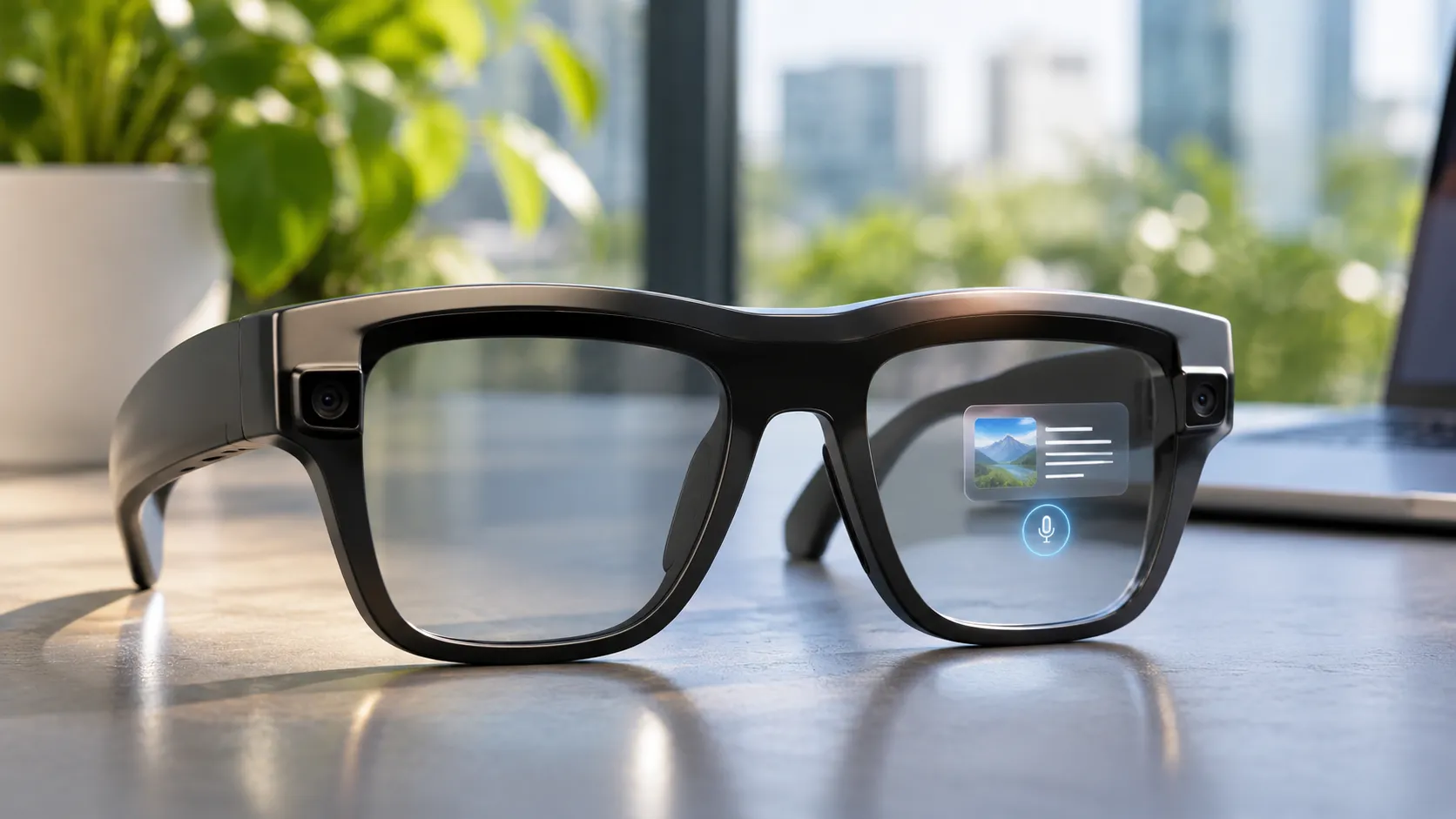
Meta Ray-Ban Display changes the output interface. An integrated 600 × 600-pixel color display in the right lens can present messages, captions, navigation cues and previews. Ray-Ban specifies a 20-degree monocular field of view. That is enough to fit brief information in view, but it is not the wide binocular field of view associated with a spatial VR headset.
The accompanying Meta Neural Band senses surface electrical activity caused by muscle activation. Electromyography, abbreviated EMG, can interpret trained hand and finger gestures without relying entirely on a camera watching the hand. The Band also provides haptic feedback and offers up to 18 hours of battery life. Gesture interpretation is a distinct control pipeline from the glasses’ voice assistant and camera imaging.
The glasses include a 12MP camera, open-ear sound and a contact microphone on some manufacturer specifications. The product’s advertised six-hour mixed-use battery rating is shorter than that of the camera-only Gen 3 line. Features such as live captions, transit directions, visual messaging and a personalized call avatar depend on market rollout and compatible applications. The display does not support continuous room mapping, unrestricted app access, or independent phone replacement.
Oakley Meta HSTN: Camera AI in a Sports-Oriented Frame
Oakley Meta HSTN puts camera, audio and Meta AI functions into a frame designed around active use. Official materials describe 3K video recording, IPX4 splash resistance, open-ear speakers and up to eight hours of typical battery life. The shell design and lens options matter for outdoor use, but they don’t change the core distinction between capture-and-audio glasses and display-based AR.
A runner can use hands-free recording or voice commands, but these functions cannot replace looking at traffic or monitoring the surrounding environment. Without a head-up display, performance readouts do not automatically appear in front of the eye. Any AI-generated guidance about weather or athletic conditions also needs confirmation when safety is involved.
Oakley Meta Vanguard: Wide-Angle Action Capture and Linked Fitness Data
Oakley Meta Vanguard is the most clearly differentiated performance design in Meta’s published lineup. It places a 12MP camera centrally with a documented 122-degree wide-angle lens. The frame carries an IP67 rating, stronger than an IPX4-only specification in both dust and defined water-resistance testing. Meta also describes louder open-ear speakers and a five-microphone array configured for challenging environments.
Integration with compatible Garmin services, Strava, and health-data connectors is not evidence that the glasses independently measure every athletic variable. When the wearer asks for a heart-rate update, the value may originate from a connected watch or service. This is an important architectural distinction between sensing a value at the eyewear and retrieving a value already recorded by another device.
Up to nine hours of rated battery operation and an additional 36 hours from the case are manufacturer figures. The camera’s wide view can be useful for moving point-of-view footage, although wide optics can change perspective and make distant subjects appear small. High-speed recording, image stabilization and data overlays should each be considered separate processing functions.
Meta Glasses: Adventurer, Fury, Starfire and the Expanding Frame Family
Meta introduced a separate Meta Glasses collection in June 2026, including Adventurer, Fury, and a Kylie-designed Starfire frame. Later announcements added further designs and special editions. The emphasis is on fit, frame shape, and lens customization rather than a documented new display or optical waveguide. Manufacturer descriptions identify hands-free capture, AI assistance and an on-the-go case as core features.
Meta said the collection launched with Muse Spark powering Meta AI in the United States and Canada. It planned broader regional availability. That is stronger evidence for a named model than a generic statement that all older glasses always run Muse Spark. The company also described more than eight hours of battery use and up to 40 hours of additional case capacity in its launch materials. Check these figures against each exact style before treating them as identical hardware specifications.
The expanding range illustrates a separate design problem: eyewear must fit faces, prescriptions and daily routines, while its electronics need a consistent thermal and radio envelope. A special-edition finish or celebrity collaboration may change aesthetics without changing the underlying AI capabilities. Where manufacturers have not published a distinct sensor, processor or radio specification, it should remain undisclosed.
How Camera AI, Speech Recognition and Translation Actually Work
A camera-based AI question begins when a user requests visual help. The system obtains image information, prepares it for processing and sends it to the software component that interprets the scene. A language model can combine a visual description with a spoken request and return a response. A successful answer depends on lighting, image framing, model capability, network status and the wording of the question. Having a 12MP camera does not mean the assistant can identify every object or read every sign.
Voice interaction uses a different front end. Microphones detect sound, signal processing separates the user’s speech from background noise, and speech recognition interprets the utterance. Translation adds another language-processing stage before voice synthesis or captions. Proper nouns, jargon, overlapping speakers and dialects remain challenging. An instant translation label does not establish human-interpreter-level accuracy.
On the Display model, the result can arrive as text or visual cues in the right lens. On Gen 3 or Meta Audio, you will usually hear it through speakers or see it in the phone app. That output difference changes the experience of a crowded train, a noisy sidewalk or a multilingual meeting, even if the assistant service is related.
Battery, Heat, Wireless Links and the Reality of an Always-Worn Computer
A small pair of glasses must share its energy budget between microphone monitoring, radio transmissions, the camera, image processing, speakers and, when present, a display. An always-visible display consumes power differently from an occasional spoken response. Continuous video also produces sustained compute and storage activity. These workloads help explain why typical-use battery claims cannot be converted into guaranteed hours of continuous AI or filming.
Bluetooth connects glasses to the phone for control and audio functions. Wi-Fi supports higher-bandwidth transfers and other eligible tasks on models that document it. The exact route varies by operation, so it would be inaccurate to state that all camera data always travels over one radio. A paired smartphone and data plan remain central to many services, even when the wearer is not physically touching the phone.
Heat is a trade-off in electronics worn against the skin. Enclosures have limited area for heat spreading, and making a frame lighter can reduce space for energy storage and cooling. Meta does not publish a consistent set of chip operating temperatures, sustained compute benchmarks or thermal-throttling curves for every model discussed here. Such values should not be inferred from advertised battery life.
Privacy and Bystander Consent Are Engineering Problems, Too
Meta says gallery photo and video recording activates a visible white capture light. For newer devices, it also describes camera disabling when the indicator is blocked or tampered with. This is meaningful engineering, but the LED alone does not explain every temporary camera use during an AI request. The distinction between saved gallery media and visual analysis should be clear to wearers and people nearby.
A wearer can control sharing, account permissions and certain saved recordings through Meta’s companion ecosystem. Those controls do not, by themselves, answer every question about server-side processing, human review, model training, or how a bystander can withdraw consent. Readers should consult the specific current policy for the feature they use, especially during live translation or in places where confidential conversations are expected.
TechAmerica has previously examined the broader questions surrounding camera and voice data in AI glasses. For Meta models, the key distinction is between a user-controlled saved media file, a live assistant interaction and data exchanged with other apps. Treating all three as one privacy category obscures their different retention and disclosure risks.
Safety also has a physical dimension. IP67 does not make a device indestructible, and open-ear speakers do not guarantee that road hazards remain audible. Spoken AI can be wrong, late or incomplete. Users should not rely on translation, navigation or AI-generated athletic advice as their sole source of critical information.
Muse, Hearing Enhancement and the Next Technical Questions
Meta announced Muse as a personal agent that can work across connected services, using a cloud-based secure virtual machine for tasks beyond a conversational answer. Meta also announced an intention to bring Muse to supported AI glasses. This does not verify that every frame performs all Muse actions today. It also does not prove execution entirely on-device or worldwide availability.
At Connect 2026, the company also described FDA-cleared hearing-enhancement software for adults with perceived mild to moderate hearing loss, with US availability planned for later in the year. Its exact compatibility, activation status and medical-use conditions need checking at the time of publication and use. It should not be described as an active feature on every listed model simply because the product family uses open-ear speakers.
The direction of development is toward more capable contextual AI, lower-friction input and richer information output. The unresolved questions are concrete. How reliably can eyewear detect user intent? How much sensor data goes to the cloud? What battery life remains under sustained use, and how clearly are bystanders informed? New styles alone won’t answer those questions.
What Meta AI Glasses Technology Means in Practice
Meta’s current smart-glasses portfolio is better understood as several interaction approaches sharing a software ecosystem. Gen 3 emphasizes camera capture and voice control. Audio deliberately omits the camera. Display adds a right-eye interface and a muscle-sensing wristband. Oakley designs adapt the capture-and-audio concept for activity, while Meta Glasses extend it into additional eyewear forms.
The most useful comparison, therefore, is not an unsupported overall winner. It depends on whether a particular workflow requires visual input, visual output, spoken interaction, or externally supplied fitness data. Those distinctions also reveal each design’s limits. A device without a display cannot show a private overlay. A device without a camera cannot inspect a scene. Hands-free responses also cannot guarantee AI reliability.