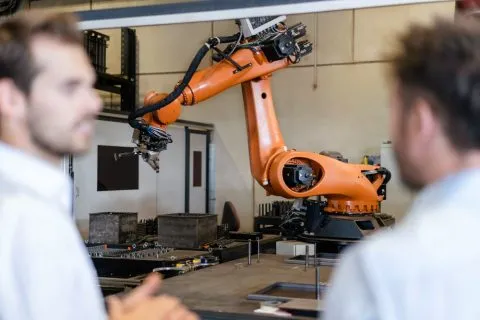
Modular robot cells combine an industrial robot arm with the equipment needed to perform a repeatable factory task. A cell may stack cartons onto pallets, transfer parts between conveyors or load components into a machining center. Its usefulness depends on the entire arrangement, including grippers, sensors, controls and safeguards, rather than the arm alone.
Modular construction allows some equipment and software routines to be reused across similar jobs. This can reduce the custom engineering required for a new installation. It does not eliminate the need to check payloads, motion paths, machine interfaces and worker safety. A cell designed for uniform boxes can face a very different challenge when the product changes to irregular metal parts.
What makes a robot cell modular?
A conventional industrial automation project may involve selecting each component separately and engineering how they fit together. A modular cell starts with a repeatable layout or base assembly. It may have a mounting frame, a robot, a control cabinet, shared electrical connections and a standard operator interface.
Task-specific elements are then selected or changed. These can include a pallet station, a parts tray, a conveyor, a protective enclosure or a different end effector. The robot’s reach and rated payload establish some limits, while the workpiece and required cycle time establish others.
Modular does not mean that any component can be connected without adjustment. Mechanical mounting, electrical signals, software support and safety functions must be compatible. Even when equipment is described as prefabricated, the complete cell must be validated in its intended production environment.
How modular robot cells automate palletizing
At the end of a packaging line, cartons arrive at a known pickup location. Sensors confirm that a carton is present and that the robot can begin its next movement. A gripper takes the carton, and the controller guides the arm to a calculated position on a pallet.
Palletizing software can arrange cartons into rows and layers based on their dimensions, orientation and weight. An operator may choose a stacking pattern through a graphical interface instead of writing a new motion program for every product. The resulting sequence still needs checks for collisions, stability and the available working envelope.
A pallet must remain stable during transport and storage. The cell must account for overhang, load distribution, maximum stack height and whether each package can tolerate contact pressure. A faster arm cannot compensate for poor carton quality or an unsuitable pallet pattern.
Some systems pick several cartons at once, but that depends on gripping capacity, spacing and payload. Multipicking may increase throughput for suitable packages, but it adds complexity when products arrive unevenly or vary in size.
Why the gripper can determine success
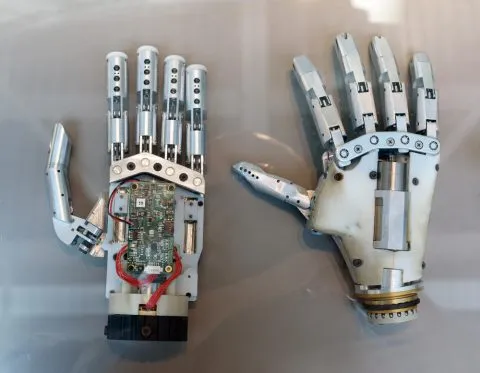
For modular robot cells, the end effector is the device attached to the robot wrist. Vacuum grippers can lift suitable cartons by applying suction to their surfaces. Mechanical fingers can clamp a component, and specialized tooling may support a part from below. Each method has a different failure mode.
Vacuum handling depends on surface quality, seal integrity and the ability to maintain suction during motion. Porous cardboard, damaged packaging or a poorly positioned suction cup can reduce the holding force. A finger gripper must provide enough force without crushing or deforming the object.
The robot’s allowable payload includes the gripper and anything it carries. Engineers also assess the object’s center of mass, acceleration and the moments applied at the wrist. A component within the nominal weight limit may still be unsuitable if its geometry creates excessive loading.
Changing products therefore involves more than typing a new box dimension. The gripping method, pickup pose, and permissible movement speed may also need to change. Reliable cells detect missed picks and recover without sending the arm into an unsafe or undefined state.
Machine tending adds another control problem.m
Machine tending uses a robot to load raw parts into equipment such as a machining center and remove finished pieces. The sequence can include opening a guarded access door, checking a fixture, placing a workpiece, confirming clamping and waiting for a machining cycle to finish.
The robot must exchange reliable signals with the machine controller. A command to begin machining should depend on confirmed conditions, including a properly secured workpiece and the robot’s position outside the hazardous area. The surrounding equipment also needs to know when it is safe for the robot to enter.
Older machines may lack convenient automation interfaces. Some require additional sensors, mechanical changes or carefully engineered control connections. Chips, coolant, sharp edges and variable part positions create further complications that a generic pick-and-place routine cannot solve.
Parts staging determines how long the cell can work without an operator. A tray holding a limited number of blanks may support a short unattended run, but cannot provide continuous operation unless the supply and removal of workpieces are also handled.
Graphical setup does not remove engineering checks
Task templates let an operator enter product dimensions, choose a pallet pattern or select known pickup and placement points. This can make routine changeovers more accessible to staff who do not write traditional robot-control code. The software still translates those settings into movements and machine commands.
For a deeper explanation of taught positions, visual routines and machine signals, see the related guide to no-code robot programming. A simplified interface does not validate every possible new workpiece, tool or layout on its own.
A changed carton may require a different suction arrangement; a new metal part may need another fixture. Operators should confirm clearances, grip reliability, emergency-stop behavior and recovery procedures after a significant change. Adjusting a task recipe is not a substitute for reviewing modifications that affect risk.
When vision helps and when it does not
A robot working with fixed fixtures can often use known coordinates and presence sensors. Camera systems become more useful when items arrive in varying positions or must be recognized before gripping. Images can help estimate where a product lies and how it is oriented.
Vision introduces its own conditions. Glare, transparent packaging, dust, shadows and overlapping objects can make detection unreliable. A camera may identify a box yet miss surface damage that a vacuum gripper needs to detect.
Three-dimensional sensing can provide depth information for some picking tasks, but accuracy depends on the sensor, calibration and object characteristics. A vision-equipped cell cannot automatically handle arbitrary products. Engineers need test data that reflects the actual lighting, materials and presentation of items on the production line.
Controls must coordinate the entire production cycle
The robot controller manages motion, while other devices may coordinate conveyors, fixtures, doors and downstream machines. A programmable logic controller can exchange production signals and help sequence those operations. Safety-related controls require their own appropriate design and validation.
Consider a carton jam on the incoming conveyor. The cell needs a defined response: stop the relevant movement, report the fault and wait for a permitted recovery action. Restarting unexpectedly after the jam clears could put a worker at risk.
Network access for monitoring or remote support can simplify maintenance, but connected controllers also require access restrictions and a defensible update process. A failed network connection should not cause an unsafe movement or make essential safety functions unavailable.
Robot cell safety extends beyond the arm.
A complete cell can create crushing, trapping and struck-by hazards at the robot, gripper, conveyor and surrounding machinery. Those hazards may become more serious during maintenance, setup or fault recovery, when a worker enters an area normally closed during automatic operation.
U.S. workplace guidance on industrial robot safety calls for documented risk assessments, appropriate safeguards and validation of safety functions. Depending on the task, protective measures can include guarding, interlocked access, light curtains, monitored stops and energy-isolation procedures.
The 2025 edition of ISO 10218-2 addresses the integration and operation of industrial robot applications and cells. It treats the whole application, including the task and surrounding equipment, as relevant to safety. Describing a robot as collaborative does not make the complete installation safe without an application-specific assessment.
European installations must also account for applicable machinery rules and conformity responsibilities. The new EU machinery regulation becomes generally applicable on January 20, 2027, replacing the prior directive. The official machinery-law summary explains the transition; the precise obligations depend on the equipment and when it is placed on the market or put into service.
How to judge throughput and operating cost
A quoted number of picks per minute describes only part of a real production cycle. The time to detect an item, grip it, move safely, release it and return for another pick all contribute. The wider process may be limited by cartons arriving slowly, a full pallet awaiting removal or a machine with a long machining cycle.
Meaningful performance measurements include successful cycles per hour, changeover time, rejected picks, unplanned stops and operator interventions. Teams should test the complete range of expected products, not only a well-behaved sample. The broader workplace robot deployment guide examines how pilot results can differ from production operation.
The total cost extends beyond the arm and gripper. It can include integration, safeguarding, tooling, maintenance, electricity, training, software support and alterations to production flow. A lower equipment price does not ensure a shorter payback period if the cell requires frequent manual attention.
Where modular cells reach their limits
Modular robot cells work best when tasks have repeatable positions, predictable objects and manageable variation. Frequent changes to product geometry, highly reflective materials, delicate items or irregular parts can demand more sensing and custom tooling.
Some factories may also lack the floor space needed for guards, pallet handling or safe maintenance access. Others have machine interfaces that require substantial adaptation. In those cases, a standard cell may be only a starting point for a larger integration project.
Better sensing, easier configuration and more adaptable grippers can widen the range of tasks that modular cells perform. But those developments do not remove physical limits or safety obligations. The practical test is whether a complete cell can handle real products consistently, recover safely from problems and deliver useful work over a full production shift.