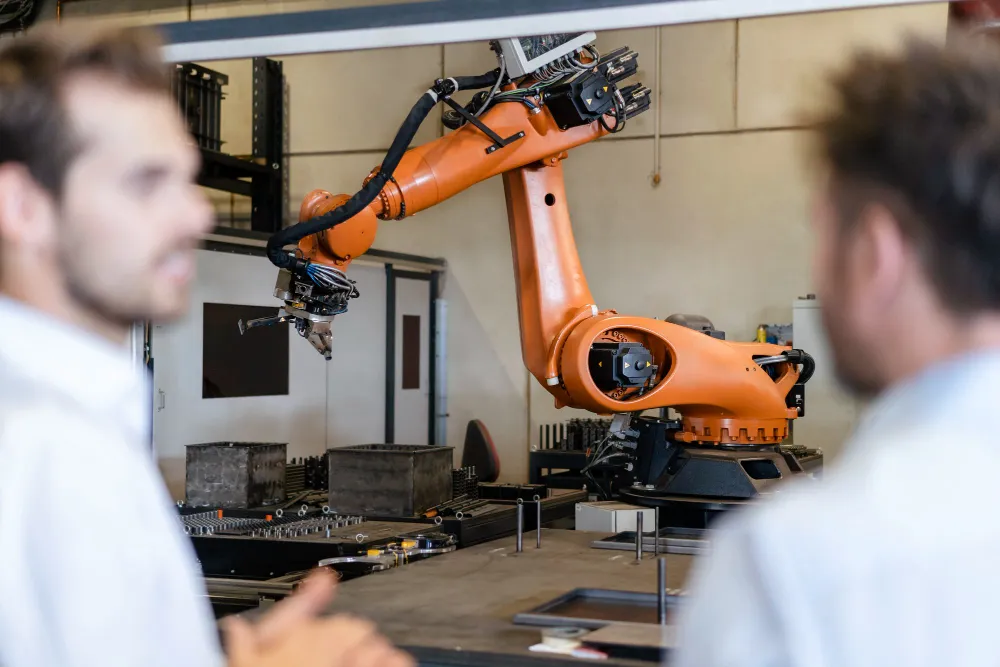
No-code robot programming lets factory workers create industrial robot routines using visual controls, taught positions, and guided setup rather than writing conventional robot-control code. An operator might select a gripper action, move an arm to a safe position and add a condition that waits for a machine to finish its cycle. The resulting routine can repeat those steps, but it still depends on accurate geometry and reliable equipment signals.
The attraction is simpler changeover. A small manufacturer may need the same robot to handle several part designs during the week. Rewriting a specialized program for each job can make automation expensive. Visual tools reduce some of that work, yet a task that is easy to describe is not automatically safe, correctly calibrated or ready for unattended production.
Programming Starts With a Real Manufacturing Task
Consider a hypothetical machine shop that wants a robot to load metal blanks into a CNC mill. A worker must pick a part from a tray, open the machine door, place it in a fixture, close the door and wait for machining to finish. The robot then retrieves the completed part and repeats the cycle. Each action depends on the condition left by the previous one.
A visual editor can represent this sequence as connected steps instead of lines of controller-specific syntax. The user might add a move command, a gripper command and a wait condition. The task still needs engineering definitions: the correct pickup location, safe travel path, fixture clearance and signals that confirm the door and vise are ready.
No-code robot programming does not mean no configuration. Some applications need external sensors, pneumatic controls or an interface to the CNC controller. These components must be connected and tested before the robot can reliably carry out the routine r
What a Teach Pendant Actually Records
With no-code robot programming, a teach pendant or tablet interface lets an authorized worker move the robot in a controlled mode and save positions for later playback. The worker may jog individual joints or command movement in a coordinate direction. A routine can then refer to the saved positions, such as approach, pickup, retract and place.
The National Institute of Standards and Technology’s research on robot programming describes traditional teach-and-playback methods as effective but time-consuming. Moving a robot and recording points often ties up the equipment and a trained person. Visual tools can streamline the workflow, although their actual time savings must be measured for the task.
Saved points do not contain every fact about a job. A worker must also define tool orientation, movement speed, gripping state and what should happen if a part is missing. An editor that hides programming syntax still has to represent these instructions somewhere in the control system.
Direct physical guidance and motor-assisted hand guiding are separate ways of teaching some robots. Not every industrial arm supports them. Any hands-on teaching method requires an approved mode and safeguards appropriate to the machine and application.
Positions Only Make Sense in the Right Coordinate Frame
Robotic arms have joints, but most factory jobs are described relative to a workbench, fixture or tool. The controller converts between joint positions and a tool pose expressed in a coordinate frame. A taught location becomes meaningful only when the robot knows where that frame sits relative to its base.
For example, a pickup point taught relative to a pallet may become wrong if the pallet fixture moves. A new gripper can also change the effective tool center point, the reference used to position the tool’s working end. Reusing an unchanged program after these alterations may move the gripper away from the intended object.
Calibration establishes the relationship among the robot, its tool, the workpiece and, when used, its sensors. NIST’s analysis of robot accuracy and repeatability distinguishes returning to a previously taught position from reaching the correct physical target. A robot can repeat a wrong location very consistently.
No-code robot programming still requires workers to verify references after changing a fixture, relocating the arm or replacing tooling. An easily edited routine does not eliminate geometric errors in the underlying cell.
A Robot Path Is More Than a Set of Destinations
The controller must move the arm between taught points while respecting joint limits and velocity and acceleration constraints. Depending on the command, the tool may follow a joint-space motion or a path intended to be straight in Cartesian space. Those motions can sweep different regions even when their endpoints are identical.
A route that clears an empty workbench might collide with a raised machine door, a full parts tray or the robot’s own fixture. A visual editor can help organize waypoints, but it cannot assume that every intermediate position is clear. Path checking and safeguarded trial runs remain essential.
Payload and tool mass matter as well. A program that handles a light plastic part may not suit a heavy metal casting. Engineers need to consider the manufacturer’s operating limits, gripping capacity and the effect of motion on a carried object.
TechAmerica.ai’s robot foundation models explainer covers systems that learn broader action policies. A sequence of taught robot positions is narrower: it specifies motions for a defined cell, with limited adaptation unless you add sensors or learned components.
Machine Tending Requires Reliable Signals
No-code robot programming for machine tending is not purely a movement problem. The robot must coordinate with equipment that has its own controller and safety functions. A digital input may indicate that machining is complete; another signal may confirm that the fixture is clamped.
In a visual routine, workers can arrange waits, branching conditions and output commands. Before unloading a part, the robot may need verified signals showing that spindle motion has stopped and the machine is in the appropriate state. Such interlocks must follow the equipment’s safety requirements; an ordinary software condition is not automatically a safety-rated safeguard.
Signals can fail or arrive late. A disconnected cable, incorrect mapping or stale state may produce an unexpected sequence. Programs need timeouts and a defined response when the expected acknowledgment never appears. Simply continuing to the next step can damage the machine or create a hazard.
Reliable integration also requires recovery after an interrupted cycle. The robot must not assume an empty vise merely because it has restarted. It should check the actual state or transfer the problem to an authorized worker.
Vision Lets a Routine Handle Some Variation
No-code robot programming can use fixed positions, but a camera can help when a part arrives slightly off-center, provided the system has been calibrated and can recognize the relevant features. Vision software may estimate the object’s pose and supply an adjusted pickup target to the motion controller.
That does not make every task autonomous. Lighting, reflective metal, occlusion and changes in part design can cause detection errors. The robot also needs to know whether a proposed target is reachable without colliding with neighboring objects.
NIST’s 2024 research on robot kinematic accuracy explains why calibration and measurement noise complicate absolute positioning. Adding a good camera does not repair an incorrectly registered robot or guarantee accurate end-effector placement.
A practical system should reject low-confidence detections or request a new observation rather than follow an implausible target. Vision expands what a routine can respond to, but the safe operating range must still be defined and tested.
AI Can Assist Programming Without Owning Every Decision
Some no-code robot programming software accepts plain-language instructions or uses AI to draft and edit robot routines. An operator might describe a repeated transfer task, while the software proposes an ordered set of actions. The resulting program can still be inspected through a visual editor and checked against machine-specific commands.
The distinction between suggesting a routine and executing it is important. A model may misunderstand which gripper is installed, choose the wrong work coordinate system or omit a necessary wait. A convincing text explanation does not resolve those failures.
AI-generated steps need deterministic checks for allowed commands, configured tools and valid ranges. A qualified person should approve consequential changes before the robot acts. The controller and protective systems must retain the authority to limit hazardous motion, regardless of what a language model proposes.
TechAmerica.ai’s causal AI in robotics analysis examines a more advanced research question: how machines estimate the consequences of physical actions. A visual program editor is not evidence that a robot has learned causal reasoning or can safely improvise unfamiliar industrial operations.
Easy Reprogramming Does Not Remove Safety Duties
No-code robot programming makes it easy to edit visual blocks, but even a small change can alter the path of a large industrial arm. The motion may bring the end effector close to a worker, another machine or an area that was clear during the previous production run. Every meaningful task change needs an assessment of the hazards it introduces.
OSHA’s industrial robotics safety guidance explains that people can be exposed to hazards during teaching, troubleshooting and maintenance, not just automatic operation. Safeguards may include restricted operating spaces, appropriate enabling devices, protective stops, guarding and lockout procedures.
The 2025 edition of ISO 10218-2 addresses safety requirements for industrial robot applications and robot cells, including integration and commissioning. Compliance cannot be inferred from a robot’s marketing description or from the availability of no-code controls. The applicable requirements depend on the specific installation.
Moving a robot at reduced speed for teaching also is not a blanket permission to enter hazardous space. Qualified personnel must establish the correct training, control mode, and protective measures for the task.
What Happens When a Routine Stops Midcycle?
A factory robot may stop while holding a part, waiting for a machine acknowledgment or reaching a fixture. Restarting from the first command could cause it to pick up a second part or move through an occupied area. Recovery therefore needs a known machine state, not simply a reusable Start button.
The routine should distinguish recoverable interruptions from faults that require intervention. Operators need to identify whether the gripper holds material, whether the fixture is occupied and whether any supporting machine is moving. Some conditions call for a controlled reset or manual removal under approved safety procedures.
Logs help explain what happened. Useful records include the active program version, last completed action, equipment status and fault code. The logs should support safe diagnosis without encouraging workers to bypass interlocks to finish a cycle quickly.
TechAmerica.ai’s workplace robot deployment guide covers the broader transition from an impressive demonstration to reliable daily operation. Recovering from ordinary disturbances is one of the main differences between those stages.
How to Test No-Code Robot Programming Before Production
A pilot should begin with a bounded task and an approved robot cell. Engineers can document the part geometry, expected machine signals, tool configuration, required output quality and operating restrictions. The same task should be performed repeatedly with representative materials rather than a single demonstration piece.
Testing should measure successful cycles, time to create or revise the program, manual interventions, unintended stops, part damage and the effort needed to recover. It should include realistic variations, such as a slightly shifted part, a missing tray item and a delayed machine signal.
Before expanding operation, an independent reviewer should confirm the coordinate frames, work envelope, tool configuration and safety functions. Controlled testing should also show how the robot responds when its camera loses a target or a peripheral device stops responding. The right result may be a safe stop rather than task completion.
No-code robot programming can reduce the amount of specialized syntax needed to automate a repetitive job. Its practical value is measured by how safely and reliably teams can create, revise and maintain the task. The editor may make a routine easier to build, but the physical robot still has to execute it in a real factory, with real equipment and real consequences.