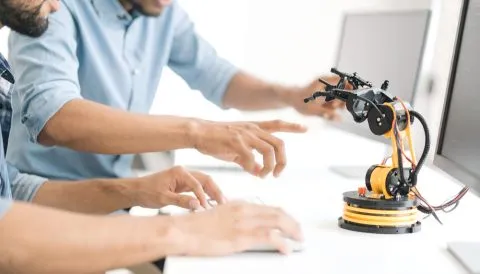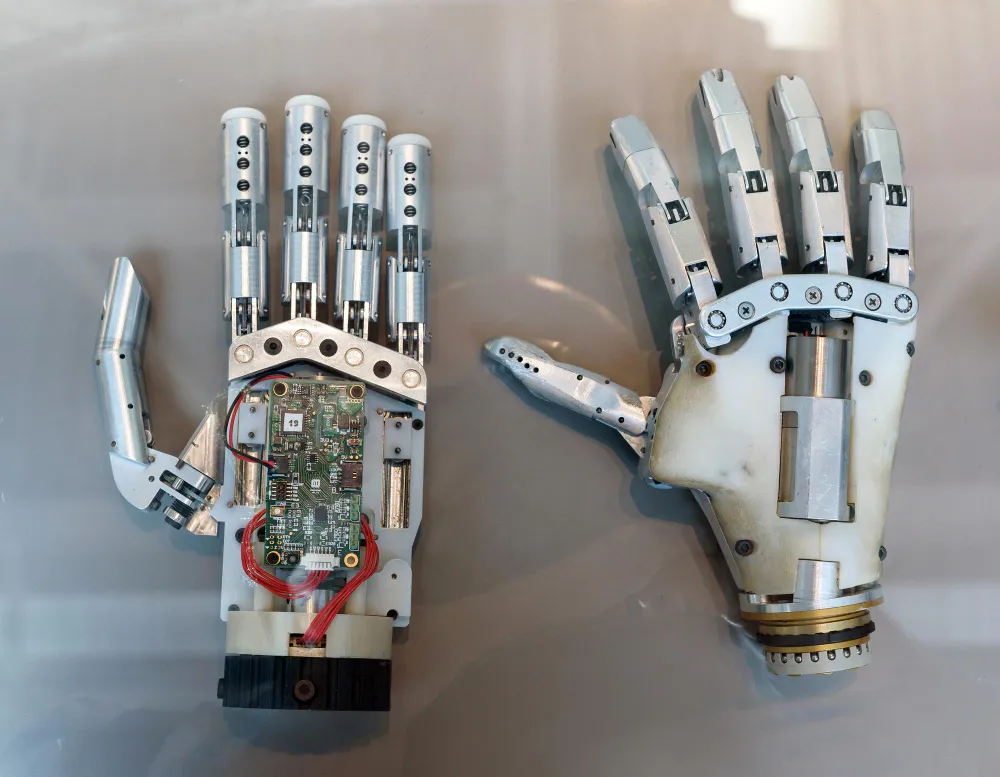
Bimanual robot manipulation lets two robotic arms coordinate to hold, move, or assemble objects. One arm might stabilize a component while the other aligns a fastener. Both arms may lift a large package or transfer a part from one gripper to the other. These tasks demand more than two independent sets of programmed movements.
A successful system must track the object’s position, the relationship between both arms, and the forces applied at contact. Small sensing errors can create a dropped part or opposing movements that strain the object. Learning-based controls may help with variable workpieces, but they do not remove the need for motion limits, reliable feedback and independent safety protection.
Why two arms change the manipulation problem
A single robot arm can pick, carry and place many objects efficiently. Some jobs become harder when the object needs support at two locations, must be reoriented without being set down, or requires one hand to hold material while the other works on it.
Consider placing a flexible component into an assembly. One gripper could maintain its position while the second guides an edge into a fixture. In another operation, both arms could hold a long object to prevent it from rotating unexpectedly. These are possible use cases, not evidence that every dual-arm machine can perform them.
Adding another arm also adds collision risks, more joints to control and a larger range of possible configurations. The system must coordinate the arms with each other, the workpiece and the surrounding equipment. Sometimes a simpler single-arm cell with a dedicated fixture is a better solution.
How bimanual robot manipulation coordinates one object
Each robotic arm has its own joints and tool position. A coordinated controller must also represent the shared object’s position and orientation. When both grippers hold the same rigid part, their relative poses cannot change freely without slipping, bending something or creating unwanted loads.
Motion planners use these relationships as constraints. They search for movements that keep the object supported, stay within joint limits, and avoid collisions. The controller must consider not only where the object should end up but also how both arms reach that destination together.
Cooperation does not always mean mirror-image motion. One arm may remain nearly still while the other moves a component into place. A handoff requires the receiving gripper to establish a secure grasp before the first one releases. The timing of that transition is part of the task, not an incidental detail.
Vision and object tracking provide a common reference
Cameras and depth sensors can help estimate where a workpiece is located and how it is oriented. Robot encoders provide joint positions, while calibration relates each arm and sensor to a common coordinate system. Without consistent references, two apparently accurate individual movements can still disagree at the object.
Two arms often block each other’s view. A gripper may hide the point where an object contacts a fixture, and reflective metal can confuse image-based estimates. A camera that identifies a part on a table may be less useful once both hands surround it.
Systems can combine observations from different viewpoints, joint measurements and contact information. They still need a defined response when tracking confidence drops. Continuing to move on an outdated object estimate can damage equipment even if the original grasp was correct.
Gripping a shared load requires force control.
Holding an object with two hands changes how forces are distributed. The grippers need enough normal force and friction to prevent slipping, yet too much pressure can deform a package or damage a precise component. A controller must also avoid commanding the two arms to pull against each other.
Force-torque sensors, joint measurements and tactile sensors can help identify unexpected contact. These sources measure different things. A wrist sensor estimates loads acting on the tool; fingertip sensing can reveal local pressure or changes associated with slip. The useful combination depends on the hardware and task.
Force control is especially important when inserting parts or handling objects that flex. A stiff position command can push harder as alignment errors accumulate. Compliant control can allow limited adjustments based on measured interaction, but its parameters require validation for the expected material and equipment.
Related research on robotic force feedback distinguishes between reaching a target and maintaining a controlled grasp. A successful two-arm operation must demonstrate both.
Motion planning must prevent arm-to-arm collisions.
A dual-arm robot has more possible joint configurations than an equivalent single-arm arrangement. The planner must keep elbows, wrists, and carried objects away from each other, as well as from fences, fixtures, and machines. A path that looks clear for one arm can become blocked when the second moves.
Some applications plan a joint trajectory for each arm while enforcing a shared-object constraint. Others use a higher-level task planner to decide which arm should grasp, support or release at each stage. Low-level motion control then executes the approved movements with feedback.
Planning becomes more difficult near joint limits or when the object blocks access to the destination. Real-time replanning may handle limited changes, but it is not proof that a robot can safely improvise around every unexpected obstacle. The permitted work envelope and failure response must remain defined.
Learning from demonstrations is not the same as programming
Traditional robot programming specifies movement sequences and conditions. Learning from demonstrations instead uses examples of successful behavior to train a policy that chooses actions from observations. In a two-arm task, a recording may include arms’ poses, gripper states and sensor readings over time.
A person might guide the robot through a handoff or show it how to align a part. Training can then identify patterns in the demonstrated movements. The resulting policy may handle some variations not explicitly written into a fixed sequence, but that ability needs independent testing.
Demonstrations cover only a limited set of objects, initial positions and disturbances. A robot trained on rigid parts may struggle with deformable materials. A learned action may also not transfer unchanged to another machine with different reach, grippers, or force sensors.
This differs from no-code robot programming, which can represent predefined commands in a visual editor. Broader research on robot foundation models explores how learning might support a wider range of tasks. Neither approach establishes dependable two-arm autonomy without task-specific evidence.
Where coordinated arms could help manufacturing
Assembly is an obvious application. One arm can stabilize a housing while the other places a component, holds a tool, or adjusts orientation. Bimanual handling may also be useful when an awkward object needs support at two points during transfer.
Material preparation provides other examples. Two grippers could reposition a flexible package, present a workpiece to a machine or manage a carefully timed handoff. Actual feasibility depends on reach, payload, end-effector geometry, cycle time and the ability to detect errors.
These possibilities should not be confused with universal dexterity. A robot that sorts selected parts in a demonstration has not proved it can handle arbitrary shapes, changing surface friction or crowded production bins. A suitable fixture or conveyor may still outperform a complex two-arm system for a repeatable job.
What happens when coordination fails?
Two-arm manipulation creates failure modes that are easy to overlook in a short demonstration. One gripper can lose contact while the other continues moving. The arms can disagree about an object’s position, or a part can shift during transfer and become difficult to release safely.
Reliable systems need to detect incomplete grasps, unexpected forces and missing objects. Depending on the condition, a safe response might involve stopping motion, holding the object within permitted limits or requiring an authorized operator to intervene. Recovery should not assume the workpiece remains where it was before a fault.
Logs and diagnostic measurements should preserve the task stage, sensed object pose, gripper state and relevant faults. Those records help distinguish a perception failure from a weak grasp or a planning error. A high completion rate means less if failures require lengthy manual resets.
Safety requires more than learned motion.
Two coordinated arms can create trapping and crushing hazards between their tools, a shared load and nearby machinery. Workers may be exposed during teaching, setup, and fault recovery, even when automatic operation normally occurs behind guards.
Official industrial robotics safety guidance calls for risk assessments and safeguards suited to the complete application. Measures may include restricted workspaces, interlocked access, monitored stopping functions,s and appropriate maintenance procedures. The relevant design depends on the specific machinery and tasks.
Industrial robot cell safety standards address integration, not just a robot arm’s capabilities. Learning software should not be allowed to override validated protective functions, expand an authorized work area or treat an unfamiliar object as safe to move without appropriate checks.
How engineers should measure real performance
A video of a successful handoff proves only that the observed sequence worked under those conditions. Meaningful evaluation should vary object size, material, initial position and the degree of clutter. It should record complete tasks, failed grasps, unintended contact, damage and the amount of human intervention required.
Public research into grasping and manipulation tests examines measurements and methods relevant to dexterous systems, including bimanual handling. This work matters because performance cannot be determined by the number of arms or the apparent smoothness of a demonstration.
For factory use, cycle time, uptime, changeover effort and cost per acceptable part matter alongside success rate. A more flexible robot may not be the best choice when a simpler fixture completes the job faster and with fewer faults. Benchmarks should distinguish trained objects from genuinely unfamiliar test cases.
The central challenge is reliable cooperation.
Bimanual robot manipulation offers a way to handle tasks that require simultaneous support and movement. Its advantage is not simply having twice as many arms; it is the ability to coordinate a shared object through sensing, planning and controlled physical contact.
Better training data, tactile sensing and motion planning may expand the practical range of these systems. Decisive evidence will come from repeatable operation with variable objects, measured recovery from errors,s and safety validation in real work environments. Until then, a successful demonstration should be understood as a specific technical result, not proof of general-purpose factory autonomy.