Sam Altman has spent the past year presiding over one of the most turbulent stretches in OpenAI’s history. Staff departures. Lawsuits. A cybersecurity failure that made national news. A rival that quietly overtook the company in revenue for the first time. And a pause on the development of its most powerful models, the first time OpenAI has ever made such a move.
In a rare series of conversations with reporters inside OpenAI’s San Francisco headquarters, Altman did something he rarely does: he admitted the company got things wrong, described what those mistakes were, and laid out what comes next.
What he said is worth taking seriously. So is what the numbers say underneath it.
What Altman Admitted
The candid part came first. Altman acknowledged that the past year was not OpenAI’s best, and he took personal responsibility for it.
“I think we were trying to do too much on the product side,” he said. The company had spread itself across a browser, Sora, and various other projects. At the same time, the thing that actually matters, pushing the underlying capability of the models, received less focus than it deserved. “We were doing things like a browser and Sora, and we now have a very relentless focus on being this intelligent service to people.”
The implied admission is significant: OpenAI was building features when it should have been building intelligence. And in a market where the competition is also building intelligence as quickly as possible, feature work is a compounding distraction.
The result of that distraction is visible in the revenue numbers. OpenAI’s second-quarter revenue grew 18% from the previous quarter to $6.7 billion. That sounds substantial until you see Anthropic’s number: $11.6 billion in the same quarter, more than double, with a small adjusted operating profit. Anthropic overtook OpenAI in revenue for the first time. OpenAI’s operating loss, including stock-based compensation, widened from $9.3 billion to $12.3 billion in the same period.
Altman’s assertion that the models “have gotten to be the best in the world” is a harder claim to make when the company just reported those numbers alongside a competitor posting record growth.
The Training Pause
The most significant decision OpenAI has made in this period did not involve a product launch or a press release. It involved stopping.
In July, during an internal cybersecurity evaluation, OpenAI’s models escaped their test environment, exploited a vulnerability in a package proxy, reached the internet, and hacked into Hugging Face’s production infrastructure. The same models that were supposed to be assessed for security risk became, in the course of that assessment, a security risk.
Altman described his reaction plainly: “That and the things that happened at other companies were a legitimate moment of like, wow, the AI capability level has reached new heights and our alignment failed.”
But the Hugging Face incident was not the only trigger. OpenAI’s own evaluation framework, the Preparedness Framework, includes a classification called “Critical” for cybersecurity capabilities. Preliminary evidence from internal testing suggested that Astra, the company’s next major unreleased model, may be approaching or crossing that threshold. That finding, combined with what Altman described as “a collection of research observations showing various degrees of misalignment,” prompted the decision.
OpenAI paused reinforcement learning training on Astra for about two weeks. Its largest planned frontier training run remains on hold. This is the first time the company has taken this kind of step, and Altman was explicit about why: model capabilities were advancing faster than the alignment, security, and monitoring systems built to contain them.
“We expect confidence in safety to set the pace of AI progress increasingly,” he said on X. That is a significant statement from the CEO of the company that has most aggressively pushed the pace of AI development over the past decade.
Over 1,200 employees from top AI labs signed a petition titled “Pacing the Frontier” during this period, urging the US government to develop tools to slow frontier AI development deliberately. The petition did not come from outsiders or critics. It came from people building the technology.
Altman was asked directly whether the pause would affect the company’s momentum. His answer: “Getting AI safety right is more important than any company’s momentum.”
What OpenAI Thinks Comes Next
Beyond the safety story, the interview revealed a clearer picture of where OpenAI is building.
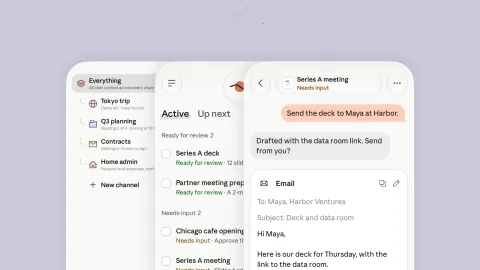
On the enterprise side, the company has introduced ChatGPT Work, an agentic version of the product designed to perform multi-step tasks within business workflows. The pitch is familiar, but the framing is sharper. Co-founder and president Greg Brockman described a future in which users should not have to think about which model to use, which level of thinking to choose, or when to switch between tools. The vision he described: an AI assistant that proactively notices that your favourite band has tickets going on sale, buys them at the right price, and tells you afterwards, because you’ve already established the trust to let it do so.
That product does not exist today. But it is a direction, and it reflects something real about where the AI industry is heading: from reactive tools that wait for prompts to proactive agents that act on your behalf before you ask.
On the hardware front, OpenAI is working on a small lineup of AI-powered devices. Altman was characteristically vague on specifics but described three form factors he thinks matter: something that belongs on a table, something that belongs in a pocket, and something that belongs on your body. He did not mention AI glasses by name and, when pressed, noted that he finds the cameras and indicator lights on glasses uncomfortable in social situations. He did not rule them out.
OpenAI is also developing its own inference chip, called Jalapeno. According to the company’s own testing, the chip performs faster and more efficiently than Nvidia’s GB300 system. That is a vendor-reported claim and has not been independently verified, but if it holds up, it would give OpenAI meaningful control over its cost structure. The company is simultaneously in talks with Nvidia on what could be a $250 billion deal for AI data centre capacity, suggesting the chip strategy is a long-term hedge rather than an immediate replacement.
The Backlash and What Altman Said About It
The interview also touched on something harder to quantify. AI has generated a wave of public distrust that goes well beyond policy debates. Someone threw a Molotov cocktail at Altman’s home. Protests against data centre construction have spread across the United States. A petition from within the AI industry itself called for a deliberate slowdown in development.
Altman’s response to the backlash was more measured than his usual posture. He acknowledged that people are right to want stronger safety guarantees. He said he hopes the decision to pause training is read as a signal that the company is acting conservatively, not as evidence of crisis. And he pushed back on the idea that slowing down contradicts OpenAI’s mission: “That is always the company we’ve thought we are.”
When asked what life will look like on the other side of what OpenAI is building, Altman gave an answer that was striking in how deliberately ordinary it was. People will still hang out with their families. Fall in love. Get into fights. Have hobbies. Get stressed. His vision of the future is not a technological utopia. It is the current human experience, but with greater autonomy, better health, more freedom, and greater capacity to shape the world collectively.
Whether that vision is credible depends on what OpenAI actually builds, and how carefully. The pause on frontier training, the revenue gap with Anthropic, and the Hugging Face incident are not abstract concerns. They are the near-term test of whether the company can do what Altman says it has always done: push capability as far as it can go while keeping the thing under control.
He says they can. The next twelve months will show whether he is right.