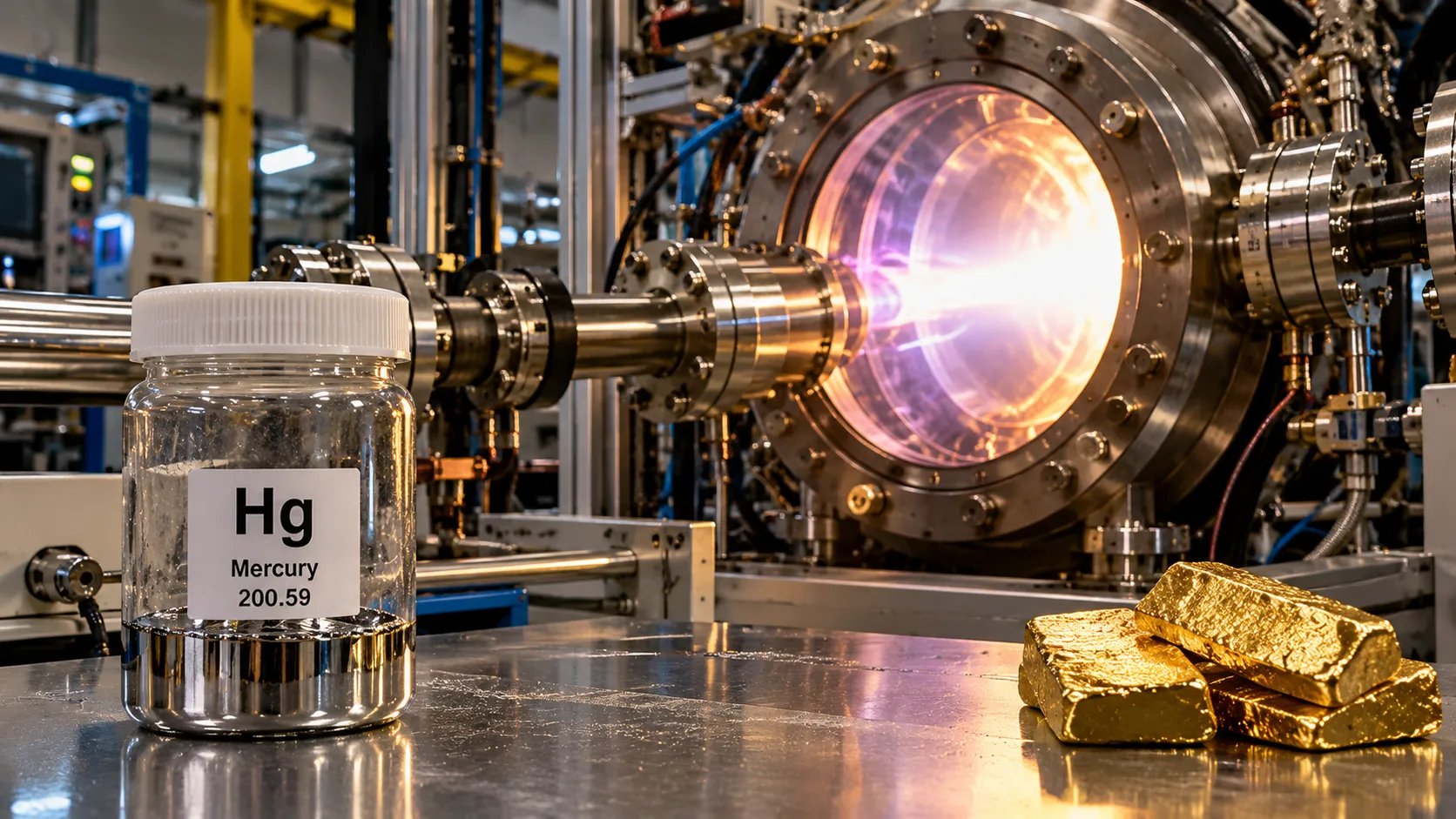
San Francisco startup Marathon Fusion says it has converted mercury into stable gold using neutrons generated by nuclear fusion. The company announced the result on October 21, 2026, claiming a production rate ten times higher than a benchmark CERN reported last year. The experiment could represent progress in nuclear transmutation, although the result has not been independently verified.
The announcement follows years of scientific work showing that nuclear reactions can transform one element into another. Marathon Fusion has not disclosed the total amount of gold produced, the cost of the experiment or enough technical data to establish whether its method could eventually operate commercially.
How Marathon Fusion Says It Turned Mercury Into Gold
The proposed technique uses nuclear transmutation, a process that changes an element by altering its atomic nucleus. Unlike ordinary chemical reactions, which cannot convert mercury into gold, nuclear reactions can change the number of protons inside an atom.
Marathon Fusion’s method starts with mercury-198, a stable mercury isotope. High-energy neutrons produced by fusion reactions strike the mercury nuclei, causing them to release two neutrons and form radioactive mercury-197. That isotope then decays into gold-197, a stable gold isotope.
The company described this approach in a 2025 research paper that used computer simulations to explore gold production in future fusion reactors. Its technical overview also explains how mercury could serve as a neutron multiplier while supporting the reactor’s tritium fuel supply.
The October announcement goes beyond those earlier theoretical calculations. Marathon Fusion says it has now demonstrated the conversion experimentally, but the publicly available information does not establish the quantity or quality of the resulting gold.
How the Claim Compares With CERN’s 2025 Gold Experiment
Scientists at CERN reported in May 2025 that experiments at the Large Hadron Collider had produced extremely small quantities of gold from lead. The results came from the ALICE collaboration, which studied interactions between high-energy lead nuclei.
According to CERN’s published findings, the collider created about 86 billion gold nuclei during its 2015–2018 operating period. Their combined mass was approximately 29 picograms, or 29 trillionths of a gram.
Those nuclei survived only briefly before striking accelerator equipment and breaking apart. The experiment demonstrated nuclear transmutation but did not offer a practical way to collect gold.
Marathon Fusion claims its production rate exceeded CERN’s reported benchmark by a factor of ten. However, the experiments use different starting materials and nuclear processes. Without a detailed account of the measurement conditions and actual output, the claimed improvement cannot be independently assessed.
Could Fusion Reactors Produce Gold on a Commercial Scale?
Marathon Fusion believes gold production could eventually become an additional revenue source for commercial fusion power plants. In its 2025 research, the company estimated that a specially designed reactor could theoretically produce about two metric tonnes of gold annually for every gigawatt of thermal fusion power.
That estimate comes from computer modeling, not an operating commercial facility. Building reactors that can sustain the necessary reactions remains a major engineering challenge, as do recovering the resulting gold and managing radioactive materials.
Production costs are another unanswered question. Even if scientists can reliably manufacture stable gold, the process would need to compete economically with conventional mining and refining. Energy requirements, specialized equipment, isotope separation and radiation protection could all affect its viability.
For now, there is no basis to expect laboratory-produced gold to influence global gold prices significantly. The quantities involved in current experiments remain far below commercial production levels.
What Comes Next for Marathon Fusion?
Marathon Fusion is developing technologies for future fusion power plants, including fuel processing, isotope enrichment and neutron-based material production. The company’s broader research also includes methods for producing medically useful isotopes, potentially extending the applications of fusion technology beyond electricity generation.
Its latest gold announcement will require more detailed experimental results to establish the claimed production rate. Independent measurements, verified yields, and an assessment of production costs would help determine whether the technique represents a practical advance or remains an early laboratory demonstration.
The underlying science of changing mercury into gold is established. What Marathon Fusion has yet to demonstrate publicly is whether its approach can produce meaningful quantities efficiently and economically. Until that evidence becomes available, the announcement is best understood as a promising but unverified experimental claim rather than a commercial breakthrough.