Batched ride matching lets on-demand transportation systems assign drivers to passengers without treating every request as an isolated race for the nearest car. Instead of immediately sending the first available vehicle to each new rider, the software briefly considers several requests and potential drivers together. It can then look for assignments that make better use of the vehicles already on the road.
The distinction matters because cities are not flat maps with equally accessible streets. A driver who appears closest may be on the wrong side of a divided road, heading away from the pickup or caught behind a traffic bottleneck. A good assignment must account for actual travel time, other people waiting, and what happens when an offer is declined.
Why the nearest car is not always the best match
A simple dispatch rule would choose the geographically closest available driver whenever a request arrives. That is easy to explain and fast to calculate. It also decides before knowing whether another rider is about to request a trip or whether the same driver would be more useful elsewhere.
Road distance is a better starting point than straight-line distance, but it still misses important conditions. One-way streets, turn restrictions, bridges, temporary closures and congestion all change the time needed to reach a pickup point. Two drivers separated by the same physical distance can arrive at very different times.
Matching systems therefore use the road network and current vehicle availability, not just dots on a map. They must also consider the requested service, operating zones and any eligibility requirements attached to the trip. The result is a constrained allocation problem, not a simple location lookup.
How batched ride matching works
The system collects a short window of eligible requests and nearby drivers. For each plausible pairing, it estimates the time and effort needed to reach the passenger. It can then compare combinations, seeking a useful result for the group instead of choosing the first acceptable pair one request at a time.
That brief collection window has a cost: a rider may wait a few additional seconds before receiving an offer. The potential benefit is a better assignment that avoids much longer pickup delays later. Waiting longer does not always improve a match; the decision depends on how many candidates are available and how quickly conditions are changing.
In practice, this is a rolling process. New requests arrive, drivers become free, existing offers are accepted or rejected, and travel estimates change. A dispatch system must update its candidate set quickly enough that its recommendations have not become obsolete by the time they reach a driver.
A two-rider example shows why order matters.
Imagine two passengers and two available cars. The first car could reach Passenger A in three minutes or Passenger B in six. The second could reach Passenger A in five minutes but Passenger B in 12. These hypothetical times illustrate the calculation, not observed results from a city.
If the first passenger receives the closest car immediately, the assignments are three and 12 minutes, totaling 15 minutes of pickup travel. Considering both passengers together offers another choice: send the first car to Passenger B in six minutes and the second to Passenger A in five. The total becomes 11 minutes.
The improvement in that example comes from avoiding a particularly poor second assignment. It does not mean every individual passenger gets the shortest possible wait. An operator must decide how much weight to place on average waiting, unusually long waits, and other outcomes before selecting an assignment rule.
Travel estimates depend on a changing road network
Road-routing software represents streets and permitted turns as connected paths. Each segment can carry an estimated travel time, adjusted for factors such as congestion, time of day or an incident. A route through those segments provides a pickup estimate that is more useful than aerial distance.
Live observations can improve the estimates, but they have weaknesses. Location signals may be late, traffic reports may cover only part of a road, and a construction closure may not yet appear on the map. Federal guidance on crowdsourced traffic data notes that accuracy varies with sample size, road coverage and the conditions under which observations are collected.
An estimated pickup time is also not a guarantee. A driver may need to turn around, find a legal stopping point or negotiate a crowded terminal entrance. Measure the difference between predicted and actual pickup time rather than hiding it behind a single optimistic number.
What can an assignment system optimize?
A matching algorithm can aim to reduce average pickup time, limit extreme waits, reduce empty driving or keep more drivers available for later requests. These goals overlap but are not identical. An assignment that saves the most aggregate time might leave one rider facing an unreasonably long delay.
Constraints narrow the available choices. A passenger may need a vehicle with an accessibility feature, a larger seating capacity or permission to collect riders in a particular zone. Airport queue rules and local operating restrictions may also prevent a geographically convenient match.
Engineers can express the problem as a set of possible driver-rider pairs, each with a cost and eligibility rules. An optimization method selects compatible pairs while respecting those rules. The specific equations, priorities and model weights differ across systems; a public explanation of batched dispatch is not a complete specification of a proprietary algorithm.
Why the trip after the pickup matters
Assigning a car changes where it will eventually end up. A short pickup followed by a long trip to an area with little demand could leave fewer drivers near passengers who will request rides next. A different assignment may be preferable when the system considers vehicle availability after current trips.
Demand forecasts and vehicle-availability models can help estimate those effects. Some advanced approaches evaluate not only immediate waiting time but the likely consequences of a series of assignments. A forecast can be useful without accurately predicting where every individual passenger will travel.
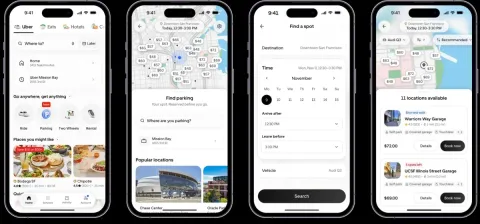
Parking and staging can also shape where vehicles wait between trips. Related coverage of parking and potential fleet staging describes an adjacent operational question: how vehicles might be positioned when they are not carrying passengers. Staging and passenger matching are separate decisions, even when they influence one another.
A match offer is not a completed ride.
Dispatch software may choose a promising driver and issue an offer, but the driver might decline it or become unavailable. The passenger might cancel, move the pickup pin or request a different type of vehicle. Each event changes the active assignment problem.
A reliable system records the difference between a candidate match, an offer, an acceptance and a completed pickup. If an offer expires, the request may need to return to the pool. The software should not count an unaccepted suggestion as a successful trip simply because the initial optimization completed.
Repeated offers can create their own problems. Sending the same unsuitable request to several drivers wastes time, while overly frequent reassignment can confuse passengers and drivers. Systems need practical timeouts, status checks and ways to recover from stale vehicle locations or dropped connections.
Shared rides introduce route overlap and detours.s
Matching becomes more complicated when several passengers may travel in one vehicle. A candidate must be evaluated against existing pickups, destinations, seat capacity, ty and the order in which stops can occur. A pair of trips that looks close on a map may require a large detour because of street direction or traffic.
A shared-ride system can test whether combining journeys saves vehicle travel without exceeding the allowed detour or delay. It also needs to respect service restrictions and the actual number of available seats. The best combination may change when a passenger cancels, or traffic slows.
Pooling should not be confused with basic batched matching. A batch can assign separate cars to separate riders, while a pooled trip adds passengers to one route: both use optimization, but the constraints and what a successful result means differ.
Airports, rush hours and unusual events change the problem
At an airport, a nearby driver may be in a queue or a pickup area that does not serve the requested terminal. On a congested downtown street, a legal pickup may be around the block. The platform’s map and local operating rules need to reflect those realities.
During heavy demand, the number of waiting passengers can exceed the immediately available cars. Batching can distribute scarce capacity more thoughtfully, but it cannot create additional vehicles. Pricing incentives or driver repositioning may influence supply, yet they remain separate mechanisms from the matching decision itself.
Unexpected events can make historical forecasts unreliable. A concert ending early, a sudden storm or a temporary road closure can change both demand and travel speeds. The software needs to detect worsening predictions and revise its approach rather than assume the last hour’s patterns still apply.
Privacy, fairness and the driver’s choice
Real-time matching depends on precise location and trip information. Those records can reveal sensitive patterns about where people live, work or seek services. Access limits, appropriate retention periods, and secure handling are necessary even when the information is used primarily to estimate travel time.
System-level efficiency must also be assessed against individual outcomes. If one neighborhood repeatedly receives slower pickups, an improving citywide average could conceal uneven service. Driver acceptance rates, long waits and access for passengers with special requirements deserve separate analysis.
These are not questions that a mathematical objective resolves automatically. The federal AI risk management framework recommends evaluating reliability, fairness and ongoing performance in the context where a system is used. That guidance is voluntary and does not certify any particular dispatch platform.
How to measure whether batching actually helps
An operator can compare observed pickup times, cancellation rates, offers per accepted trip, empty-driving distance and the share of passengers facing unusually long waits. Break the measurements down by location, time of day, and service type. A single citywide average may be too coarse to reveal operational failures.
Testing a new algorithm is difficult because dispatch decisions change the system being measured. Sending one driver to a pickup also changes who remains available nearby. Offline replay and simulation can help, but their assumptions about human behavior, traffic and cancellations require validation against real operations.
Monitoring should continue after rollout. Engineers need to identify whether forecast errors rise during major events, whether a change benefits one area at another’s expense and whether a software failure leaves requests unassigned. These checks are more informative than a vendor’s unsupported claim of universally faster pickups.
Why matching is separate from self-driving technology
Ride matching decides which vehicle should serve a passenger. Autonomous driving determines how a vehicle perceives roads and safely carries out the trip. A driverless fleet still needs dispatch, vehicle availability estimates, pickup rules and a plan for cars that require charging or maintenance.
That distinction is apparent in reporting on an expanding robotaxi service, where the number of vehicles and geographic coverage remain operational questions. A larger service area does not necessarily mean enough suitable vehicles are available for every request.
Batched ride matching is ultimately a way to make better decisions under limited time and uncertain information. It can improve assignments when several requests compete for the same cars, but it cannot eliminate traffic, create supply or guarantee every rider the fastest possible pickup. Its success has to be demonstrated in the waits people actually experience.