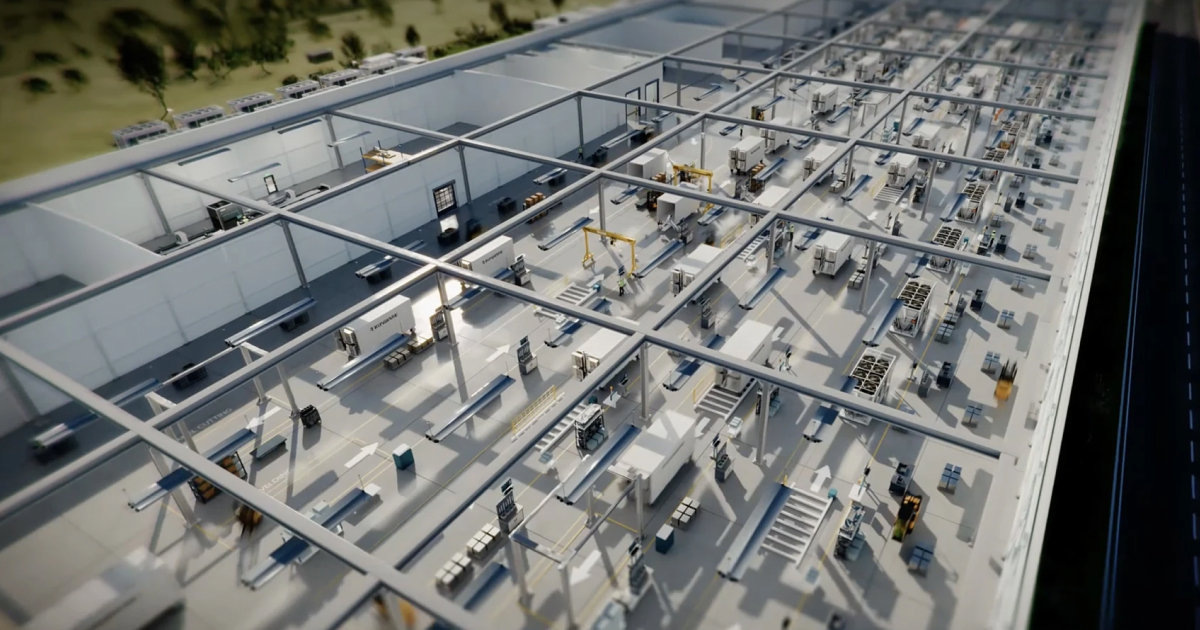
Runware wants to manufacture its Sonic Inference Pods on automotive-style assembly lines. The modular AI data centers would arrive largely assembled, reducing on-site installation work. The company plans to expand production in Romania and reach 30 megawatts of daily capacity by 2028.
That target equals roughly 900 megawatts over 30 days. Runware co-founder and CEO Flaviu Radulescu says the expansion could accelerate the deployment of AI computing infrastructure. The manufacturing model is designed to bring new capacity online faster.
Runware already operates one factory and began building a second earlier this year. It expects the newer site to start operating in early 2027. Production would then rise gradually, although the company has yet to demonstrate its proposed scale.
Sonic Inference Pods Designed for Rapid Installation
Runware aims to move much of the construction process from customer sites into factories. Runware would assemble each pod before shipment, then connect it at a prepared location. Customers can provide a site or ask Runware to find one.
The company aims to bring pods online within 48 hours of arrival. That estimate covers installation and setup, not factory production or shipping. Runware says building a pod once took three weeks. It expects to cut manufacturing time to one day as production increases.
The pods share a standard design but can accommodate different customer requirements and GPU generations. Runware says its engineers can develop and test components for newer processors. Radulescu said pod delivery times are shorter than current GPU lead times. That gives the company room to adapt units while customers await their chips.
Customers can rent computing capacity directly from Runware. Alternatively, they can supply GPUs and pay monthly fees for the pods and their operation. Power and internet connectivity are charged separately. The company also plans to supply replacement parts when equipment fails.
AI Data Center Manufacturing Draws More Competitors
Runware is not alone in pursuing prefabricated infrastructure. Crusoe and Schneider Electric also offer modular data center systems. Nvidia is developing standardized designs intended to simplify large AI installations.
Earlier this year, Nvidia announced its Vera Rubin AI factory platform. It also introduced the DSX POD reference design, which supports modular infrastructure deployment. Runware’s proposed distinction is its own production-line manufacturing operation, rather than a reference design for partners.
Demand for computing infrastructure has encouraged efforts to shorten construction schedules. Goldman Sachs research projects U.S. data center power demand will rise sharply through 2027. The investment bank has also identified equipment, labor and construction constraints as potential obstacles.
Other companies are pursuing growth through large infrastructure partnerships. Nvidia’s investment in CoreWeave supports plans for substantial additional AI computing capacity. Runware’s factory approach differs, but access to hardware and electricity remains essential.
Manufacturing Costs and Supply Chains Pose Risks
Building modular data centers at scale will require workers, inventory, financing and dependable suppliers. The challenge extends beyond designing a pod that works. Runware must produce units consistently and at costs customers will accept.
The company has raised more than $60 million, including a $50 million Series A last December. It is using that funding to complete the new factory and plans to seek Series B financing. The eventual cost of reaching its 2028 target remains unclear.
Manufacturing history offers a cautionary example. Electric vehicle startup Arrival struggled to achieve cost-effective mass production despite once reaching a valuation above $13 billion. Runware says standard components and internally designed systems should help control its expenses.
Radulescu said Runware hired a plant manager with automotive industry experience. The manager will work with the company’s hardware leadership on production. Some components, including pumps and fans, come from Germany. Runware also depends on Nvidia for networking equipment.
Runware claims it has received $1 billion in committed interest for its pods. Radulescu said those commitments represent more than 20 megawatts of capacity. The company is now working to deliver that capacity. Customer interest, however, is not the same as completed installations.
Power and Cooling Remain Central to Expansion
Electricity availability could determine where Runware can install its systems. The company says each pod needs power and an internet connection, but no external water supply. Its closed-loop liquid cooling system transfers heat to air-cooled radiators.
That design avoids a dedicated cooling-water connection, but it does not eliminate electricity demand. Sites still need adequate electrical infrastructure and suitable operating conditions. Power constraints are also shaping broader data center infrastructure investments.
Runware says it is working with power providers on prospective sites totaling 397 megawatts. Its pipeline could eventually expand to 1.2 gigawatts, Radulescu said. The company favors smaller locations, often with existing power connections, over sprawling hyperscale campuses.
Radulescu said the pods operate silently at temperatures up to 86 degrees Fahrenheit. He also said Runware uses renewable power when possible. The company wants renewables to become its main energy source, but has not announced a firm deadline.
Runware expects its expanded Romanian factory to open in early 2027. It then plans to expand into the United States and other regions. Its central test will be turning manufacturing targets into reliably delivered computing capacity.