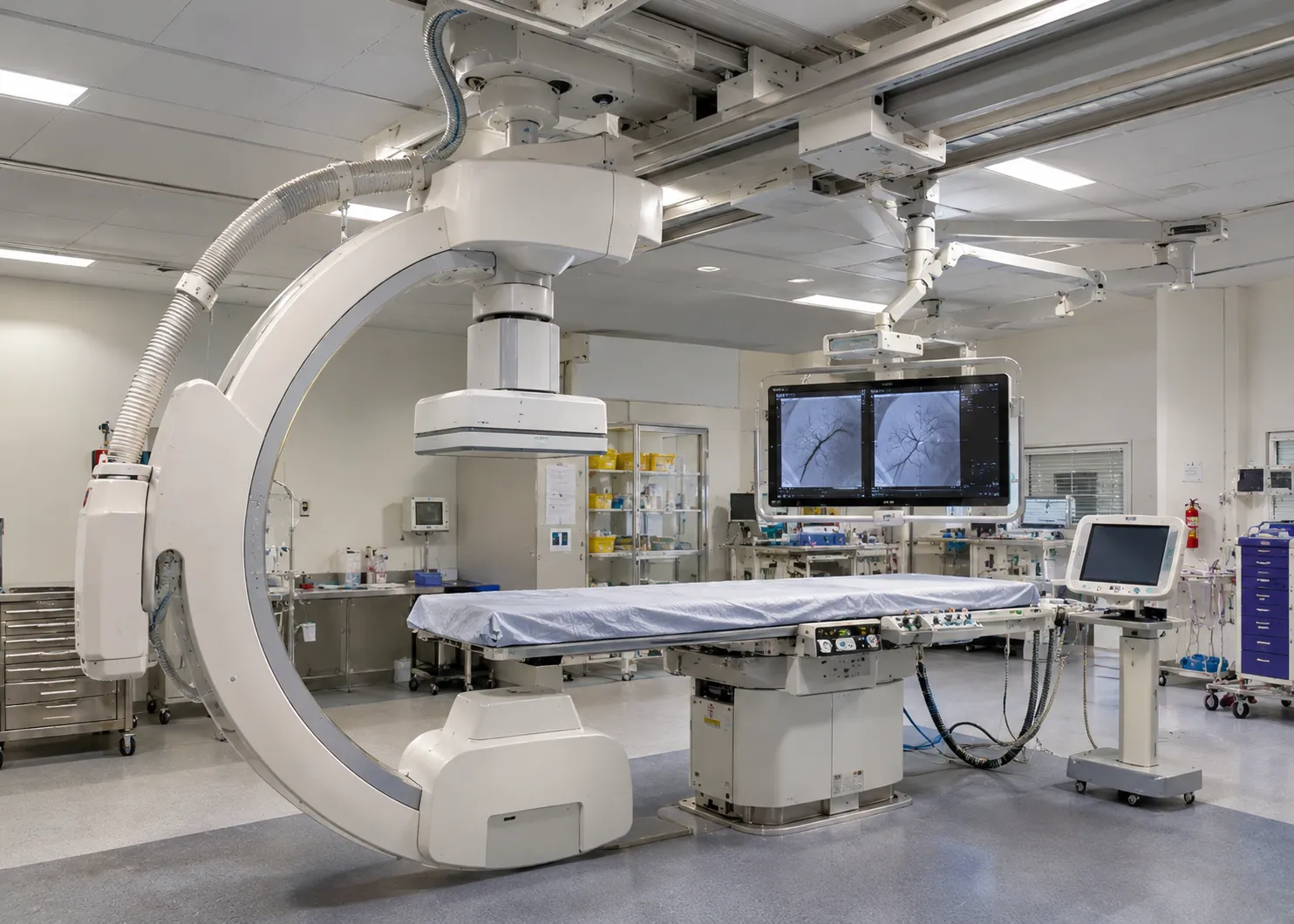
GE HealthCare has introduced Allia Celeo, a ceiling-mounted imaging system for cardiology and interventional radiology procedures. Unveiled Nov. 1 at the Transcatheter Cardiovascular Therapeutics conference in San Diego, it combines a wide-bore C-arm with automated imaging and positioning tools.
The system has received CE marking, but its FDA 510(k) clearance remains pending. GE HealthCare said it is not available for sale in the United States, and availability elsewhere may vary by market.
The introduction follows the commercial debut of the floor-mounted Allia Moveo earlier this year. With the new model, GE HealthCare is expanding the mounting options available within its Allia imaging family.
Allia Celeo puts equipment positioning at the centre
The system’s ceiling gantry incorporates its cabling within the structure. Its extra-wide opening allows the C-arm to move around patients and reach angled imaging positions. That includes positioning around patients with a high body mass index.
A slim C-arm and thin detector limit obstruction across the procedure table. The arrangement is intended to help staff maintain sightlines while working around the patient.
According to GE HealthCare’s announcement, the positioning features include:
- An on-screen digital twin that previews equipment positioning.
- Gantry and table controls accessible from several locations.
- Personalised controls and layouts for individual operators.
- Coordinated table and gantry movements for lower-limb imaging through InnovaBreeze.
GE HealthCare says InnovaBreeze supports imaging of the full lower-limb anatomy in a single acquisition. The broader design aims to reduce interruptions caused by equipment adjustments, although the announcement did not present comparative clinical outcomes.
Imaging software supports treatment guidance.
Allia Celeo uses AI-enabled imaging technology to adjust acquisition settings automatically. GE HealthCare says the system is designed to balance image quality and radiation dose across two-dimensional and three-dimensional imaging.
The platform also offers different cardiac image renderings to suit operator preferences. These functions relate to how images are acquired and displayed, leaving clinical interpretation and treatment decisions to the medical team.
That approach reflects the wider adoption of AI-enabled equipment. Across imaging systems, software increasingly assists with reconstruction, measurements and acquisition tasks within the equipment clinicians already use.
Radiation exposure remains part of that workflow. The FDA explains that fluoroscopy lets clinicians track instruments and contrast material using moving X-ray images. Complex interventions can require prolonged imaging, making exposure management important throughout the procedure.
The agency recommends the lowest acceptable exposure for the shortest necessary time. It also notes that the benefits of medically necessary fluoroscopic procedures generally outweigh their radiation risks.
Applications extend across cardiac and radiology procedures
The system is designed to work with GE HealthCare applications for stent visualisation, structural heart planning and interventional radiology. The announced options include StentViz, 3DStent, Valve ASSIST 2, Embo ASSIST AI, Vessel ASSIST and Needle ASSIST.
Embo ASSIST AI, for example, uses cone-beam CT images to identify vascular structures and support embolisation planning. Its tools allow clinicians to examine vessels in cross-section and simulate injections from different positions.
Needle ASSIST displays needle positions in three-dimensional space to support image-guided interventions. These applications serve different stages of treatment, from planning an approach to visualising instruments during a procedure.
GE HealthCare also lists integration with Vscan Air handheld ultrasound as one of the platform’s capabilities. The company’s portable ultrasound technology is part of the broader development of handheld medical devices, bringing imaging tools closer to the patient.
Hospitals will need to distinguish system compatibility from what’s included in a purchase package. GE HealthCare says it sells clinical applications separately, and some may not be available in every market.
Remote monitoring supports maintenance planning.
Allia Celeo is also designed to work with OnWatch Predict, GE HealthCare’s equipment-monitoring service. It tracks component indicators and performance trends to help identify potential faults before an unexpected shutdown.
When the service flags a possible problem, maintenance teams can arrange parts and schedule repairs. The aim is to move some servicing into planned maintenance windows and reduce disruptions to patient schedules.
Remote monitoring depends on hospital connectivity and the applicable service plan. Those requirements make servicing arrangements another consideration alongside the imaging hardware and optional clinical software.
GE HealthCare did not disclose pricing or a U.S. clearance date. The system remains unavailable for U.S. sale while its FDA review is pending, as MassDevice reported.