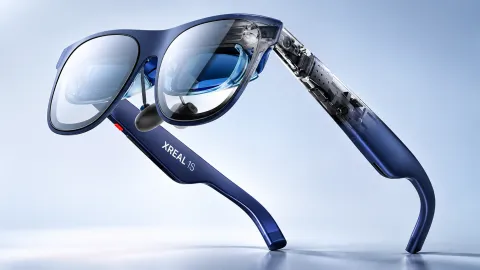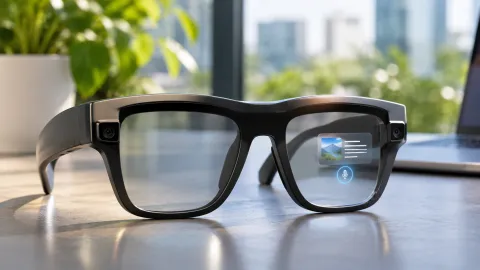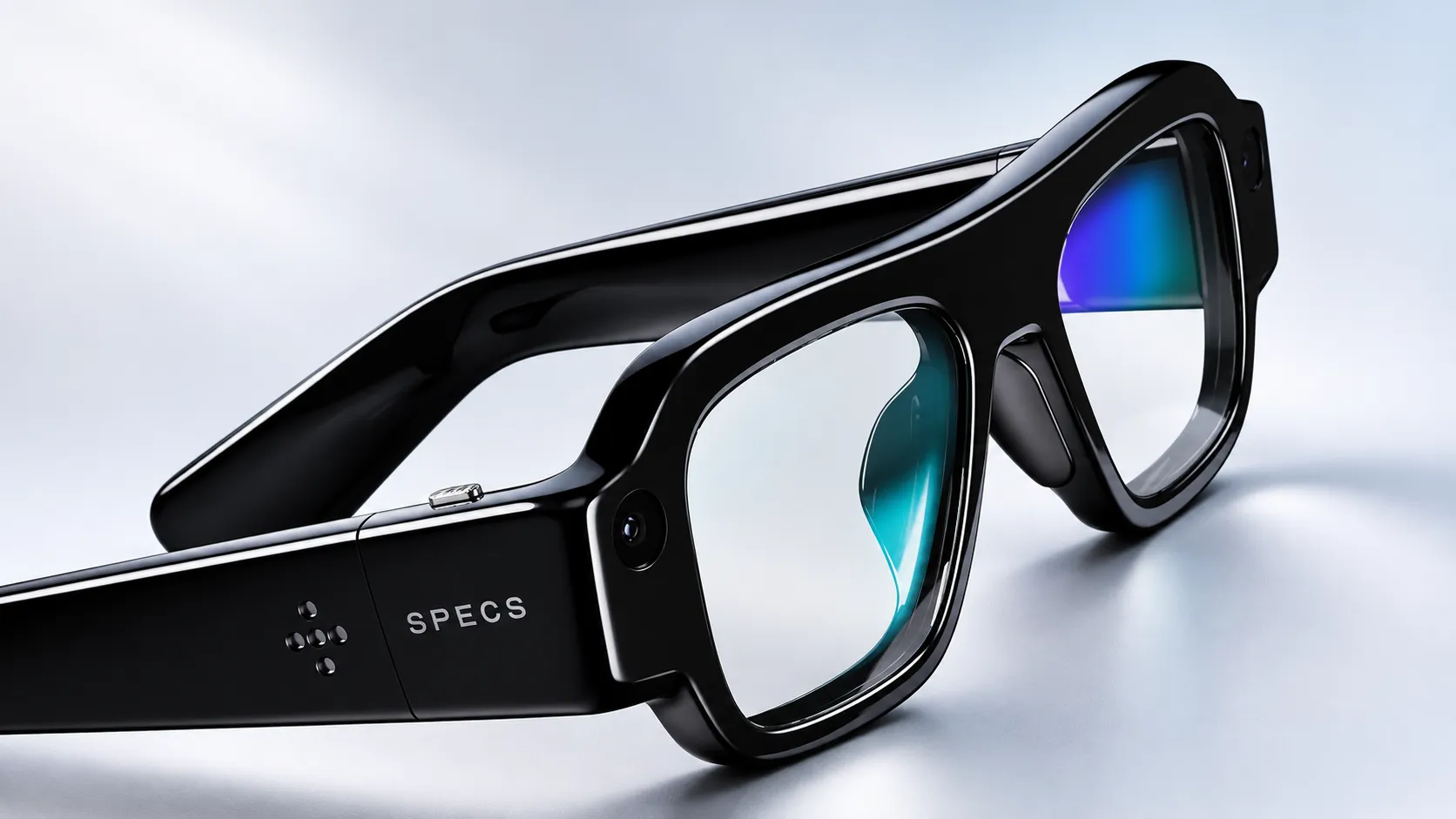
Snap Specs AR glasses are a standalone augmented reality computer designed to overlay digital information on the physical world. The 2026 device combines see-through waveguide optics, dedicated spatial-processing hardware, voice commands, hand tracking and AI assistance. That makes it fundamentally different from camera-only smart glasses, which can describe a scene without projecting persistent 3D content into it.
Snap announced the consumer SPECS device in June 2026 and expanded its technical and software demonstrations in September. As of November 15, the official product page still lists pre-orders and expected fall shipping, not confirmed deliveries. This is therefore an independent, specification-based technology analysis rather than a hands-on review or a claim that final retail firmware has been independently tested.
Snap SPECS 2026: The verified hardware at a glance
The disclosed specifications are unusually specific about the optical architecture and spatial latency, but less specific about imaging resolution, memory and sensor components. The table distinguishes official specifications from information not yet released. “Not publicly disclosed” is not another way of saying a feature is absent.
| Hardware category | SPECS 2026: published specification | Engineering significance |
|---|---|---|
| Device class | Standalone, see-through AR glasses | Runs spatial applications without a phone or external compute puck |
| Size and weight | 47 mm / 132 g; 52 mm / 136 g | Two fitting choices; weight remains material for extended wear |
| Frame | Swiss TR90 polymer | Lightweight structural frame material |
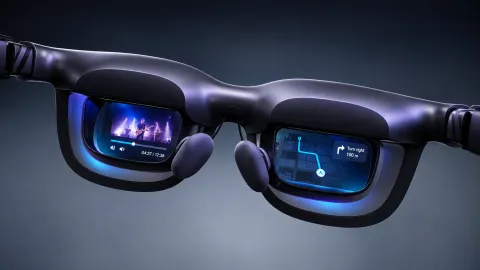
| Display | LCoS light engine with proprietary waveguides | Projects digital imagery while transmitting real-world light |
| Field of view | 51 degrees; 16 million colors | Determines the available angular window for graphics |
| Pixel resolution/peak brightness | Not publicly disclosed | Sharpness and sunlight visibility cannot be quantified |
| Tint control | Electrochromic, approximately 10 seconds clear to tinted | Changes background transmission, not image resolution |
| Compute | Two Snapdragon processors; specific models undisclosed | Divides vision tracking from AR Lens workloads |
| Spatial response | 7 ms motion-to-photon, manufacturer-reported | Measures pose-to-image delay under the stated measurement method |
| Battery | Up to 4 hours mixed use; up to 20 hours with case | Not a guarantee of continuous 3D rendering or recording |
| Recording camera specification | Recording supported; sensor, megapixels and video modes not disclosed | Cannot evaluate camera fidelity from a spec sheet |
| Prescription inserts | Single-vision -8 to +2 diopters in listed market | Accessibility and optics depend on fitting and inserts |
How the see-through display and waveguide optics work
Liquid crystal on silicon, or LCoS, is a reflective microdisplay architecture. Liquid crystals above a silicon backplane modulate the light. The resulting image is coupled into an optical waveguide, which redirects that light toward the eye. The wearer simultaneously sees the world through the Lens. A waveguiLens is therefore an optical relay, not a miniature opaque television positioned in front of the pupil.
Snap says its redesigned waveguide incorporates billions of nanostructures and offers a 51-degree field of view with 16 million colors. Field of view measures the angular size of the digital image, not the resolution of each displayed element. A wider field makes large virtual windows and spatial objects easier to keep in view, but it does not automatically produce sharper text, higher contrast or more accurate occlusion.
Transparent displays face a difficult physical constraint: a bright real-world background can wash out projected graphics. The device therefore uses electrochromic tinting that shifts the Lens from clear to tinted in roughly 10 seconds. Tint can increase perceived contrast by reducing light from the scene, although it also changes how naturally a wearer sees their surroundings. This balance matters for outdoor navigation and indoor collaboration.
| Display and optical technology | Documented SPECS behavior | Technical qualification |
|---|---|---|
| LCoS engine | Supported | Reflective microdisplay; detailed panel pixel count undisclosed |
| Waveguide optics | Supported | Routes projected imagery through transparent Lens |
| Color gamut | 16 million colors | Published color-count claim, not a measured gamut or color accuracy result |
| See-through overlays | Supported | Real-world visibility depends on ambient light and tint |
| Electrochromic tint | Clear-to-tinted in about 10 seconds | Not the same as pixel dimming or eye tracking |
| Binocular depth and eye tracking | Eye-tracking hardware not publicly disclosed | Do not infer gaze control or a specific depth-display method |
| Field of view | 51 degrees | Not a measurement of readable screen area at every angle |
| Display resolution, refresh rate, brightness | Not publicly disclosed | No basis for invented PPD, nit or hertz figures |
Dual Snapdragon processors and the spatial-computing pipeline
A three-dimensional overlay must stay registered to real objects as the wearer turns or moves. Cameras and inertial sensing provide motion and environmental observations. Tracking software estimates the current pose, while the rendering processor updates the position and appearance of digital objects. Without rapid, consistent updates, a label appears to swim across a physical surface instead of staying attached to it.
SPECS divides this work between two Snapdragon processors. Snap assigns one to computer vision and another to AR Lenses. Splitting the workload can reduce interference between tracking and application rendering, although clock speeds, exact chip identities, RAM and sustained thermal performance are not published. Snap reports 7-millisecond motion-to-photon latency using robotic measurement systems; that is a manufacturer result and should not be presented as a TechAmerica laboratory measurement.
The distinction between a fast motion pipeline and a fast AI answer matters. A 7-millisecond graphics response does not mean speech recognition, cloud reasoning or translation finishes in seven milliseconds. Those functions depend on separate computation, network conditions and application design.
| Compute and tracking capability | 2026 disclosure | What it means |
|---|---|---|
| Snapdragon chips | Two; exact part numbers undisclosed | Dedicated vision and Lens workloads |
| Hand tracking | Supported | Camera-based estimation of hand pose and gesture |
| World anchoring | Supported through spatial computing | Virtual objects can remain related to mapped surroundings |
| Motion-to-photon latency | 7 ms, Snap measurement | Not an AI inference latency or user-independent benchmark |
| Eye tracking | Not publicly disclosed | Do not infer eye-based input |
| CPU/GPU speed, RAM, storage | Not publicly disclosed | No defensible synthetic benchmark comparison |
| Continuous scene recording for tracking | Snap says no | Tracking is not necessarily saved video capture |
| Thermal behavior under sustained use | Not independently established | Real-world duty cycles need further testing |
Gesture controls, microphones and spatial interaction
The primary interaction model is hands and voice rather than a touchpad-only interface. Hand tracking software estimates joints and gesture states from optical observations. Pinch, drag, and other interactions can then move a pointer or manipulate a virtual element. Not requiring a physical controller helps with hands-free tasks, but camera tracking can be sensitive to occlusion, lighting,g and the usable tracking volume.
Snap also describes open-ear stereo speakers and microphones integrated into the frame. Open-ear audio leaves the ear canal unsealed, so environmental sound remains audible while playing speech or media. It also introduces a privacy tradeoff: sound intended for the wearer may sometimes be heard nearby. Snap has not published a sufficiently complete 2026 microphone specification to verify every claimed array count or far-field performance condition.
| User input/output | SPECS 2026 | Limitation or requirement |
|---|---|---|
| Hand gestures | Supported | Hands must be visible to the tracking system |
| Voice commands | Supported | Recognition quality varies with noise and language |
| On-device spatial graphics | Supported | Tracking and rendering consume power |
| Open-ear stereo sound | Supported | Some audio leakage is possible |
| Microphones | Present; exact 2026 count not clearly specified in core announcement | No independent speech-quality metric |
| Optional phone pairing | Bluetooth calling, notifications and music described | Phone features are not identical to operating without a phone |
| Dedicated eye-gaze controls | Not publicly disclosed | Should not be assumed |
SPECS OS, Snap OS and Lens Studio: the software stack
The current commercial material uses the SPECS name for the wearable platform, while Snap developer announcements have also referred to Snap OS and Snap OS 2.0. These names should not be treated as proof of completely separate operating systems. The important architectural point is that Lenses run against a spatial interface, with developer tools for objects, interactions, shared experiences and networking.
Lens Studio is the authoring environment. Snap has described APIs and development kits for AR interactions, multiplayer synchronization, cloud-connected functions and native libraries. A Lens can place a virtual object, follow a user action, retrieve data or coordinate several users in the same physical space. Implementation still depends on permissions, network availability, and whether a particular Lens is compatible with the 2026 hardware.
Snap announced browser experiences, virtual workspaces and navigation, while some integrations remain previews or partner demonstrations. An announced developer capability should not be confused with an app that every wearer can immediately install and use in every region.
| Software layer | Reported function | Status/caveat |
|---|---|---|
| SPECS/Snap OS spatial interface | Hand and voice interaction | Platform described by Snap; branding varies across documents |
| Lens Studio | AR development and publishing | Official developer tool |
| Connected Lenses | Shared spatial experiences | Requires compatible experiences and participants |
| Browser / virtual screens | Streaming and productivity windows | Available examples; compatibility varies by content |
| Native Development Kit | Bringing developer libraries into Lens Studio | Announced as new tool |
| Spatial Benchmark | Testing spatial applications | Developer tool, not a published retail benchmark score |
| WebXR and browser APIs | Spatial web support in developer roadmap | Check current release support per browser version |
| Enterprise management | Exploration with management vendors | Not proof of completed company-wide compliance certification |
SPECS Intelligence: AI assistance versus the available preview
Snap presented SPECS Intelligence in September 2026 as an anticipatory service that can organize goals, relationships and routines using connected tools. The idea is broader than a conventional wake-word assistant. Instead of only answering a question after a command, the system is designed to surface a relevant reminder, briefing or next action based on prior context.
That vision must be separated from what is actually accessible. Snap said a limited iOS preview was available for adults in the United States, while the fuller Mac experience opened through invitation-only early access. The iOS preview focuses on insights from connected services and does not include the broader anticipatory suggestions or actions. The glasses are not required to use the software preview. Neither the exact foundation-model lineup nor a complete device-versus-cloud inference breakdown has been publicly specified.
SPECS also enables visually grounded assistance, where a scene or object can provide context for instructions. The reasoning pipeline could use local vision processing and protected cloud services. It would be inaccurate to claim that every answer is computed entirely within the frames, or that the service never transfers sensitive data. Specific behavior depends on app permissions and documented service architecture.
| AI category | Officially described capability | Availability qualification |
|---|---|---|
| Context-aware visual assistance | Described for SPECS | Exact supported tasks depend on app and Lens |
| SPECS Intelligence on iPhone | US adult preview launched in September 2026 | Preview provides insights; not a full proactive agent |
| Mac intelligence experience | Invitation-only early access announced | Not a general release |
| Anticipatory suggestions and actions | Designed functionality | Not fully included in initial iOS preview |
| Specific large language model names | Not publicly disclosed | Do not assign an unnamed AI model |
| On-device processing | Prioritized for spatial and privacy-sensitive work | Not proof all AI is processed offline |
| AI-generated spatial content | Developer capabilities exist | Quality and latency differ by Lens |
| Offline AILens translation coverage | Not fully documented | Requires per-feature verification |
Real-time translation, navigation and remote work
Translation is more than speech recognition. A wearable translation pipeline must capture the speaker, separate speech from noise, transcribe it, translate it and render subtitles with enough spatial stability to follow a conversation. Snap describes on-screen translated captions and support for 60 languages. That figure does not mean every language pair has the same quality, every dialect is equally reliable, or the feature always works offline.
Navigation illustrates a different requirement: the glasses must position arrows and cues relative to the wearer and surrounding environment. Any positioning drift could place an instruction in the wrong visual location. The system must also avoid blocking hazards, street signs or other important objects. The announced walking guidance and optional voice prompts need independent testing across varied environments before precise accuracy claims are justified.
For work, virtual windows, whiteboards and remote annotations could reduce the need to stop and look at a separate screen. Snap has outlined partnerships for field-service guidance and enterprise data access. These are credible development directions, but security administrators still need access controls, logging, deployment tools and data-handling documentation before treating the device as ready for regulated workflows.
Cameras, capture and Privacy: what the specifications leave open
SPECS use camera-based vision and support photo or video capture, yet their public 2026 product materials do not provide a complete camera table. Sensor size, still-image megapixels, video resolution, stabilization, frame-rate options and storage limits remain unconfirmed. A tracking camera and a recording camera serve different jobs, so neither should be assumed to have the same image quality.
Snap says the glasses do not use facial recognition to identify people and do not continuously record the environment to understand it. It also says a prominent external LED lights up or flashes when a wearer records audio, photographs or video. These are manufacturer privacy-design statements rather than the result of an independent source-code or hardware audit. Bystander awareness, consent laws and the settings used by individual apps still matter.
Snap also describes permissions for sensitive camera and microphone access, on-device processing and controls for stored or synchronized data. Evaluate the safeguards separately for the operating system, cloud services, developer Lenses, and any connected AI accounts. A single indicator light does not determine Privacy.
| Imaging/privacy item | Publicly supported claim | Evidence gap |
|---|---|---|
| Camera-assisted spatial sensing | Yes | Detailed 2026 sensor count and type not fully published |
| Photo and video capture | Yes | Video resolution and stabilization not disclosed |
| Audio capture | Supported for user actions | Recording modes not fully detailed |
| External recording indicator | Yes | Manufacturer describes light-on or flashing behavior |
| Continuous recording for world understanding | Snap says not used | Requires independent technical audit for verification |
| Facial recognition for person identification | Snap says not used | Statement is specific to identification behavior |
| Sensitive-data permissions | Snap describes explicit requests | Third-party Lens policies must also be examined |
| Cloud AI processing | Used in parts of the broader service | Task-specific data paths not exhaustively disclosed |
Battery, connectivity and frame ergonomics
A complete AR computer must fit processors, optics, sensing, speakers and batteries into a wearable frame. SPECS weigh 132 grams in the smaller size and 136 grams in the wider one. That’s a notable reduction from the 226-gram 2024 developer Spectacles, but weight alone doesn’t determine long-session comfort. Nose-pad fit, contact pressure, temperature and visual accommodation all affect the experience.
Snap rates the 2026 glasses for up to four hours of mixed use, with a charging case providing four additional full charges for up to 20 hours total. The rating covers varied activities, not four hours of uninterrupted high-load AR graphics. Battery endurance under maximum brightness, sustained navigation, translation or video capture remains unverified.
The glasses can connect to Wi-Fi. An optional cellular-connected charging case provides a separate route to mobile data, which should not be confused with a 5G radio necessarily being housed in the frame. The published product page also describes a magnetic five-pin charging interface and USB-C streaming cable for connecting to other devices. Exact compatibility and latency depend on the source and cable setup.
| Connectivity/power | SPECS 2026 | Qualification |
|---|---|---|
| Standalone compute | Yes | No tether required for core spatial interface |
| Wi-Fi | Supported | Connection needed for various online services |
| Bluetooth phone pairing | Calls, notifications and audio described | Specific phone OS feature parity not fully published |
| Cellular connectivity | Optional 5G-capable case | Radio is associated with case, not confirmed as in-frame |
| Charging | Included portable case; magnetic connector described | Fast-charge wattage not publicly specified |
| Battery endurance | Up to 4 hours mixed use | Manufacturer claim; heavy-load results untested |
| Battery plus case | Up to 20 hours mixed use | Includes four additional case charges |
| Prescription inserts | Single vision -8 to +2 diopters listed | Fit and availability vary by region |
Snap SPECS 2026 versus Spectacles 2024: what actually changed
The comparison with Snap’s own fifth-generation Spectacles is especially useful because it follows the same spatial-computing concept through two hardware generations. The 2024 model was primarily a developer platform. The 2026 SPECS product targets a broader consumer launch, while retaining Lenses, see-through graphics and hand tracking.
Snap’s published figures show substantial changes in mass, field of view, reported motion-to-photon latency, and rated endurance. These figures are not all based on identical testing protocols. They should be read as reported platform specifications, not as proof of a particular experience being proportionally better.
| Technology | Spectacles 2024 | SPECS 2026 |
|---|---|---|
| Product position | Developer-oriented fifth generation | Consumer-oriented standalone AR glasses; pre-order |
| Weight | 226 g | 132 g or 136 g |
| Field of view | 46-degree diagonal | 51-degree reported |
| Display optics | LCoS and waveguide | Revised LCoS and waveguide |
| Processors | Dual Snapdragon design | Dual Snapdragon, task-separated |
| Reported motion-to-photon | 13 ms | 7 ms |
| Published endurance | Up to 45 minutes continuous standalone | Up to 4 hours mixed use |
| Cameras | Four cameras explicitly stated | Camera recording and tracking; exact 2026 array unspecified |
| Operating system | Snap OS | SPECS/Snap OS spatial platform |
| Cellular case | Not listed in original platform release | Optional connected charging case |
Wi-Fi-only SPECS versus SPECS with a cellular case
The two connectivity configurations should not be misrepresented as different optical or processing models. Snap describes the same core glasses, with a Wi-Fi-only configuration or an option that includes a 5G-capable charging case. The case extends internet connectivity beyond familiar networks; it does not add a different display, processor, camera, or battery inside the frame.
The cellular path also introduces network and coverage dependencies. A connected case may improve access to cloud services or remote collaboration, but mobile plans, service availability and performance can differ by country. Evaluate offline spatial functions and internet-backed AI features separately.
Which smart glasses technology class is SPECS competing in?
Ranking every pair of smart glasses on a single feature count is misleading. Audio-first glasses emphasize listening and voice commands. Camera-centric AI glasses emphasize captured images and scene questions. Display glasses can provide a virtual screen from an external phone or computer. Standalone spatial AR glasses must combine optics, tracking, compute, graphics and environmental awareness within one wearable system.
SPECS belongs primarily to the last category. That distinction explains why its heavier frame and battery requirements aren’t directly comparable to ordinary camera glasses. The better question is which computing functions happen in the frames, what remains dependent on cloud or connected devices, and how comfortably spatial content remains anchored during motion.
| Technology class | Primary technical function | Typical limitation |
|---|---|---|
| Audio-first AI glasses | Open-ear sound and voice access | No spatial visual overlay |
| Camera-first AI glasses | Photos, video and scene-aware assistance | No persistent world-anchored graphics in many models |
| Tethered display glasses | Large virtual display from another device | Depend on source device or cable |
| Heads-up information glasses | Small in-view text or notifications | Limited immersive 3D field |
| Standalone spatial AR: SPECS | World-anchored graphics with local compute | Higher thermal, weight and power burden |
Practical applications and engineering constraints
The most credible applications arise where spatial placement offers more than a phone notification. An instructor could place guidance near a physical mechanism. A field technician could refer to a remote annotation while keeping both hands available. A visitor could see translated captions or contextual information at the point of interest. Each example depends on accurately identifying the environment, delivering information promptly and keeping the display legible.
The technology also has limits that specifications cannot settle. Sustained temperature and comfort depend on usage patterns. Real-world translation accuracy varies across speakers and noise conditions. Shared AR requires reliable synchronization, and privacy protections must extend to third-party developers. The device’s display pixel resolution, brightness, precise imaging specifications and independent endurance remain important unanswered questions.
A further constraint is publication status. Snap continues to describe the product as open for pre-order with shipping expected in fall 2026. Readers should not confuse press demonstrations and first-look sessions with widespread ownership or independently measured retail performance.
What comes next for Snap’s AR platform
Further progress will depend less on a single advertised feature than on the interaction between optics, heat management, tracking, a nd software. Higher display efficiency could help with outdoor readability or battery life. Better spatial mapping could reduce drift in shared environments. More transparent local-versus-cloud AI controls could help users and organizations assess Privacy and latency.
Those are engineering directions, not confirmed specifications for an unannounced next model. The immediate test for SPECS will be whether consumer hardware ships broadly, supports dependable Lenses, and meets its stated power and latency claims under independent measurement. Until that evidence exists, the 2026 story is best understood as a technically detailed, promising spatial-computing platform with meaningful disclosure gaps.